 Preview
 Send
Send Share
Share
 Details

 Download
 Similars
 X-Ray
X-Ray Diaporama
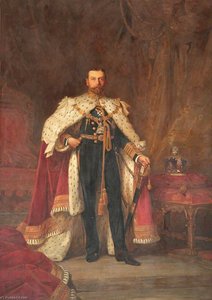
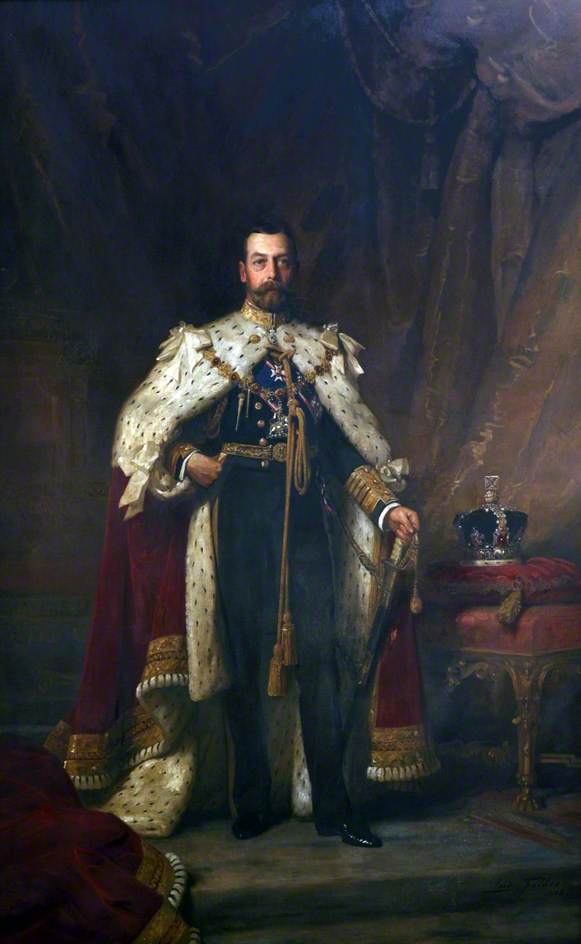
George V (1865–1936)
 Acrylic On Canvas
- WallArt
- Contemporary Realism
 1913
1913 280.0 x 183.0 cm
 Walker Art Gallery
 Read More
Hand Made Oil Reproduction
Hand-painted oil on canvas in your size and frame, made to order by our artists. ( Buy Print Buy Image)




P118B $10

P118H $10

P118W $10

P438Z $10

P508JH $12

P508YH $12

P805H $10

P805Z $10

P919BZ $10

P919G $10

P919XJ $10

P959ZH $10

P968JZ $12

W106C $8

W218G $10

W218JH $8

W218Y $10

W307PJ $10

W316G $10

W316PJ $8

W316Y $10

W398PJ $8

W4111J $10

W500HY $15

W500JH $15

W692G $12

W849H $8

W940BG $15

W953PJ $8




Pick from our preset sizes that match the artwork's original proportions.

You may enter your own dimensions to fit a specific frame or space. If your selected size does not match the original image's proportions, we will either crop the artwork or extend the painting with additional hand-painted elements. A digital mockup will be sent for your approval before production begins.
Please note that the on-screen preview does not reflect the actual cropping or extension. Only the mockup will accurately show the final composition.
While custom sizes are available, we recommend selecting a dimension from the predefined list to preserve the original proportions.
After order, ArtsDot.com team will email client for instructions and provide a mockup preview
Worldwide Delivery () in 3/4 weeks instead of standard 5 weeks. (21 August). No compromise on quality.

Free Worldwide Express Shipping

High-Quality Linen Canvas

Full Shipping Insurance

Customs Tax Refund Guarantee

True Color Matching Guarantee

60-Day Return Policy (Defects Only)

100% Money-Back Guarantee

Bulk Discount Offer
 Glass option is only available in size under 110 CM

George V (1865–1936)
Reproduction Medium
Reproduction Size
-


Total Price
$ 263
Artwork Description
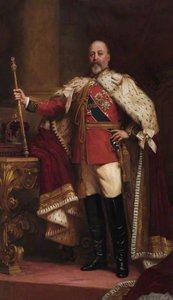
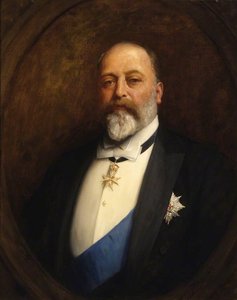
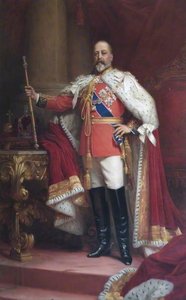
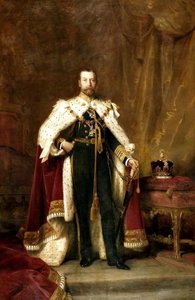
George V (1865–1936): A Portrait of Dignified Majesty
Samuel Luke Fildes’ monumental portrait of King George V, completed in 1913, stands as a testament to Victorian artistic ambition and the enduring fascination with portraying royalty. More than just a likeness, it's an immersive experience into the grandeur of Edwardian Britain—a moment frozen in time by a masterful artist deeply attuned to both visual aesthetics and social commentary. The painting resides within the Royal Collection Trust’s holdings, ensuring its preservation for generations to come.Composition and Visual Harmony
The canvas commands attention with its impressive dimensions (280 x 183 cm), immediately establishing a sense of scale that reflects George V's position as sovereign ruler. Fildes meticulously centered the King within an ornate armchair—a deliberate choice designed to convey stability and authority. Subtle asymmetry introduces visual dynamism, preventing the image from feeling static while maintaining balance. The chair itself is positioned slightly off-center, drawing the eye upwards towards the regal figure and reinforcing his dominance over the space.Color Palette and Lighting: Echoes of Wealth and Reflection
The color palette is dominated by deep hues—rich golds, crimson reds, dusky blues, and earthy browns—reflecting the opulent fabrics adorning George V’s robes and conveying a sense of solemn grandeur. Fildes skillfully employed chiaroscuro lighting, originating from an unseen source to the left of the frame, casting dramatic shadows that sculpt the King's face and clothing. These shadows aren’t merely decorative; they heighten the emotional impact of the portrait, emphasizing George V’s features and conveying a palpable seriousness. The subtle gradations within each color contribute to a profound sense of depth and realism—a hallmark of Fildes’ technique.Technique: Detail and Texture – A Masterful Rendering
Fildes' mastery lies in his painstaking attention to detail, achieved through meticulous brushwork and layering of oil paints on canvas. He painstakingly rendered textures with remarkable accuracy—the sheen of the gold fabrics, the velvety softness of the armchair upholstery, and even the roughness of George V’s beard—creating an illusion of palpable materiality. The artist's technique exemplifies Victorian realism, prioritizing observation and capturing the nuances of human form and surface qualities. This dedication to craftsmanship ensures that every brushstroke contributes to the overall impression of dignity and power.Symbolism: Representing Power and Tradition
Beyond its visual beauty, the portrait is laden with symbolic significance. The royal robes—embroidered with intricate patterns—represent George V’s lineage and adherence to tradition. The crown perched atop his head signifies his supreme authority and unwavering duty as monarch. And finally, the scepter held firmly in his hand symbolizes power and dominion—visual emblems that encapsulate the essence of Victorian monarchy. Fildes' deliberate inclusion of these elements elevates the portrait beyond mere representation, transforming it into a powerful statement about Britain’s cultural heritage.Emotional Resonance: A Portrait of Quiet Strength
The overall emotional tone is one of solemnity, formality, and quiet strength—a reflection of George V’s character as he navigated the complexities of his reign during a period marked by significant social upheaval. Fildes captures not just the King's physical appearance but also his inner composure, conveying an impression of unwavering resolve and dignified bearing. This enduring image continues to inspire admiration for its artistic excellence and serves as a poignant reminder of Britain’s imperial past.Related Artworks
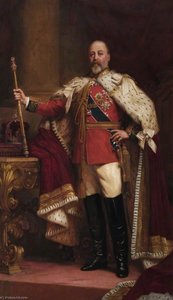
Artist Biography
A Life Etched in Realism: The World of Samuel Luke Fildes
Born amidst the bustling port city of Liverpool in 1843, Samuel Luke Fildes emerged as a pivotal figure bridging Victorian illustration and painting. His lineage hinted at a life steeped in both artistry and social consciousness; he was the grandson of Mary Fildes, a dedicated political activist whose commitment to reform would subtly permeate his own artistic vision. Early experiences shaped young Luke’s path – a childhood spent observing the vibrant energy and underlying hardships of maritime Liverpool, followed by formal training that began at Warrington School of Art in 1860. This foundational period led him to South Kensington (later the Royal College of Art) and the prestigious Royal Academy Schools, where he forged lasting connections with fellow artists like Hubert von Herkomer and Frank Holl. However, it was the influence of Frederick Walker, a leading light of the social realist movement, that truly ignited Fildes’ artistic direction, instilling in him a desire to depict life as it *was*, not merely as it appeared to be. The young artist absorbed Walker’s commitment to portraying everyday struggles with honesty and empathy, a principle that would define much of his early work.
From Graphic Detail to Painted Narrative
Fildes initially found his voice – and an audience – through illustration. In 1869, he joined the staff of The Graphic, a groundbreaking illustrated newspaper edited by William Luson Thomas. This wasn’t merely a job; it was immersion in a world where art served as a powerful tool for social commentary. The Graphic's commitment to exposing societal ills resonated deeply with Fildes, and he quickly became known for his unflinching depictions of poverty and injustice. His work during this period wasn’t simply about documenting hardship; it was about humanizing those often rendered invisible by society. A pivotal moment arrived when Charles Dickens himself commissioned Fildes to illustrate the unfinished novel The Mystery of Edwin Drood, following a particularly poignant illustration of Dickens' empty chair after his death – an image that captured the nation’s grief and established Fildes’ reputation. This commission, alongside illustrations for other prominent periodicals like The Sunday Magazine, The Cornhill Magazine, and The Gentleman's Magazine, solidified his position as a leading illustrator of his time. The wood-engraving “Houseless and Hungry,” depicting the desperate plight of London’s homeless, brought him to Dickens’ attention and became emblematic of his early commitment to social realism. It was a stark reminder of the realities faced by many in Victorian England, and Fildes’ ability to convey this with such raw emotion set him apart.
A Shift in Medium: Embracing Oil and Expanding Vision
By 1870, Fildes felt a growing pull towards oil painting, a medium that allowed for greater nuance and depth than illustration. This transition marked a turning point in his career, as he began to establish himself not just as a skilled recorder of social realities but as a painter capable of capturing the complexities of human emotion and experience. He quickly rose through the ranks of the English art world, gaining recognition for works like The Casual Ward (1874), a stark portrayal of life within a workhouse; The Widower (1876), a deeply moving depiction of grief and loss; and The Village Wedding (1883), which offered a more optimistic, yet still grounded, view of rural life. His artistic horizons expanded beyond social commentary to encompass scenes of Venetian life – reflecting a growing fascination with light, color, and atmosphere – and an increasingly sought-after talent for portraiture. He became particularly renowned for his portraits commemorating the coronation of King Edward VII and Queen Alexandra, demonstrating his ability to capture both regal dignity and individual character. This period saw Fildes masterfully blending realism with a more refined aesthetic sensibility, showcasing his versatility as an artist.
Recognition, Legacy, and Lasting Influence
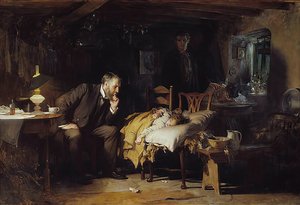
Fildes’ artistic achievements were met with increasing acclaim throughout his career. He was elected an Associate of the Royal Academy (A.R.A.) in 1879 and a full Royal Academician (R.A.) in 1887, solidifying his position within the established art world. In 1906, he received the honor of knighthood from King Edward VII, and later, in 1918, was appointed Knight Commander of the Royal Victorian Order (KCVO) by King George V. Beyond official recognition, Fildes also explored a lighter side to his artistry, producing caricatures under the pseudonym “Elf” for Vanity Fair. He became recognized as a leader of the Neo-Venetian school alongside Henry Woods, showcasing a shared passion for capturing the unique atmosphere and light of Venice. His personal life was equally fulfilling; he married Fanny Woods, sister to his friend Henry, in 1874, and together they had two sons, Philip and Sir Paul Fildes – the latter becoming an eminent scientist. Perhaps one of the most striking examples of his enduring influence is the inspiration his illustration of Dickens’ empty chair provided to Vincent van Gogh, leading to the creation of Van Gogh's iconic painting The Yellow Chair. Even in later years, his work continued to resonate – notably when his 1891 masterpiece, The Doctor, was used in a 1949 American Medical Association campaign, demonstrating the power of art to shape public discourse. Samuel Luke Fildes left behind a legacy not only as a gifted painter and illustrator but as an artist who dared to confront social realities while simultaneously celebrating the beauty and complexity of human life. His work continues to resonate with audiences today, offering a poignant glimpse into Victorian society and the enduring power of art to inspire empathy and understanding.
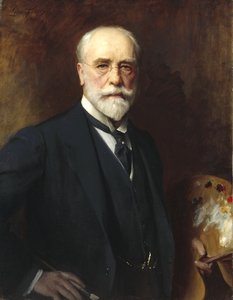
Samuel Luke Fildes
1843 - 1927 , United Kingdom
Quick Facts
- Artistic Movement Or Style: Social Realism
- Artists Or Movements Influenced By This Artist: ['Vincent van Gogh']
- Artists Who Influenced This Artist: ['Frederick Walker']
- Date Of Birth: 1843
- Date Of Death: 1927
- Full Name: Samuel Luke Fildes
- Nationality: British
- Notable Artworks:
- The Doctor
- The Casual Ward
- The Widower
- Houseless and Hungry
- Place Of Birth: Liverpool, UK
Related Articles

Georges Braque's Masterpieces: 25 Paintings That Defined Cubism & Modern Art | ArtsDot
Explore 25 iconic Georges Braque paintings that revolutionized Cubism & modern art. Discover the stories behind his masterpieces, from Fauvism to Analytical Cubism. Find museum-quality reproductions & elevate your home decor with ArtsDot.com.

Georges Seurat's Masterpieces: 25 Paintings That Defined Pointillism | ArtsDot
Explore 25 iconic Georges Seurat paintings & discover the brilliance of Pointillism. From 'La Grande Jatte' to his harbor scenes, delve into art history with ArtsDot.com. Find museum-quality reproductions for your home decor. Explore the full collection online!
Samuel Luke Fildes: Capturing Victorian Life Through Narrative & Social Realism
Explore the poignant world of Samuel Luke Fildes, a master of Victorian Social Realism. Discover his iconic paintings like 'The Doctor' and delve into his artistic journey with ArtsDot.
George Hayter: Portraiture, Power & Victorian Society's Canvas
Explore the life & work of George Hayter, Queen Victoria’s Principal Painter. Discover his iconic Victorian portraits, historical masterpieces, and lasting impact on British art history. Learn more at ArtsDot.
George Goodwin Kilburne: Capturing Victorian Sentimentality Through Genre Painting
Explore the evocative Victorian paintings of George Goodwin Kilburne. Discover his detailed scenes of domestic life, masterful use of light, and lasting impact on British genre painting. Learn more at ArtsDot.