 Preview
 Send
Send Share
Share
 Details

 Download
 Similars
 X-Ray
X-Ray Diaporama
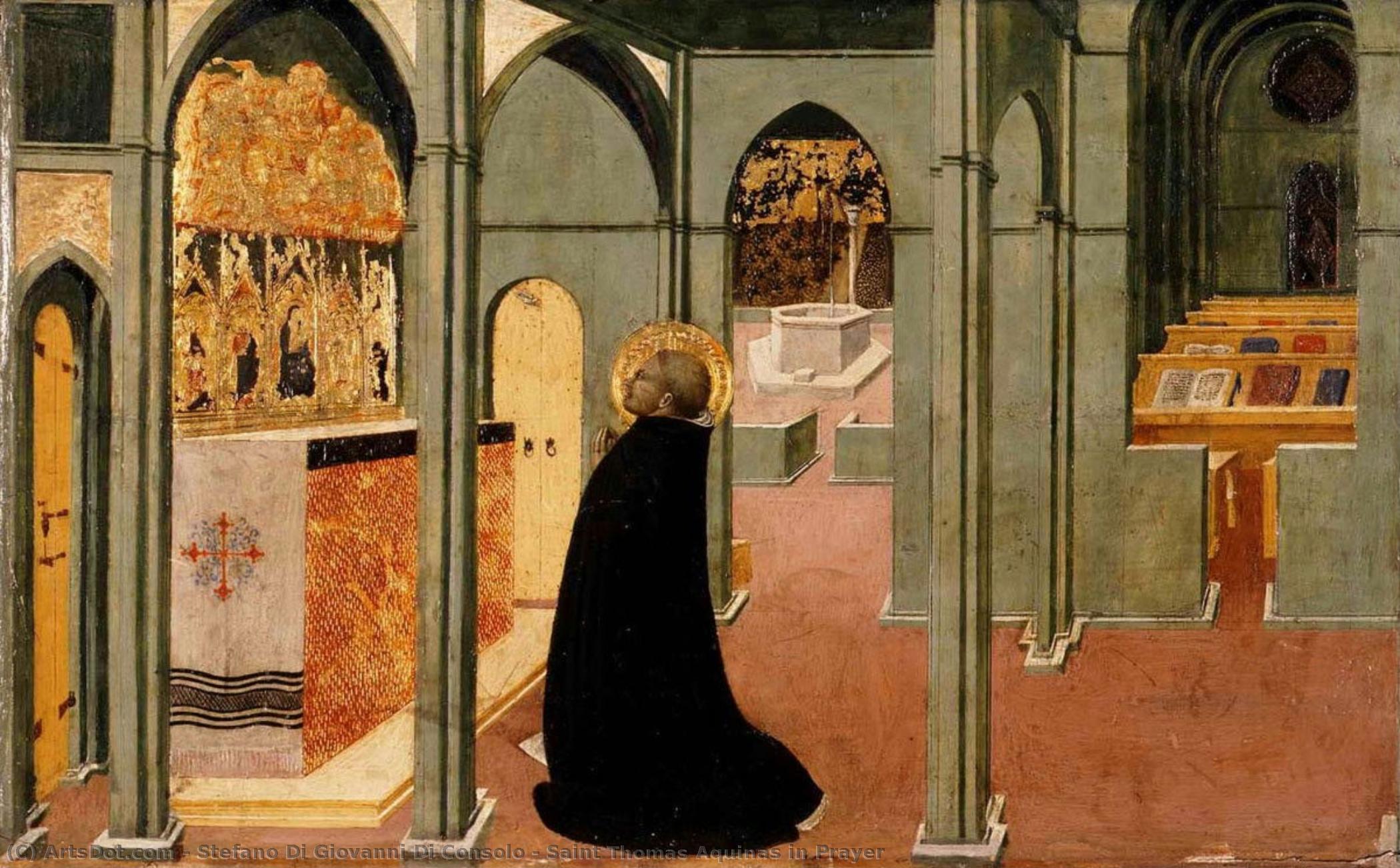
Saint Thomas Aquinas in Prayer
 Tempera
- Sienese Renaissance
 1425
1425- Renaissance
 23.0 x 39.0 cm
 Museum of Fine Arts
 Read More
Giclée / Art Print
Museum-quality giclée or canvas print with fast production and flexible finish options. ( Buy Hand Made Painting Buy Image)




P118B $10

P118H $10

P118W $10

P438Z $10

P508JH $12

P508YH $12

P805H $10

P805Z $10

P919BZ $10

P919G $10

P919XJ $10

P959ZH $10

P968JZ $12

W106C $8

W218G $10

W218JH $8

W218Y $10

W307PJ $10

W316G $10

W316PJ $8

W316Y $10

W398PJ $8

W4111J $10

W500HY $15

W500JH $15

W692G $12

W849H $8

W940BG $15

W953PJ $8




Pick from our preset sizes that match the artwork's original proportions.

You may enter your own dimensions to fit a specific frame or space. If your selected size does not match the original image's proportions, we will either crop the artwork or extend the image with a mirrored or solid-fill edge. A digital mockup will be sent for your approval before production begins.
Please note that the on-screen preview does not reflect the actual cropping or extension. Only the mockup will accurately show the final composition.
While custom sizes are available, we recommend selecting a dimension from the predefined list to preserve the original proportions.
Worldwide Delivery () in 2 weeks instead of standard 4/5 weeks. (25 August)

Free Worldwide Express Shipping

High-Quality Linen Canvas

Full Shipping Insurance

Customs Tax Refund Guarantee

True Color Matching Guarantee

60-Day Return Policy (Defects Only)

100% Money-Back Guarantee

Bulk Discount Offer
 Glass option is only available in size under 110 CM

Saint Thomas Aquinas in Prayer
Giclée / Art Print
Reproduction Size
-


Total Price
$ 63
Collectible Description
A Moment of Divine Contemplation
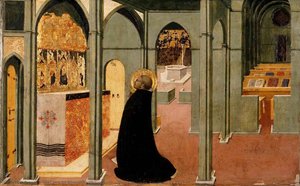
In the quietude of a monastic interior, time seems to suspend itself within Stefano di Giovanni di Consolo’s Saint Thomas Aquinas in Prayer. Created in 1425, this intimate masterpiece serves as a profound window into the spiritual devotion of the early Renaissance. The scene captures the venerable theologian in a moment of deep, internal communion, his hands folded in a gesture of humble supplication. Beside him, a secondary figure stands in silent witness, grounding the celestial focus of the saint within a tangible, human reality. The setting—likely a cloister or a private chapel—is suggested by the subtle presence of architectural elements like a simple bench, which evokes the austere yet sacred atmosphere of a 15th-century monastery.
The painting is a masterful example of the Sienese school's ability to marry the delicate, ornamental grace of the Gothic tradition with the emerging realism of the Florentine Renaissance. Through the medium of tempera on canvas, the artist achieves a luminous quality that breathes life into the figures. The technique allows for fine, precise linework that defines the folds of the saint's garments and the soft contours of his contemplative face. This delicate application of pigment creates a sense of weightlessness and light, as if the very air within the frame is infused with the divine presence being sought by the subject.
The Intersection of Devotion and Artistry
For the discerning collector or interior designer, this work offers more than mere decoration; it provides an emotional anchor for a space. The composition relies on a quiet, rhythmic balance that invites the viewer into a state of reflection. There is no grand, sweeping drama here—only the profound power of stillness. This restraint makes the piece exceptionally versatile, capable of adding a layer of historical depth and intellectual sophistication to a curated gallery wall or serving as a focal point in a room designed for study and peace.
The historical significance of Sassetta’s work lies in his role as a bridge between eras. In Saint Thomas Aquinas in Prayer, we see the transition from the stylized, symbolic language of the Middle Ages to a more human-centric approach to sacred subjects. The emotional impact is one of profound serenity, making it an ideal acquisition for those who appreciate art that speaks to the enduring human search for meaning and tranquility. Owning a high-quality reproduction of this work allows one to bring the hallowed atmosphere of the Museum of Fine Arts in Budapest into the modern home, preserving a fragment of 15th-century spiritual heritage.
Related Artworks
![Legend Of St Francis - [21] - Apparition To Fra Agostino And To Bishop Guido Of Arezzo — Giotto Di Bondone, Proto-renaissance](/media/artworks/images-thumb/8a/06/8a0632ef03ba49f12919faa78718a88b.jpg)
Artist Biography
The Luminous Synthesis of Sassetta
Stefano di Giovanni, known to history by the evocative moniker Sassetta, remains one of the most enchanting figures of the Sienese Renaissance. His art serves as a bridge between two worlds: the ornate, jewel-like splendor of the Gothic tradition and the burgeoning, grounded realism of the Florentine masters. Born around 1392, his life was deeply rooted in the cultural soil of Siena, a city that cherished its decorative heritage even as the winds of change from Florence began to blow. To look upon a Sassetta panel is to witness a delicate dance between the celestial and the terrestrial, where every gilded edge and vibrant pigment tells a story of spiritual devotion and human observation.A Legacy Forged in Tradition and Innovation
The formative years of this Tuscan master are draped in the soft shadows of history, yet his artistic lineage is clearly etched in his brushwork. It is widely believed that he refined his craft under the guidance of Maestro Piero Lorenzetti, a painter whose work already embodied the dualities of Sienese art. From this foundation, Sassetta developed a unique visual language. While he remained fiercely loyal to the Sienese School’s penchant for intricate tracery and rich, emotive color, he was not immune to the revolutionary spirit of his era. He looked toward the innovations of Masaccio, embracing the emerging principles of linear perspective and a more profound anatomical accuracy. This synthesis allowed him to create compositions that felt both timelessly sacred and strikingly present, imbuing his figures with a psychological depth that was rare for his time.The Spiritual Resonance of Technique
In the quietude of his most celebrated works, such as the Saint Thomas Aquinas in Prayer, one finds the true heart of his genius. Utilizing the meticulous medium of tempera on panel, Sassetta achieved a luminous quality that seems to emanate from within the wood itself. His technique allowed for:- Intricate Detail: The fine, precise linework that defines the heavy folds of monastic robes and the delicate features of contemplative faces.
- Vibrant Color Palettes: A use of pigment that captures the ethereal light of a divine presence.
- Emotional Depth: A mastery of gesture and stillness that invites the viewer into a state of silent, prayerful reflection.
stefano di giovanni di consolo
1450 , Italy
Quick Facts
- Artistic Movement Or Style: Early Renaissance
- Artists Or Movements Influenced By This Artist: ['Renaissance']
- Artists Who Influenced This Artist:
- Giotto di Bondone
- Masaccio
- Date Of Birth: c.1392
- Full Name: Stefano di Giovanni di Consolo
- Nationality: Italian
- Notable Artworks:
- Madonna of Humility with Saints John the Baptist and Andrew
- Saint Thomas Aquinas in Prayer
- Place Of Birth: Siena, Italy
Related Articles
Beyond Borders: The Spiritual & Stylistic Innovations of International Gothic Art
Explore the exquisite beauty & spiritual depth of International Gothic art. Discover key artists like Simone Martini & Pol de Limbourg, its origins, symbolism, and lasting influence on European painting. Expert insights at ArtsDot.
The Radiant Dusk of Medieval Vision: Exploring Late Gothic Art's Synthesis of Faith, Form & Emotionality (c. 1300-1500)
Explore the exquisite beauty & spiritual depth of Late Gothic art (c. 1300-1500). Discover key artists, symbolism, and its lasting influence on the Renaissance. Expert insights at ArtsDot.
The Shadow of Faith: Exploring Gothic Art's Spiritual Intensity & Architectural Innovation
Explore the spiritual intensity & architectural innovation of Gothic art! Discover the symbolism behind cathedrals, stained glass & master artists like Giotto and Monet. A deep dive into medieval history & artistic expression.
Fra Angelico's Masterpieces: 25 Renaissance Paintings for Your Home | ArtsDot
Explore 25 breathtaking masterpieces by Fra Angelico, a Renaissance master. Discover the stories behind his iconic frescoes, Annunciations & religious art. Find museum-quality reproductions and elevate your home decor with ArtsDot.com.

Thomas Barker of Bath: Landscape Painting & Societal Reflection in Early 19th-Century England
Explore the life & work of Thomas Barker of Bath, a key figure in 19th-century English Romanticism. Discover his Parisian success, iconic paintings like 'The Bride of Death', and lasting artistic legacy. Learn more at ArtsDot.