 Preview
 Send
Send Share
Share
 Details

 Download
 Similars
 X-Ray
X-Ray Diaporama
Grand Canal, Venice


 Read More
Hand Made Oil Reproduction
Hand-painted oil on canvas in your size and frame, made to order by our artists. ( Buy Print Buy Image)




P118B $10

P118H $10

P118W $10

P438Z $10

P508JH $12

P508YH $12

P805H $10

P805Z $10

P919BZ $10

P919G $10

P919XJ $10

P959ZH $10

P968JZ $12

W106C $8

W218G $10

W218JH $8

W218Y $10

W307PJ $10

W316G $10

W316PJ $8

W316Y $10

W398PJ $8

W4111J $10

W500HY $15

W500JH $15

W692G $12

W849H $8

W940BG $15

W953PJ $8




Pick from our preset sizes that match the artwork's original proportions.

You may enter your own dimensions to fit a specific frame or space. If your selected size does not match the original image's proportions, we will either crop the artwork or extend the painting with additional hand-painted elements. A digital mockup will be sent for your approval before production begins.
Please note that the on-screen preview does not reflect the actual cropping or extension. Only the mockup will accurately show the final composition.
While custom sizes are available, we recommend selecting a dimension from the predefined list to preserve the original proportions.
After order, ArtsDot.com team will email client for instructions and provide a mockup preview
Worldwide Delivery () in 3/4 weeks instead of standard 5 weeks. (17 August). No compromise on quality.

Free Worldwide Express Shipping

High-Quality Linen Canvas

Full Shipping Insurance

Customs Tax Refund Guarantee

True Color Matching Guarantee

60-Day Return Policy (Defects Only)

100% Money-Back Guarantee

Bulk Discount Offer
 Glass option is only available in size under 110 CM

Grand Canal, Venice
Reproduction Medium
Reproduction Size
-


Total Price
$ 263
Artwork Description
A Window into Venetian Splendor
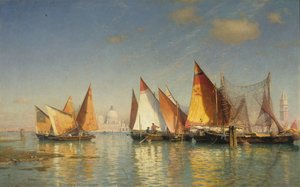
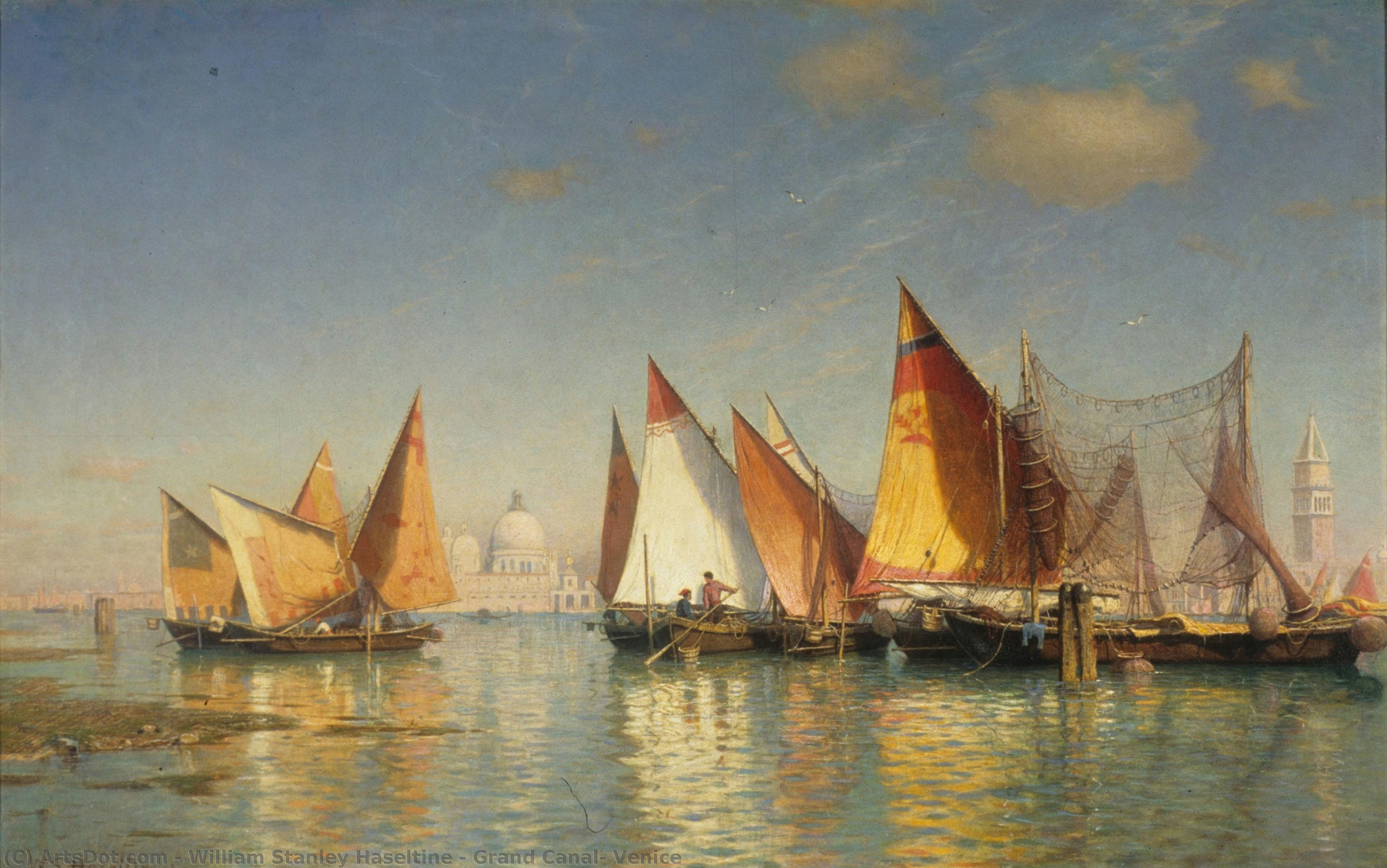
In his evocative masterpiece, Grand Canal, Venice, William Stanley Haseltine invites the viewer to step directly onto the shimmering waters of Italy’s most iconic waterway. Painted in 1882, this breathtaking oil on canvas captures a moment of serene maritime activity, where the rhythmic dance of gondolas and sailboats defines the pulse of the city. As the eye wanders through the composition, it is led by a masterful use of one-point perspective, traveling past the intricate details of wooden hulls and billowing sails toward the majestic silhouette of the Basilica di Santa Maria della Salute. The painting does more than merely depict a location; it captures the very soul of Venice, where the boundary between the liquid streets and the architectural grandeur seems to dissolve under the soft, golden light of a late afternoon sun.
The technical brilliance of Haseltine lies in his ability to marry academic realism with a palpable sense of atmosphere. Utilizing the rich, layered traditions of the Düsseldorf School, the artist employs an impasto technique in specific areas to lend physical dimension to the water's reflections and the heavy textures of sailcloth. There is a profound sense of depth achieved through atmospheric perspective, where the distant structures of the city become paler and more ethereal, shrouded in a light haze that suggests the humid, salt-kissed air of the Venetian lagoon. The interplay of geometric shapes—the sharp triangles of the sails against the sturdy rectangles of the boats—creates a structured yet fluid composition that feels both stable and alive.
Symbolism and Emotional Resonance
Beyond its surface beauty, the artwork serves as a profound meditation on the relationship between human industry and historical permanence. The bustling boats in the foreground, representing the vital trade and daily transportation that sustain the city, act as a dynamic counterpoint to the enduring, stone-clad authority of the Basilica. This juxtaposition creates a silent dialogue between the ephemeral nature of daily life and the eternal legacy of Venetian history and religious devotion. For the collector or interior designer, this piece offers more than just a decorative element; it provides an emotional anchor of tranquility and timelessness.
To possess a reproduction of this work is to bring a sense of classical elegance and worldly sophistication into a living space. The warm, diffused lighting and the harmonious palette of blues, golds, and earthy tones make it a versatile centerpiece for any curated collection. Whether placed in a sunlit gallery or a quiet study, Grand Canal, Venice evokes a nostalgic longing for the "Serenissima," offering an enduring escape into a world of romantic splendor and artistic mastery.
Related Artworks
Artist Biography
Early Life and Education
- Born: June 11, 1835, Philadelphia, United States of America
- Died: February 3, 1900, Rome, Italy
- Family Background: Born into a prosperous family – his father, John Haseltine, was a successful businessman, and his mother, Elizabeth Shinn Haseltine, an amateur landscape painter.
- Formal Education: Received early education at the University of Pennsylvania before attending Harvard University, graduating in 1854.
- Early Exhibitions: First showcased his work at the Pennsylvania Academy of Fine Arts in 1855.
European Influences and Artistic Development
- European Sojourn (1857-1864): Traveled to Europe in 1857, joining a colony of American painters studying in Düsseldorf, Germany. Explored the Rhine Valley, Switzerland, and Italy.
- Düsseldorf School Influence: Exposure to European artistic traditions profoundly influenced his style. The Düsseldorf school emphasized meticulous draftsmanship and realistic depiction.
Artistic Style and Notable Works
- Luminism and Realism: Paintings characterized by Luminist qualities – a focus on capturing the effects of light and atmosphere with remarkable precision, combined with a strong sense of realism.
- Hudson River School Association: Aligned with the Hudson River School tradition, celebrating the grandeur and beauty of the American landscape.
- Subject Matter: Primarily included coastal scenes from New England (particularly Nahant, Massachusetts) and Italian landscapes, including views of Capri and Venice.
- Notable Works:
- After a Shower – Nahant, Massachusetts
- Castle Rocks at Nahant, Massachusetts
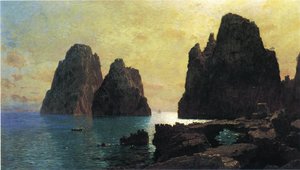
- Isle of Capri: The Faraglioni
- Saint Malo, Brittany
- Rocks at Narragansett 1
- Technical Skill: Evident in careful attention to detail, subtle gradations of light and shadow, and overall sense of atmospheric perspective.
Later Life, Legacy, and Family
- Return to America and European Residence: After returning to Philadelphia in 1858, settled permanently in Rome, Italy.
- Membership in Artistic Organizations: Elected an Associate of the National Academy of Design in 1860 and a full Academician in 1861.
- Founding Member of Saint Paul's Church: Founding member of the Episcopal Church of Saint Paul’s Within the Walls in Rome.
- Family Legacy: His son, Herbert Chevalier Haseltine, achieved fame as a sculptor specializing in animal figures.
- Death and Burial: Died of pneumonia in Rome in 1900 and is buried at the Protestant Cemetery in Rome.
Historical Significance
- Contribution to Luminism: Played a significant role in popularizing and refining the Luminist style.
- Bridging European and American Traditions: Integrated European techniques with an American sensibility for landscape painting.
- Detailed Observation of Nature: Meticulous depictions of nature provide valuable visual records of landscapes that have undergone changes over time.
- Influence on Subsequent Artists: Emphasis on atmospheric effects and realistic detail influenced later generations of American landscape painters.
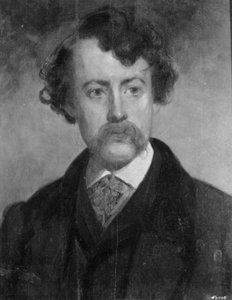
William Stanley Haseltine
1835 - 1900 , United States of America
Quick Facts
- Artistic Movement Or Style: Luminism, Hudson River School
- Artists Who Influenced This Artist: ['Wilhelm von Schadow']
- Date Of Birth: June 11, 1835
- Date Of Death: February 3, 1900
- Full Name: William Stanley Haseltine
- Nationality: American
- Notable Artworks:
- After a Shower – Nahant
- Castle Rocks at Nahant
- Isle of Capri: The Faraglioni
- Saint Malo, Brittany
- Rocks at Narragansett 1
- Place Of Birth: Philadelphia, USA
Related Articles
Hudson River School: 10 Masterpieces That Capture America's Wild Beauty | ArtsDot
Journey through America's breathtaking landscapes with our guide to the Top 10 Hudson River School masterpieces. Explore Thomas Cole, Frederic Church & more! Find museum-quality art reproductions and elevate your home decor at ArtsDot.com.

The Sublime Landscape: Exploring the Hudson River School Movement
Explore the captivating world of the Hudson River School! Discover the history, artists, and defining characteristics of this iconic American art movement. Learn about Romanticism's influence & find inspiration for your collection.
Giovanni Antonio Canal (Canaletto): A Venetian Master of Light, Space & Societal Observation
Explore the life & art of Giovanni Antonio Canal (Canaletto), a Venetian master renowned for his breathtaking cityscapes. Discover his techniques, legacy, and captivating depictions of 18th-century Venice & London.

Jacopo Tintoretto's Masterpieces: 25 Paintings That Define Venetian Drama | ArtsDot
Explore 25 breathtaking masterpieces by Jacopo Tintoretto, the Venetian master of drama and light. Discover the stories behind iconic Renaissance paintings & find museum-quality art reproductions to elevate your home decor on ArtsDot.com.
Robert Spencer: Luminism, Narrative & the American Landscape Tradition
Explore the captivating world of Luminism & the Hudson River School with our expert analysis. Discover the history, artists, and enduring beauty of 19th-century American landscape painting. Find museum-quality reproductions at ArtsDot.