 Preview
 Send
Send Share
Share
 Details

 Download
 Similars
 X-Ray
X-Ray Diaporama
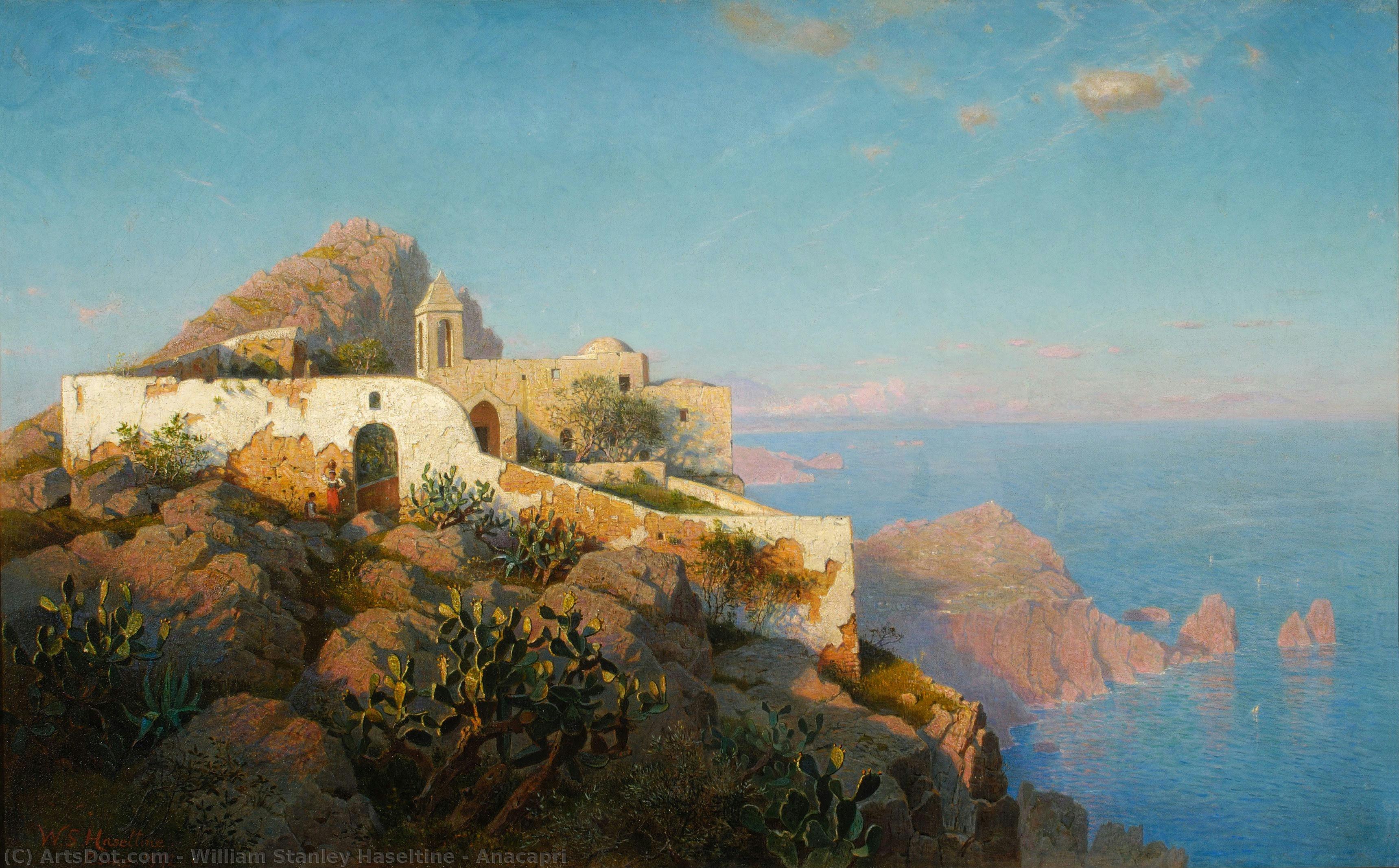
Anacapri


 Read More
Hand Made Oil Reproduction
Hand-painted oil on canvas in your size and frame, made to order by our artists. ( Buy Print Buy Image)




P118B $10

P118H $10

P118W $10

P438Z $10

P508JH $12

P508YH $12

P805H $10

P805Z $10

P919BZ $10

P919G $10

P919XJ $10

P959ZH $10

P968JZ $12

W106C $8

W218G $10

W218JH $8

W218Y $10

W307PJ $10

W316G $10

W316PJ $8

W316Y $10

W398PJ $8

W4111J $10

W500HY $15

W500JH $15

W692G $12

W849H $8

W940BG $15

W953PJ $8




Pick from our preset sizes that match the artwork's original proportions.

You may enter your own dimensions to fit a specific frame or space. If your selected size does not match the original image's proportions, we will either crop the artwork or extend the painting with additional hand-painted elements. A digital mockup will be sent for your approval before production begins.
Please note that the on-screen preview does not reflect the actual cropping or extension. Only the mockup will accurately show the final composition.
While custom sizes are available, we recommend selecting a dimension from the predefined list to preserve the original proportions.
After order, ArtsDot.com team will email client for instructions and provide a mockup preview
Worldwide Delivery () in 3/4 weeks instead of standard 5 weeks. (17 August). No compromise on quality.

Free Worldwide Express Shipping

High-Quality Linen Canvas

Full Shipping Insurance

Customs Tax Refund Guarantee

True Color Matching Guarantee

60-Day Return Policy (Defects Only)

100% Money-Back Guarantee

Bulk Discount Offer
 Glass option is only available in size under 110 CM

Anacapri
Reproduction Medium
Reproduction Size
-


Total Price
$ 263
Artwork Description
A Mediterranean Dream Captured in Oil
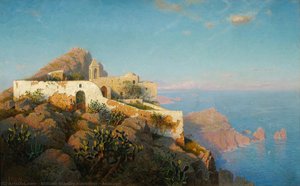
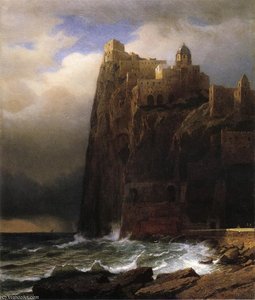
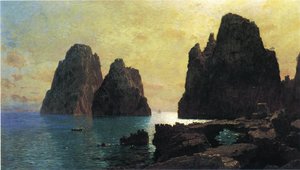
In the luminous masterpiece Anacapri, painted in 1892, William Stanley Haseltine invites the viewer on a sensory journey to the sun-drenched cliffs of Italy. The canvas unfolds as a breathtaking panorama of the Amalfi Coast, where a majestic castle perches precariously atop a rugged hill, acting as a silent sentinel over the shimmering Tyrrhenian Sea. This is not merely a landscape; it is an evocative window into a bygone era of European tranquility. The composition masterfully balances the formidable strength of the rocky cliffs with the delicate, sprawling charm of a village nestled within the verdant hills. As the eye wanders through the scene, one encounters the gentle rhythms of coastal life, with figures scattered across the landscape—some lingering near the fortress, others strolling along the water's edge—all contributing to an atmosphere of profound serenity and timelessness.
The technical brilliance of this work lies in Haseltine’s mastery of the Düsseldorf School’s tradition, a style he refined during his formative years in Germany. This influence is evident in the meticulous rendering of textures; one can almost feel the rough, weathered stone of the ancient fortifications and the cool, salt-sprayed surface of the cliffs. His brushwork possesses a robust draftsmanship that provides structural clarity to the sprawling scenery, yet it remains fluid enough to capture the ethereal quality of Mediterranean light. The interplay of light and shadow creates a sense of depth that pulls the observer into the heart of the Italian coastline, making the distant village feel both reachable and dreamlike.
For the discerning collector or interior designer, Anacapri offers more than just aesthetic beauty; it provides an emotional anchor for any space. The painting symbolizes a longing for peace and the enduring majesty of nature and history intertwined. Its palette, rich with earthy tones and brilliant coastal hues, possesses a versatile elegance that complements both classical and contemporary interiors. Whether placed in a grand salon to serve as a focal point or in a quiet study to inspire contemplation, this reproduction brings the warmth of the Italian sun and the romantic spirit of the late 19th century into the modern home. It is an investment in atmosphere, offering a permanent escape to a world where time seems to stand still amidst the beauty of the sea.
Related Artworks
Artist Biography
Early Life and Education
- Born: June 11, 1835, Philadelphia, United States of America
- Died: February 3, 1900, Rome, Italy
- Family Background: Born into a prosperous family – his father, John Haseltine, was a successful businessman, and his mother, Elizabeth Shinn Haseltine, an amateur landscape painter.
- Formal Education: Received early education at the University of Pennsylvania before attending Harvard University, graduating in 1854.
- Early Exhibitions: First showcased his work at the Pennsylvania Academy of Fine Arts in 1855.
European Influences and Artistic Development
- European Sojourn (1857-1864): Traveled to Europe in 1857, joining a colony of American painters studying in Düsseldorf, Germany. Explored the Rhine Valley, Switzerland, and Italy.
- Düsseldorf School Influence: Exposure to European artistic traditions profoundly influenced his style. The Düsseldorf school emphasized meticulous draftsmanship and realistic depiction.
Artistic Style and Notable Works
- Luminism and Realism: Paintings characterized by Luminist qualities – a focus on capturing the effects of light and atmosphere with remarkable precision, combined with a strong sense of realism.
- Hudson River School Association: Aligned with the Hudson River School tradition, celebrating the grandeur and beauty of the American landscape.
- Subject Matter: Primarily included coastal scenes from New England (particularly Nahant, Massachusetts) and Italian landscapes, including views of Capri and Venice.
- Notable Works:
- After a Shower – Nahant, Massachusetts
- Castle Rocks at Nahant, Massachusetts
- Isle of Capri: The Faraglioni
- Saint Malo, Brittany
- Rocks at Narragansett 1
- Technical Skill: Evident in careful attention to detail, subtle gradations of light and shadow, and overall sense of atmospheric perspective.
Later Life, Legacy, and Family
- Return to America and European Residence: After returning to Philadelphia in 1858, settled permanently in Rome, Italy.
- Membership in Artistic Organizations: Elected an Associate of the National Academy of Design in 1860 and a full Academician in 1861.
- Founding Member of Saint Paul's Church: Founding member of the Episcopal Church of Saint Paul’s Within the Walls in Rome.
- Family Legacy: His son, Herbert Chevalier Haseltine, achieved fame as a sculptor specializing in animal figures.
- Death and Burial: Died of pneumonia in Rome in 1900 and is buried at the Protestant Cemetery in Rome.
Historical Significance
- Contribution to Luminism: Played a significant role in popularizing and refining the Luminist style.
- Bridging European and American Traditions: Integrated European techniques with an American sensibility for landscape painting.
- Detailed Observation of Nature: Meticulous depictions of nature provide valuable visual records of landscapes that have undergone changes over time.
- Influence on Subsequent Artists: Emphasis on atmospheric effects and realistic detail influenced later generations of American landscape painters.

William Stanley Haseltine
1835 - 1900 , United States of America
Quick Facts
- Artistic Movement Or Style: Luminism, Hudson River School
- Artists Who Influenced This Artist: ['Wilhelm von Schadow']
- Date Of Birth: June 11, 1835
- Date Of Death: February 3, 1900
- Full Name: William Stanley Haseltine
- Nationality: American
- Notable Artworks:
- After a Shower – Nahant
- Castle Rocks at Nahant
- Isle of Capri: The Faraglioni
- Saint Malo, Brittany
- Rocks at Narragansett 1
- Place Of Birth: Philadelphia, USA
Related Articles
Mario Sironi: A Poetic of Modern Italian Identity Through Symbolism & Social Commentary
Explore the profound works of Mario Sironi, a key figure in Italian Modernism. Discover his evolution from Futurism to Metaphysical painting and his powerful social commentary. Learn about his legacy at ArtsDot.

Echoes of the Azure Coast: Art Selection Strategies for Mediterranean Villa Interiors – Harmonizing Space, Light, and Legacy
Discover art selection strategies for stunning Mediterranean villa interiors. Expert guidance on harmonizing space, light & legacy. Elevate your home with timeless elegance – curated collections & bespoke solutions.
Giovanni Fattori: Realism, Identity & the Tuscan Landscape – A Macchiaioli Master
Explore the life & art of Giovanni Fattori, a leading figure of the Macchiaioli movement. Discover his revolutionary realism, captivating Tuscan landscapes, and lasting impact on Italian painting. Learn more at ArtsDot.

Carlo Carrà: Futurist Visions & Metaphysical Transformations in Early 20th-Century Italian Painting
Explore the artistic journey of Carlo Carrà, a pivotal figure in Italian Futurism & Metaphysical painting. Discover his dynamic compositions, collaborations with de Chirico, and lasting influence on modern art history.
Civic Virtue and Artistic Rivalry: Patronage and Innovation in the Italian Renaissance Republics, 1400–1600
Explore the Italian Renaissance! Discover how competitive patronage & humanist ideals fueled artistic innovation in republics like Florence & Venice. Expert insights for art lovers and collectors.