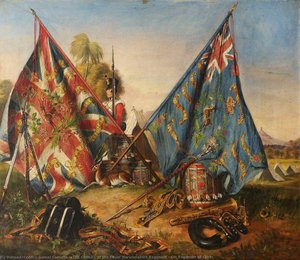
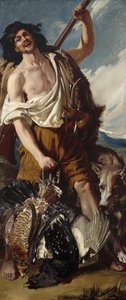
Early Life & Artistic Foundations: From Cork to London
Daniel Maclise’s journey from the bustling port city of Cork, Ireland, to the heart of the London art world is a testament to the power of unwavering dedication and burgeoning talent. Born in 1806 to a family with Scottish roots – his father, Alexander McLish, was a tanner by trade but carried the heritage of a Highland soldier – Maclise’s early life offered little indication of the artistic prominence he would achieve. His formal education remained modest, yet an innate thirst for culture and a keen eye for observation quickly became apparent. A pivotal moment arrived when, at sixteen, he briefly entered the employ of Newenham's Bank, a position soon abandoned in pursuit of his true calling: art. This decision, fueled by passion rather than practicality, marked the beginning of a remarkable transformation.
Maclise’s initial steps involved diligent self-study and portrait sketching, quickly gaining local recognition through lithographed portraits – notably one of Sir Walter Scott which garnered considerable popularity. These early works weren't merely exercises in likeness; they revealed an emerging ability to capture character and presence. Crucially, the support of influential friends facilitated his move to London in 1827, a city brimming with artistic opportunity. Entering the Royal Academy Schools the following year proved decisive, where he excelled in life drawing and history painting, laying the groundwork for a career defined by narrative power and technical skill.
The Rise of Historical Painting & Maclise's Early Successes
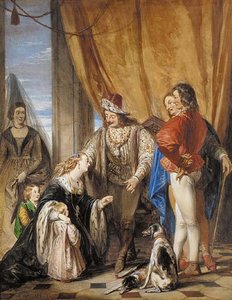 The reign of King Richard the Third
Witness the drama of Richard III's reign! Daniel Maclise’s 'The Reign of King Richard the Third' captures a pivotal moment with striking detail and Victorian flair. Own a hand-painted reproduction today!
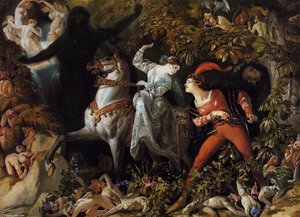
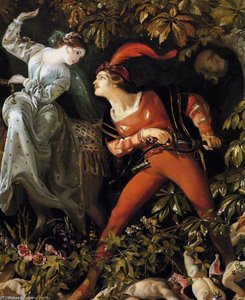
The early 19th century witnessed a burgeoning fascination with historical subjects, fueled by Romantic ideals and a growing sense of national identity. Daniel Maclise swiftly rose to prominence within this milieu, establishing himself as a leading figure in British history painting. His initial exhibitions at the Royal Academy showcased a developing mastery of composition and dramatic storytelling. Works like “Malvolio Affecting the Count” (1829) demonstrated his ability to translate literary scenes into compelling visual narratives, hinting at a future deeply intertwined with the works of Shakespeare and other great authors.
Maclise’s success wasn't solely confined to subject pictures. His portraits, too, garnered acclaim for their insightful characterizations of prominent figures – Lord Campbell, Letitia Landon, and Charles Dickens all sat before his easel. However, it was his ambitious historical compositions that truly captivated audiences. The awards he received at the Academy—the Silver Medal in 1829 and the Gold Medal in 1831—were not merely accolades but confirmations of a unique artistic vision. By 1835, his election as an associate of the Royal Academy solidified his position within the established art world, paving the way for full membership five years later.
Murals at Westminster: Justice, Chivalry, and the Victorian Public Sphere
Perhaps no commission defines Maclise’s legacy more profoundly than the series of monumental murals he undertook for the Palace of Westminster during its rebuilding in the mid-19th century. Tasked with depicting allegorical scenes representing key virtues, Maclise embarked on a project that would test his artistic and physical limits. “The Spirit of Justice” (completed 1849) and “The Spirit of Chivalry” (completed 1848) were not simply decorative elements; they were intended to embody the moral foundations of Victorian society.
These vast frescoes, teeming with figures and intricate detail, reflect the era’s fascination with historical grandeur and its desire to project an image of strength and righteousness. The sheer scale of the undertaking demanded exceptional skill in composition and a meticulous attention to anatomical accuracy. Maclise's approach involved painstaking research and countless preparatory studies, ensuring that each figure contributed to the overall narrative impact. These murals became central features of the new Houses of Parliament, visible symbols of British law and honor for generations to come.
Shakespearean Scenes & Literary Illustrations: A Captivating Blend
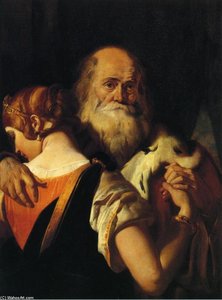 King Lear and Cordelia
Experience Shakespeare's tragedy with Maclise’s 'King Lear and Cordelia.' This dramatic painting captures the poignant moment between father and daughter, rich in emotion and detail.
Beyond his historical paintings, Maclise cultivated a remarkable relationship with literature, particularly the works of William Shakespeare. His series of scenes from the Bard’s plays—including a poignant depiction of “King Lear and Cordelia”—demonstrated an exceptional ability to capture emotional depth and dramatic tension. These weren't mere illustrations; they were reinterpretations of iconic moments, imbued with Maclise’s own artistic sensibility.
This fascination extended beyond painting. He became a prolific illustrator, contributing significantly to publications like *Fraser’s Magazine*. Under the pseudonym “Alfred Croquis,” he created a celebrated series of lithographed portraits of contemporary literary and cultural figures – a project that offered a fascinating glimpse into the intellectual life of Victorian London. His illustrations for works by Milton, Tennyson, Thomas Moore, and Charles Dickens further cemented his reputation as a versatile and insightful artist capable of bridging the gap between visual art and the written word.
Maclise’s Portraits: Reflecting a Celebrated Era
While celebrated for his grand historical compositions, Daniel Maclise also excelled in portraiture. His portraits weren't simply representations of physical likeness; they were insightful studies of character, capturing the essence of prominent figures within Victorian society. He possessed an uncanny ability to convey personality and social standing through subtle nuances of expression and pose.
His sitters included Lord Campbell, novelist Letitia Landon, and Charles Dickens, individuals who shaped the cultural landscape of their time. Maclise’s portraits often reveal a keen awareness of social conventions and artistic trends, reflecting the era's emphasis on respectability and refinement. These works provide invaluable insights into the lives and personalities of Victorian celebrities, offering a visual record of a celebrated generation.
Legacy and Influence: Romanticism, Realism, and Beyond
Daniel Maclise’s career spanned a period of significant artistic transition, bridging the gap between Romantic idealism and the emerging currents of Realism. His works embody a unique blend of historical grandeur, emotional intensity, and meticulous detail. While his later years were marked by health challenges – exacerbated by the demanding labor involved in the Westminster murals – his influence on British art remained profound.
His commitment to narrative storytelling, coupled with his technical mastery, inspired generations of artists. Though he declined the presidency of the Royal Academy in 1865, his legacy endures through his captivating paintings and illustrations, which continue to resonate with audiences today. Maclise’s works offer a compelling window into the Victorian era—its aspirations, its anxieties, and its enduring fascination with history, literature, and the human condition. Explore these masterpieces at ArtsDot.com, where handmade oil paintings and museum-quality prints bring his vision to life.