 Preview
 Send
Send Share
Share
 Details

 Download
 Similars
 X-Ray
X-Ray Diaporama
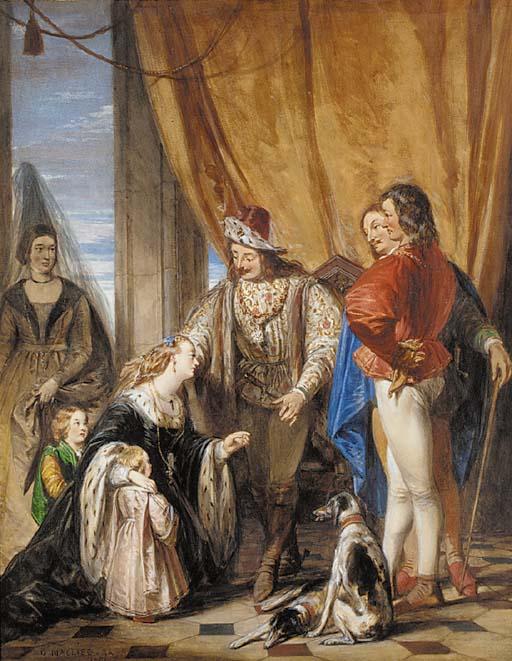
The reign of King Richard the Third

 Read More
Hand Made Oil Reproduction
Hand-painted oil on canvas in your size and frame, made to order by our artists. ( Buy Print Buy Image)




































Pick from our preset sizes that match the artwork's original proportions.

You may enter your own dimensions to fit a specific frame or space. If your selected size does not match the original image's proportions, we will either crop the artwork or extend the painting with additional hand-painted elements. A digital mockup will be sent for your approval before production begins.
Please note that the on-screen preview does not reflect the actual cropping or extension. Only the mockup will accurately show the final composition.
While custom sizes are available, we recommend selecting a dimension from the predefined list to preserve the original proportions.
After order, ArtsDot.com team will email client for instructions and provide a mockup preview
Worldwide Delivery () in 3/4 weeks instead of standard 5 weeks. (17 August). No compromise on quality.

Free Worldwide Express Shipping

High-Quality Linen Canvas

Full Shipping Insurance

Customs Tax Refund Guarantee

True Color Matching Guarantee

60-Day Return Policy (Defects Only)

100% Money-Back Guarantee

Bulk Discount Offer
 Glass option is only available in size under 110 CM

The reign of King Richard the Third
Reproduction Medium
Reproduction Size
-


Total Price
$ 363
Artwork Description
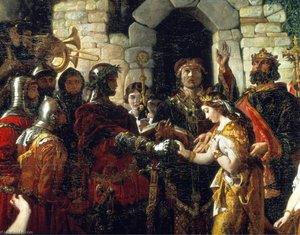
The Reign of King Richard the Third: A Dramatic Historical Narrative
Daniel Maclise's "The Reign of King Richard the Third" is a monumental Victorian history painting, capturing a pivotal moment in English history with dramatic flair and meticulous detail. Completed around 1850, this artwork offers viewers a glimpse into the complex political landscape and personal dynamics surrounding one of England’s most controversial monarchs.
Composition and Narrative
The composition is carefully orchestrated to draw the viewer's eye directly to King Richard III, positioned centrally within the scene. He stands as a figure of authority, yet his expression hints at contemplation rather than outright dominance. A woman kneels before him, holding a child – likely pleading for mercy or recognition, adding an element of pathos and human drama. Other figures populate the space, observing the interaction from various vantage points, creating a sense of bustling court life. The semi-circular arrangement of these figures contributes to the dynamism of the scene, suggesting movement and unspoken tensions.
Style and Technique
Maclise’s style is firmly rooted in 19th-century history painting, blending realism with Romantic sensibilities. He employs a rich color palette dominated by warm tones – reds, golds, browns, and creams – contrasted by cooler blues and greens in the clothing and background elements. The use of oil paints allows for layering and glazing techniques, resulting in a depth of color saturation and subtle gradations of light and shadow. Noticeable brushstrokes reveal the artist's hand while contributing to the texture of various surfaces—smooth skin, polished fabrics, rough stone, and even the realistic depiction of the dog’s fur.
Symbolism and Emotional Impact
Beyond its historical portrayal, "The Reign of King Richard the Third" is laden with symbolic elements. The kneeling woman embodies humility and supplication, while the king's posture conveys authority tempered by introspection. The presence of a loyal dog symbolizes companionship and steadfastness. The dramatic lighting, focused on the central figures, amplifies the emotional intensity of the scene—a palpable sense of tension hangs in the air, inviting viewers to ponder the power dynamics at play and the potential consequences of this encounter. Maclise masterfully evokes a feeling of drama and suspense, characteristic of Victorian history painting’s emphasis on narrative storytelling.
Historical Context and Legacy
This artwork was created during a period when historical paintings were immensely popular, serving as both entertainment and educational tools. Richard III has long been a figure of fascination and debate, and Maclise's depiction reflects the Victorian era’s interest in exploring complex historical figures and events. "The Reign of King Richard the Third" stands as a testament to Maclise’s skill as an artist and his ability to capture not only a moment in history but also the emotional weight of human interaction within that context.
Related Artworks


Artist Biography
Early Life and Education
- Born: January 25, 1806, Cork, Ireland
- Died: April 25, 1870, London, England
- Parents: Alexander McLish (tanner/shoemaker) and Rebecca McLeish
- Early education in Cork; showed artistic talent from a young age.
- Studied at the Cork School of Art, focusing on drawing and anatomy.
- Self-funded move to London in 1827 to pursue art studies.
- Entered the Royal Academy Schools in 1828, excelling in life drawing and history painting.
Career and Major Works
- Rapidly gained recognition for his portrait skills, notably depicting Charles Kean and Niccolò Paganini.
- Contributed significantly to *Fraser's Magazine* under the pseudonym "Alfred Croquis," creating a series of character portraits that enhanced his reputation.
- Became an Associate of the Royal Academy in 1835 and a full member in 1840.
- Notable Works:
- The Meeting of Wellington and Blücher after the Battle of Waterloo (located at Westminster Palace)
- The Death of Nelson (located at Westminster Palace) – A monumental fresco considered one of his masterpieces.
- The Chivalric Vow of the Ladies and the Peacock
- Illustrations for Charles Dickens' Christmas books and other works.
Artistic Style and Influences
- Maclise’s style blended historical narrative with elements of realism and portraiture.
- Influenced by French and classical art, particularly after his visit to Paris in 1830.
- His work often depicted scenes from history, literature (Shakespeare), and mythology.
- Demonstrated a keen eye for detail and characterization in both portraits and historical compositions.
Later Life and Legacy
- Intense dedication to his art took a toll on his health.
- Declined the presidency of the Royal Academy in 1865 due to declining health.
- Died in Chelsea, London, in 1870.
- A memoir was published by William Justin O'Driscoll in 1871.
- Maclise’s murals at Westminster Palace remain significant contributions to British art and architecture.
- His illustrations for Dickens helped popularize the author's works.
- Considered a key figure in Victorian-era history painting, bridging the gap between Neoclassicism and Realism.
Historical Significance
- Maclise played a crucial role in documenting significant historical events and figures for a wider audience.
- His work reflects the cultural and artistic trends of the 19th century, particularly the Victorian era's fascination with history and literature.
- He helped establish the tradition of large-scale narrative painting within British art.
- His contributions to Westminster Palace’s decoration are integral to the building's aesthetic and symbolic importance.
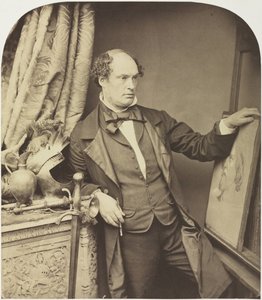
Daniel Maclise
1806 - 1870 , Ireland
Quick Facts
- Artistic Movement Or Style: History painting, portraiture
- Artists Who Influenced This Artist: ['Sir Walter Scott']
- Date Of Birth: January 25, 1806
- Date Of Death: April 25, 1870
- Full Name: Daniel Maclise
- Nationality: Irish
- Notable Artworks:
- The Marriage of Strongbow and Aoife
- The Meeting of Wellington and Blücher
- The Death of Nelson
- Chivalric Vow of the Ladies
- Place Of Birth (City And Country): Cork, Ireland
Related Articles
Daniel Maclise: Historical Narratives & Romantic Ideals in 19th-Century British Art
Explore the life & works of Daniel Maclise, a leading Victorian historical painter. Discover his captivating murals, Shakespearean scenes, and portraits at ArtsDot.com – handmade oil paintings & museum-quality prints.
Frederick Richard Lee: Capturing Victorian Domestic Life on Canvas
Explore the captivating Victorian genre paintings of Frederick Richard Lee. Discover his life, style, influences & legacy. Expert insights for collectors and art enthusiasts at ArtsDot.
Richard Caton Woodville: Chronicles of Victorian Life & Narrative Realism
Explore the captivating world of Richard Caton Woodville, a pivotal American artist who masterfully captured Victorian life through detailed narrative realism. Discover his legacy and influence on 19th-century painting.

Dramatic Masterpieces: 10 Artworks for a Powerful Home Decor Statement |
Explore 10 dramatic artworks by masters like Caravaggio, Van Gogh & Munch. Uncover the stories behind these powerful paintings and find museum-quality reproductions to transform your home decor. Discover all masterpieces on .

William Trost Richards: Luminism, Spirituality & the American Landscape Tradition
Explore the captivating landscapes of William Trost Richards, a master of Luminism associated with both the Hudson River School & American Pre-Raphaelite movements. Discover his spiritual connection to nature and lasting influence on American art.