Early Life & Academic Foundations: Shaping a Romantic Vision
History paintings is a genre Western art that focuses on the depiction of historical, mythological, biblical, or literary subjects, often with a moral or didactic purpose. Considered the most prestigious genre in the academic art hierarchy during the...
Karl Pavlovich Bryullov, born Karl Bryullo in St. Petersburg in 1799, emerged from a family deeply entrenched in the artistic world. His father, Pavel Ivanovich Briullo, was an accomplished academician specializing in woodcarving and engraving—a lineage that instilled within young Karl a profound respect for craftsmanship and meticulous detail. However, it wasn’t merely inherited skill that propelled Bryullov towards greatness; from his earliest years, he harbored a fervent fascination with Italy, a land perceived as the cradle of artistic excellence. This yearning would fundamentally shape his aesthetic trajectory. His formal education began at the Imperial Academy of Arts in 1809, an institution steeped in classical tradition. Yet, even within this rigorous framework, Bryullov’s inherent Romantic sensibility proved difficult to contain. While mastering the technical demands of academic painting—anatomy, perspective, composition—he simultaneously sought a more expressive and emotionally resonant style, diverging from the strict neoclassical norms favored by his mentors and, notably, his brother Alexander. This early tension between tradition and innovation would become a defining characteristic of Bryullov’s oeuvre.
The Triumph of 'The Last Day of Pompeii': A Masterpiece Unveiled
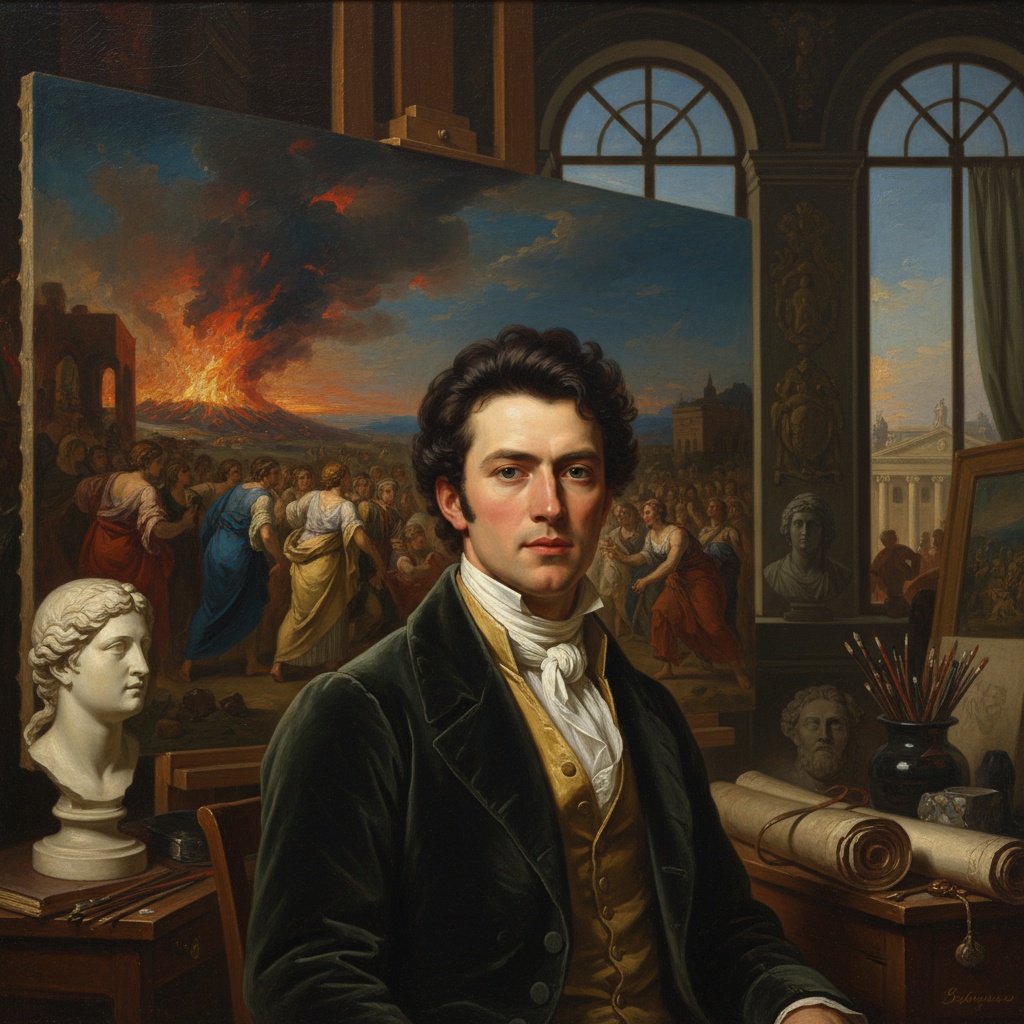
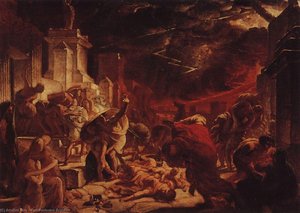
Bryullov's ascent to international renown rests squarely upon the monumental canvas, 'The Last Day of Pompeii' (1830-1833). This ambitious work, depicting the cataclysmic eruption of Mount Vesuvius in 79 AD, wasn’t simply a historical recreation; it was an emotional tour de force. The painting transcends mere documentation, plunging viewers into the heart of chaos and despair. Bryullov meticulously researched the event, studying archaeological findings and contemporary accounts to achieve unparalleled accuracy. But what truly sets this masterpiece apart is its dramatic composition, swirling energy, and intensely human portrayal of suffering. The sheer scale—over 4 meters high and nearly 7 meters wide—is breathtaking, enveloping the spectator in a scene of overwhelming destruction. The influence of Baroque masters like Rubens is palpable in the dynamic arrangement of figures and the rich, saturated colors. Upon its completion, 'The Last Day of Pompeii' caused a sensation in Italy, earning Bryullov widespread acclaim and establishing him as one of Europe’s leading painters. Pushkin and Gogol lauded the work, comparing it favorably to the achievements of the Old Masters.
Portraiture and Historical Paintings: Bryullov's Diverse Oeuvre
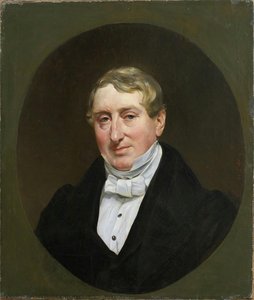 Portrait of Georg Kleberg
Admire Bryullov’s ‘Portrait of Georg Kleberg,’ a classic 1833 Russian oil painting. Experience its formal elegance, rich details & historical significance – a timeless masterpiece.
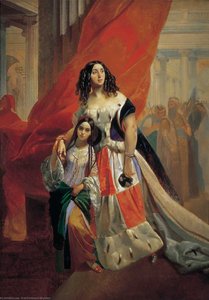
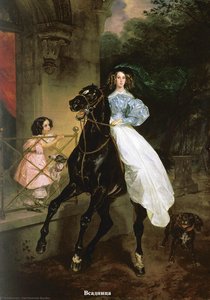
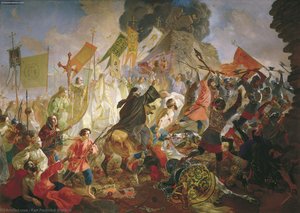
While 'The Last Day of Pompeii' remains his most celebrated achievement, Bryullov’s artistic output was remarkably diverse. Prior to this landmark work, he honed his skills as a portraitist, capturing the likenesses of St. Petersburg’s elite with both technical precision and psychological insight. 'Portrait of Georg Kleberg' (1833) exemplifies this period—a classic example of Russian oil painting showcasing formal elegance and rich detail. Beyond portraits, Bryullov consistently returned to historical subjects, often imbued with a sense of grandeur and moral weight. 'Genserich’s Invasion of Rome' (1835), for instance, depicts the sack of Rome by the Vandals in 455 AD—a chaotic battle scene rendered with Baroque-inspired drama and intense emotion. He also explored mythological themes, demonstrating a mastery of narrative composition and allegorical symbolism. This breadth of subject matter reveals Bryullov’s intellectual curiosity and his commitment to exploring the full spectrum of human experience.
Bryullov’s Influence on Russian Art: A Legacy of Dramatic Realism
Karl Bryullov's impact on Russian art was profound and far-reaching. He didn’t merely introduce a new style; he fundamentally altered the course of 19th-century painting in Russia. His emphasis on dramatic realism, coupled with his masterful technique, inspired a generation of artists to break away from rigid academic conventions. He championed emotional intensity and narrative power, paving the way for later movements like Peredvizhniki (The Wanderers), who sought to depict social realities and human suffering. Bryullov’s teaching at the Imperial Academy of Arts (1836-1848) further solidified his influence. He encouraged his students to embrace individuality and experiment with new approaches, fostering a spirit of innovation that transformed the Russian art scene. His legacy extends beyond specific stylistic traits; he instilled a sense of national pride and artistic ambition within a burgeoning creative community.
Technique & Style: Exploring the Characteristics of Bryullov’s Work
Bryullov's distinctive style is characterized by a compelling fusion of classical precision and Romantic expressiveness. He possessed an exceptional command of anatomy, perspective, and composition—skills honed through rigorous academic training. However, he didn’t simply replicate classical forms; he infused them with a dynamic energy and emotional depth that set his work apart. His brushwork is often described as bold and confident, creating visible textures and a sense of movement. He employed a rich, saturated color palette, utilizing dramatic lighting effects to heighten the emotional impact of his scenes. A key element of Bryullov’s technique was his meticulous attention to detail—evident in everything from the rendering of fabrics and architecture to the expressive faces of his figures. This commitment to realism, combined with his Romantic sensibility, resulted in paintings that were both visually stunning and emotionally resonant.
Beyond the Canvas: Personal Life, Travels & Later Years
Bryullov’s life was as captivating as his art. His return to Russia after achieving fame in Italy saw him embraced by aristocratic society and appointed a professor at the Imperial Academy of Arts. However, he found himself increasingly burdened by administrative duties and frustrated by the limitations imposed upon artistic expression. His health began to deteriorate while working on the monumental plafond for St Isaac’s Cathedral—a project that demanded immense physical and mental exertion. Seeking respite, Bryullov embarked on a journey to Madeira in 1849, hoping the climate would alleviate his suffering. He spent the final three years of his life in Italy, near Rome, continuing to paint despite declining health. He died in Manziana in 1852 and was buried at the Cimitero Acattolico—a testament to his enduring connection with the land that had so profoundly inspired his artistic vision. His work continues to captivate audiences today, a powerful reminder of a master who bridged the gap between tradition and innovation.