Early Life & Artistic Foundations: A Spitalfields Beginning
 Wikipedia: Mark Gertler (artist)
Mark Gertler (born Marks Gertler; 9 December 1891 – 23 June 1939) was a British painter of figure subjects, portraits and still-life. His early life and his relationship with Dora Carrington were the inspiration for Gilbert Cannan's novel Mendel. Th...
Mark Gertler’s story is one steeped in the anxieties of a rapidly changing world, a narrative etched onto canvas with a raw emotionality that continues to resonate today. Born Marks Gertler in 1891 in the bustling, impoverished district of Spitalfields, London, his origins were firmly rooted in the immigrant experience. His parents, Louis and Kate Berenbaum, Polish Jews seeking refuge and opportunity, instilled a sense of both striving and precariousness that would profoundly shape their youngest son’s artistic vision. The family's brief return to Austria-Poland in 1892, an attempt at establishing an inn, proved unsuccessful, foreshadowing the instability that marked Gertler’s early years. This nomadic existence, coupled with his father’s eventual departure for America and subsequent failure to provide, cast a long shadow over the young artist's life, fostering a deep-seated insecurity and a yearning for belonging.
Returning to London in 1896, Gertler began to demonstrate an early aptitude for drawing. Despite limited formal education due to financial constraints, he secured a place at Regent Street Polytechnic, though his studies were short-lived. A brief apprenticeship at Clayton & Bell, the stained glass company, proved unfulfilling, yet it provided a foundational understanding of technique and composition. It was during this period that Gertler’s talent began to blossom, culminating in a third-place award in a national art competition – a pivotal moment that spurred him towards pursuing formal training at the prestigious Slade School of Fine Art in 1908.
The Bloomsbury Circle & The Quest for Recognition
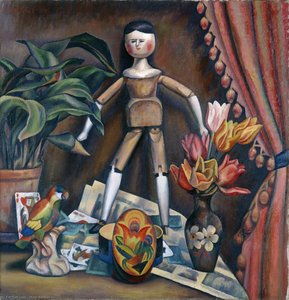 The Dutch Doll
Discover "The Dutch Doll" by Mark Gertler – a poignant early Modernist painting. Explore his expressive figures & London-inspired art at ArtsDot. A unique investment!
The Slade proved transformative. Gertler found himself amidst a cohort of future luminaries—Paul Nash, Edward Wadsworth, Stanley Spencer, and C.R.W. Nevinson – all grappling with the burgeoning modernist currents sweeping across Europe. However, it was his entanglement with the Bloomsbury Group that would most significantly influence his artistic trajectory and personal life. Introduced to Lady Ottoline Morrell, a prominent patron of the arts, Gertler entered a world of intellectual ferment and aesthetic experimentation. Morrell became a crucial advocate, facilitating introductions to key figures like Walter Sickert and providing access to a network of collectors and critics.
Yet, this entry into the Bloomsbury circle was not without its complexities. While celebrated for his portraiture, Gertler struggled with self-doubt and a persistent need for validation. His temperamental nature and uncompromising artistic vision often alienated potential sitters and buyers. He craved recognition but found himself increasingly at odds with the prevailing tastes of the art world. This tension – between ambition and insecurity, acceptance and isolation – became a defining characteristic of his career.
Vorticism, War, and the 'Merry-Go-Round' – A Period of Turmoil
The years surrounding World War I were particularly turbulent for Gertler. He briefly aligned himself with Vorticism, the radical British modernist movement founded by Wyndham Lewis, embracing its geometric abstraction and rejection of traditional forms. However, his association was relatively short-lived; Gertler’s inherently figurative style proved incompatible with Vorticism's more austere aesthetic principles. The outbreak of war further exacerbated his anxieties. He was initially rejected for military service due to his “Austrian” parentage, a reflection of the prevailing anti-immigrant sentiment. Later called up, he successfully claimed exemption on grounds of ill health, though this came at the cost of publicly declaring his pacifist beliefs.
It was during this period that Gertler created Merry-Go-Round (1916), arguably his most iconic work. This complex and unsettling composition, a swirling vortex of figures caught in a perpetual cycle of movement, is widely interpreted as a powerful indictment of the futility and alienation of war. D.H. Lawrence famously hailed it as “the best modern picture I have seen,” recognizing its profound emotional depth and symbolic resonance.
Gertler’s Portraiture: Capturing a Generation’s Disquiet
Despite his experimentation with abstraction, Gertler remained fundamentally a portrait painter. His portraits are not merely likenesses; they are penetrating psychological studies that reveal the inner lives of his sitters – and, perhaps more importantly, reflect his own anxieties and obsessions. He sought to capture not just physical appearance but also the emotional weight of modernity, the sense of disillusionment and fragmentation that characterized the era.
The Artist’s Brother Harry Holding an Apple, for example, is a deceptively simple composition that reveals a profound intimacy and vulnerability. The apple itself can be interpreted as a symbol of temptation, knowledge, or even mortality. Similarly, his portraits of women – often members of the Bloomsbury circle – are imbued with a sense of melancholy and longing. He wasn’t interested in idealizing beauty; instead, he sought to portray his subjects with unflinching honesty, capturing their flaws and imperfections.
Themes of Isolation & Unrequited Love in Gertler’s Oeuvre
Underlying much of Gertler's work is a pervasive sense of isolation. This stemmed not only from his personal struggles but also from his profound alienation from the prevailing social norms of his time. His obsessive, unrequited love for Dora Carrington proved to be a defining force in his life and art. Their complex relationship – marked by intense passion, jealousy, and ultimately, disappointment – is documented in his published letters and served as inspiration for several literary works, including Gilbert Cannan’s novel *Mendel*. The characters of Loerke in D.H. Lawrence's *Women in Love* and Gombauld in Aldous Huxley’s *Crome Yellow* are widely believed to be based on Gertler.
This emotional turmoil found expression in his paintings, which often depict figures isolated from one another, lost in their own thoughts and anxieties. Even seemingly idyllic scenes, such as Summer, can be imbued with a sense of underlying sadness and longing. His inability to achieve lasting personal fulfillment profoundly impacted his artistic output, contributing to the raw emotionality that defines his work.
Legacy & Influence: Reassessing Mark Gertler’s Place in Modern British Art
Mark Gertler's life was tragically cut short in 1939 at the age of 47. His suicide, a culmination of years of depression and ill health, left behind a body of work that remained largely overlooked for decades. However, in recent years, there has been a growing reassessment of his artistic significance. Scholars and critics are increasingly recognizing him as a key figure in Modern British Art, a painter who captured the anxieties and complexities of a generation with unparalleled honesty and emotional depth.
His influence can be seen in the work of subsequent artists who explored themes of alienation, isolation, and psychological vulnerability. Today, Gertler’s paintings are held in major public collections, including the Tate, and continue to captivate audiences with their raw power and enduring relevance. At ArtsDot.com, we offer meticulously crafted reproductions of his masterpieces, allowing you to experience the beauty and emotional resonance of Gertler’s art in your own home or collection. Explore our selection and discover a unique investment that speaks to the complexities of the human condition.