
The Industrial Genesis: From Printing Presses to Fine Art
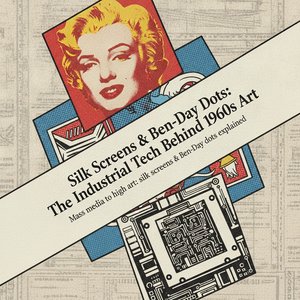 Silk Screens & Ben-Day Dots: The Industrial Tech Behind 1960s Pop Art
The Industrial Foundation: Silk Screening and Mass Production Aesthetics To understand the visual revolution of the 1960s, one must look beyond the canvas and toward the factory floor. The Pop Art movement did not emerge from a vacuum of classical in...
To understand the seismic shift of the 1960s Pop Art movement, one must look beyond the hallowed, quiet halls of traditional galleries and instead turn toward the rhythmic, mechanical hum of the mid-twroll century factory floor. The revolution did not begin with a brush dipped in pigment, but rather with the relentless efficiency of the printing press and the burgeoning expansion of consumerism in post-war America. This was an era defined by an unprecedented surge in economic prosperity, where the rise of advertising and a vibrant youth culture transformed the visual landscape into a saturated sea of mass-produced imagery.
The artists who would eventually define this movement did not seek inspiration in the ethereal landscapes of Romanticism or the heavy emotionality of Abstract Expressionism. Instead, they found a potent visual language within the ubiquitous symbols of everyday life: the glossy sheen of an advertisement, the bold graphics of industrial packaging, and the disposable charm of comic books. By looking toward these "low-culture" sources, they began to dismantle the long-standing barriers between high art and commercial utility, suggesting that the very tools used to sell soap or news could be repurposed to interrogate the soul of a modern society.
This transition was not merely an aesthetic choice but a radical philosophical inquiry. As the boundaries between fine art and mass media began to dissolve, the movement forced a confrontation with the authenticity of artistic creation itself. The industrial foundation of Pop Art—rooted in the accessibility of the printed image—allowed for a new kind of democratic engagement with art, where the familiar and the commonplace were elevated to the status of monumental icons.
The Mechanics of Perception: Decoding the Ben-Day Dot
 Beyond the Dot: Exploring the Bold Impact of Ben-Day Dots in Modern Art
The Mechanics of Perception: Understanding the Ben-Day Dot To look closely at a masterpiece of Pop Art is to witness a fascinating optical illusion, a dance between what the eye perceives and what the mind interprets. At the heart of this phenomenon ...
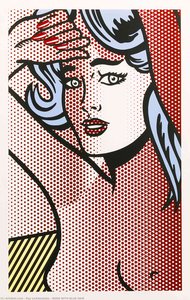
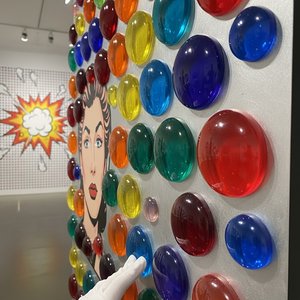
At the very heart of this visual revolution lies a fascinating optical illusion, a delicate dance between what the human eye perceives and what the mind must interpret. This phenomenon is anchored by the Ben-Day dot, an inexpensive mechanical printing method developed in the late 19th century by Benjamin Henry Day, Jr. Originally engineered for the humble world of newsprint and pulp fiction, these tiny, rhythmic clusters of color were never intended to be viewed as individual points of ink. Rather, they were designed to blend seamlessly when seen from a distance, creating the illusion of continuous tone, soft shading, and secondary hues.
When one examines a Pop Art masterpiece closely, the magic of optical mixing is revealed in all its clinical precision. The dots appear as isolated, mechanical marks—a stark, almost artificial texture that reminds the viewer of the work's industrial origins. However, as the viewer retreats, these scattered pigments undergo a metamorphosis. The eye bridges the gaps between the cyan, magenta, yellow, and black points, weaving them into smooth gradients and complex shadows. This technique creates a profound tension: it is a way of trickcepting the retina, inviting the observer to participate actively in the construction of the image.
This mastery of perception allows for a unique form of storytelling. By manipulating the density and spacing of these dots, an artist can simulate the depth found in classical oil paintings while maintaining the flat, graphic energy of a comic strip. It is a technique that celebrates the artifice of representation, acknowledging that what we see is not a direct window into reality, but a carefully constructed layer of mechanical symbols.
The Aesthetics of Mass Production: Silk Screens and Commercial Imagery
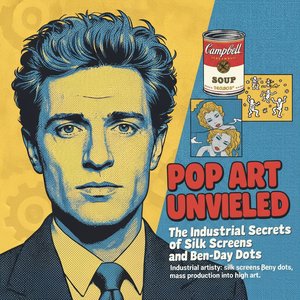
 Pop Art Unveiled: The Industrial Secrets of Silk Screens and Ben-Day Dots
The Aesthetic of Mass Production: Recontextualizing the Industrial Image To understand the profound revolution of Pop Art, one must first look beyond the canvas and into the bustling machinery of the mid-twentieth century. At its core, this movement ...
While the Ben-Day dot provided the texture, the silk screen provided the medium for a new era of repetition and scale. The Pop Art movement embraced the aesthetics of mass production, adopting the very tools used in commercial manufacturing to achieve a sense of detachment and objectivity. Silk screening, or serigraphy, allowed artists to move away from the subjective, heavy brushstrokes of the individual hand and toward an aesthetic that felt as though it could have emerged directly from a factory line.
This method facilitated a fascination with the repetitive nature of modern life. Just as a consumer encounters the same brand logo on countless storefronts, the Pop artist could use screens to replicate imagery with a striking, uniform precision. This approach stripped away the complexities of reality, replacing them with bold outlines and primary colors that echoed the visual language of the supermarket aisle and the billboard. The result was an art form that felt inherently modern—a reflection of a world where identity and experience were increasingly shaped by mass-produced goods.
By utilizing these industrial techniques, artists could explore themes of consumption and desire through a lens of detachment. The use of silk screens allowed for the creation of works that were both monumental in scale and seemingly impersonal in execution, mirroring the way mass media saturates our consciousness with images that are simultaneously everywhere and nowhere.
Roy Lichtenstein: Recontextualizing the Comic Strip Aesthetic
 Roy Lichtenstein
The Genesis of a Pop Visionary Roy Fox Lichtenstein, born in the vibrant metropolis of New York City on October 27, 1923, indelibly altered the landscape of twentieth-century art. Emerging as a pivotal figure within the Pop Art movement, Lichtenstein...
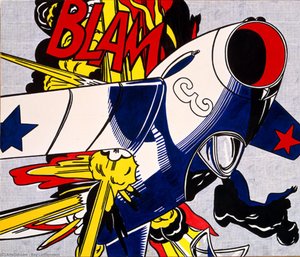
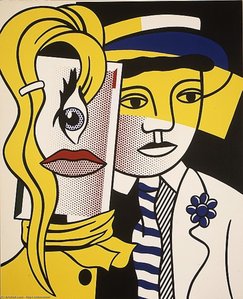
No figure embodies this intersection of industry and artistry more profoundly than Roy Lichtenstein. A pivotal visionary of the New York art scene, Lichtenstein did not simply reflect his era; he actively interrogated it. His work represents a brilliant re-contextualization of the comic book panel, transforming what was once considered disposable entertainment into profound artistic statements. Through his meticulous application of Ben-Day dots and heavy, uniform black outlines, he magnified the small-scale textures of pulp fiction into monumental canvases that demanded serious intellectual engagement.
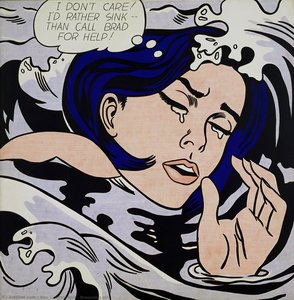
In masterpieces such as “2 Apples” or his various comic-inspired compositions, Lichtenstein utilized a deceptively simple visual vocabulary. He would take a single, decisive moment—a bite taken from an apple or a dramatic expression of grief in a comic strip—and render it with a mechanical, almost clinical precision. This deliberate choice was a conscious effort to mimic the look of mass-produced imagery, challenging the traditional notions of "artistic seriousness." His work does not merely imitate the comic book; it elevates its graphic language to the realm of fine art, forcing the viewer to confront the power of the simplified form.
Lichtenstein’s technique was a masterclass in controlled abstraction. By stripping away the nuances of realistic drawing and replacing them with the rigid geometry of the dot and the line, he created a world of pure, primary color. His ability to bridge the gap between the high-brow traditions of art history and the low-brow aesthetics of popular culture remains one of the most significant achievements in twentieth-century art.
The Cultural Impact: Bridging High Culture and Low Brow Media
 Roy Lichtenstein's Masterpieces: 25 Iconic Pop Artworks for Your Home | ArtsDot
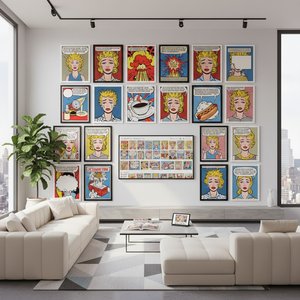
Introduction To embark on a journey through the top 25 artworks of Roy Lichtenstein is to enter a world where the boundaries between high art and popular culture dissolve, replaced by bold lines, vibrant colors, and an audacious commentary on America...
The true legacy of the Pop Art movement lies in its ability to collapse the distance between "high" and "low" culture. Before this era, the hierarchy of art was clearly defined: fine painting and sculpture occupied the pedestal of intellectual merit, while advertisements, comics, and packaging were relegated to the realm of mere commerce. The 1960s shattered this paradigm, suggesting that the visual language of the street was just as worthy of contemplation as the themes of classical mythology.
This blurring of lines had a profound impact on the collective consciousness of a post-war society grappling with unprecedented consumerism. By bringing the imagery of the everyday into the gallery, Pop Art forced a confrontation with the pervasive influence of mass media. It prompted viewers to question the authenticity of their own perceptions and the very definition of artistic expression in an age of infinite reproduction. The movement turned the mirror back on society, using the tools of advertising to critique the very culture that produced them.
Ultimately, this era redefined the relationship between art, commerce, and society. It paved the way for a more inclusive visual culture where the boundaries are fluid, and the ordinary can become extraordinary. The movement's audacity continues to resonate in contemporary design, advertising, and digital media, proving that the "industrial secrets" of the 1960s are still very much alive in our visually saturated world.
Preserving the Pop Revolution: The Legacy of Mechanical Texture
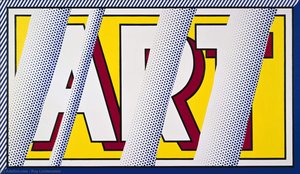 Reflections Art
Reflections Art: A Bold Exploration of Pop Aesthetic Roy Lichtenstein’s “Reflections Art,” created in 1988, stands as a testament to the enduring influence of Pop Art on twentieth-century visual culture. This oil painting embodies Lichtenstein's sign...
Today, we look back at the works of the Pop era not merely as historical artifacts, but as enduring symbols of a transformative moment in human creativity. The textures of the Ben-Day dot and the bold weight of the silk screen have become iconic elements of our visual heritage. As collectors and students of art history, there is a profound desire to preserve this legacy—to keep the vibrant energy and the mechanical soul of these masterpieces alive for future generations.
The challenge in preserving such an aesthetic lies in capturing the tension between the flat, graphic surface and the tactile reality of the medium. While modern technology allows us to view these works in high-definition digital formats, nothing can truly replicate the physical presence of a hand-painted reproduction that honors the original's intent. To appreciate the true depth of a Lichtenstein or the rhythmic precision of a screen print, one must engage with the interplay of light and pigment that exists only on a physical canvas.
As we continue to navigate an era of digital saturation, the lessons of Pop Art remain more relevant than ever. The movement taught us to find beauty in the mechanical, meaning in the mass-produced, and art in the everyday. Whether through the study of historical archives or the acquisition of museum-quality reproductions, the mission remains the same: to ensure that the bold, dot-filled revolution of the 1960s continues to inspire awe and contemplation in the modern age.