
The Post-War Shift: From Abstract Expressionism to Pop Iconography
 Beyond the Ben-Day Dots: Roy Lichtenstein's Pop Art Revolution & Enduring Legacy
The Precursors to Pop: Challenging Artistic Conventions Pop art Pop art is an art movement that emerged in the United Kingdom and the United States during the mid- to late 1950s. The movement presented a challenge to traditions of fine art by includi...
To understand the seismic shift brought about by Roy Lichtenstein, one must first contemplate the heavy, emotive atmosphere of the post-war era. Before his arrival, the art world was dominated by the profound, often turbulent landscapes of Abstract Expressionism. Figures such as Jackson Pollock and Mark Rothko had established a visual language rooted in subjective emotion, spontaneous gesture, and the pursuit of universal truths through non-representational forms. The canvas was a site of existential struggle, where every drip and sweep of paint served as a direct conduit to the artist's internal psyche.
However, by the mid-1950s, a subtle undercurrent of dissatisfaction began to ripple through the artistic community. There was a growing yearning for an art that could reflect the burgeoning consumer culture and the tangible realities of a rapidly modernizing America. While pioneers like Jasper Johns and Robert Rauschenberg had begun to introduce recognizable symbols—flags, maps, and newspaper clippings—into their work, it was Lichtenstein who would ultimately dismantle the hierarchy between high and low art. He moved away from the internal world of the artist toward the external, vibrant, and often overlooked world of mass media, transforming the disposable imagery of comic books and advertising into a sophisticated subject for serious contemplation.
The Mechanics of Perception: The Ben-Day Dot as a Visual Language
 Beyond the Dot: Exploring the Bold Impact of Ben-Day Dots in Modern Art
The Mechanics of Perception: Understanding the Ben-Day Dot To look closely at a masterpiece of Pop Art is to witness a fascinating optical illusion, a dance between what the eye perceives and what the mind interprets. At the heart of this phenomenon ...
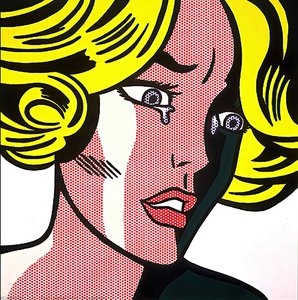
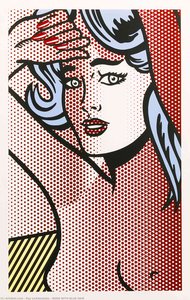
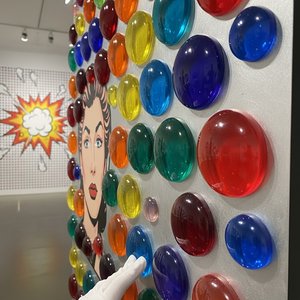
At the heart of Lichtenstein’s revolutionary aesthetic lies a fascinating optical illusion—a dance between what the eye perceives and what the mind interprets. This phenomenon is anchored by the Ben-Day dot, a printing technique originally engineered for the humble world of newsprint and inexpensive comic books. These tiny, rhythmic clusters of color were never intended to be viewed as individual points; rather, they were designed to blend seamlessly when seen from a distance, creating the illusion of continuous tone, shading, and secondary hues.
Lichtenstein’s genius was in his ability to elevate this mechanical process into a deliberate artistic tool. By meticulously recreating these dots on canvas, he achieved a sense of depth and texture that mimicked the very commercial processes he sought to critique. This technique creates a mosaic effect, where the viewer is caught in a loop of perception: up close, one sees the artificiality of the dot; from a distance, one sees a fully realized, albeit stylized, image. It is through this mechanical mimicry that Lichtenontstein challenged the "hand-made" sanctity of fine art, forcing the observer to confront the pervasive influence of mass-produced visual language on our collective consciousness.
Primary Emotions: Analyzing Lichtenstein's Use of Bold Color Theory
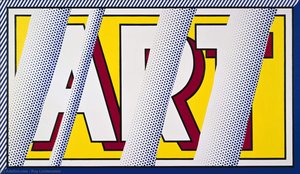 Reflections Art
Reflections Art: A Bold Exploration of Pop Aesthetic Roy Lichtenstein’s “Reflections Art,” created in 1988, stands as a testament to the enduring influence of Pop Art on twentieth-century visual culture. This oil painting embodies Lichtenstein's sign...
The psychological impact of a Lichtenstein masterpiece is often immediate, driven by a palette that refuses to be ignored. His work leans heavily on the power of primary colors—red, yellow, and blue—often set against stark black outlines and crisp white spaces. This use of color is not merely decorative; it is a calculated strategy to evoke the directness of commercial printing while intensifying the emotional resonance of his subjects.
Consider, for instance, his Reflections Art, where a heavy reliance on yellow hues is contrasted against a calming blue border. This tension between warmth and coolness enhances the visual impact, drawing the eye into a structured, almost architectural composition. In works like Woman in a Wheelchair, the cool blue of a garment can contrast sharply with warmer background tones to intensify a sense of isolation or vulnerability. By stripping away the complex gradients found in traditional oil painting and replacing them with flat, saturated planes of color, Lichtenstein achieved a clarity that is both visually arresting and psychologically profound, using the most basic elements of the spectrum to communicate complex human states.
Subverting the Narrative: Deconstructing Historical and Comic Imagery
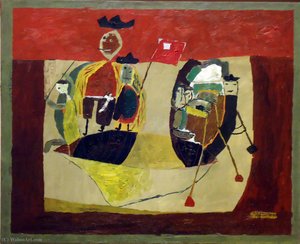 Washington crossing delaware
Washington Crossing Delaware: A Pop Art Reinterpretation of History Roy Lichtenstein’s *Washington Crossing Delaware* stands as a pivotal artwork, encapsulating the spirit of Pop Art while simultaneously interrogating its relationship to historical n...
Lichtenstein’s brilliance extended far beyond simple imitation; he was a master of recontextualization. He possessed an uncanny ability to take established historical narratives or dramatic comic book panels and dismantle them, reconstructing them through a lens of modern irony. A striking example is his Washington Crossing the Delaware. In this work, he does not merely recreate Emanuel Leutze’s monumental patriotic painting; instead, he deconstructs it, using a visual vocabulary borrowed from advertising to interrogate how history itself is presented and perceived as a constructed narrative.
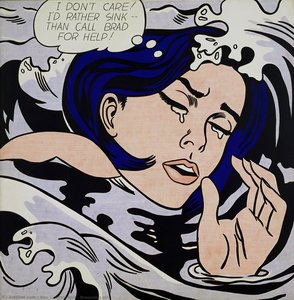
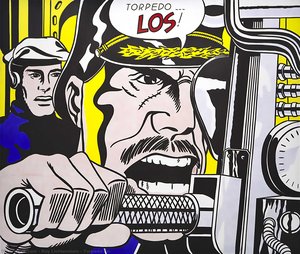
This subversion is equally evident in his engagement with the melodrama of comic strips. By isolating a single moment of intense emotion—a tearful farewell or a heroic confrontation—and rendering it with the clinical precision of a printing press, he creates a tension between the "low" subject matter and the "high" art format. He takes the ephemeral, often sensationalist imagery of popular culture and grants it a permanence and gravity that forces the viewer to reconsider the authenticity of artistic expression in an age of mass reproduction.
The Intersection of Mass Media and Fine Art: A Psychological Critique
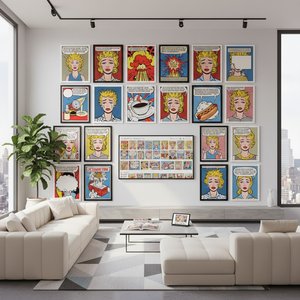 Roy Lichtenstein's Masterpieces: 25 Iconic Pop Artworks for Your Home | ArtsDot
Introduction To embark on a journey through the top 25 artworks of Roy Lichtenstein is to enter a world where the boundaries between high art and popular culture dissolve, replaced by bold lines, vibrant colors, and an audacious commentary on America...
Ultimately, Lichtenstein’s oeuvre serves as a profound meditation on the relationship between art, commerce, and society. His work emerged during a period of significant cultural upheaval in post-war America—an era characterized by unprecedented economic prosperity, the rise of advertising, and an explosion of youth culture. By appropriating imagery from these sources, he did not simply reflect his era; he actively interrogated it.
His paintings act as a mirror to a society grappling with the pervasive influence of mass media. Through the use of simplified forms and commercial aesthetics, he prompts us to question how much of our own identity and perception is shaped by the ubiquitous images of consumer culture. There is a subtle critique embedded in his work regarding societal expectations and the way mass-produced imagery can flatten complex human experiences into digestible, consumable icons. He invites us to look past the surface of the "pop" aesthetic to find the deeper, often unsettling, truths about our dependence on the visual language of the marketplace.
Preserving the Pop Legacy: The Enduring Impact of Lichtenstein’s Aesthetic
 Roy Lichtenstein
The Genesis of a Pop Visionary Roy Fox Lichtenstein, born in the vibrant metropolis of New York City on October 27, 1923, indelibly altered the landscape of twentieth-century art. Emerging as a pivotal figure within the Pop Art movement, Lichtenstein...
The legacy of Roy Lichtenstein continues to resonate across the landscape of contemporary art and design. His ability to dissolve the boundaries between high culture and popular imagery paved the way for countless artists to explore the intersections of identity, media, and consumerism. Today, we see his influence in everything from graphic design and advertising to the bold, iconographic styles of modern street art.
For the student of art history and the dedicated collector alike, Lichtenstein’s work remains a vital touchstone for understanding the evolution of twentieth-century visual culture. His mastery of technique—the precision of the line, the strategic use of the Ben-Day dot, and the psychological weight of his primary palette—ensures that his contributions are not merely historical footnotes, but living, breathing components of our modern aesthetic experience. To study Lichtenstein is to study the very mechanics of how we see, interpret, and find meaning in a world saturated with images.
At ArtsDot.com, we are dedicated to preserving the profound impact of history's greatest artists. We offer museum-quality, hand-painted oil reproductions that capture the true essence of masterpieces like those of Lichtenstein. Our master artists utilize traditional techniques on 100% cotton canvas to ensure every brushstroke and color nuance is authentically rendered. Whether you are looking to adorn your home with a bold Pop Art statement or seeking a custom commission that reimagines history, our collection provides an unparalleled gateway to the world's most iconic works of art.