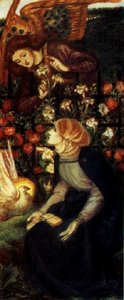
Introduction: The Enduring Appeal of Spiritual Seeking in Art
From the earliest cave paintings to the grand frescoes of the Renaissance, art has served as a profound vehicle for humanity’s enduring quest for meaning and connection with something beyond the tangible world. This impulse—to visualize the invisible, to grapple with existential questions, and to express the ineffable—lies at the heart of countless masterpieces. Throughout history, artists have not merely depicted religious narratives or spiritual figures; they've translated complex theological concepts into visual languages that resonate across cultures and generations. The power of these works stems from their ability to tap into universal human experiences – longing, faith, doubt, and the search for transcendence. This exploration delves into how various artistic movements have approached this fundamental theme, revealing a fascinating interplay between belief, symbolism, and aesthetic expression.
Early Christian Symbolism: Icons as Windows to the Divine
The nascent stages of Christianity, often unfolding in secrecy amidst persecution, gave rise to a unique visual vocabulary. Early Christian art wasn’t about realistic representation; it was about conveying coded messages understood by initiates. Before grand basilicas and elaborate frescoes, symbols reigned supreme. The fish (ichthys), for example, served as a discreet identifier among believers, its acronym representing “Jesus Christ Son of God Savior.” But beyond these simple emblems lay a sophisticated system of iconography designed to communicate complex theological ideas. Images of the Good Shepherd evoked Psalm 23 and the protective care of Christ, while early depictions of Mary often featured her as the Hodegetria, ‘She who shows the way,’ pointing towards Jesus as the path to salvation. These weren’t merely portraits; they were windows into a divine realm, intended to inspire contemplation and reinforce faith in a time when open expression was dangerous. The focus wasn't on capturing physical likeness but on conveying spiritual truth through carefully chosen motifs.
Renaissance Visions of Faith & Sacrifice: Titian and Fra Angelico
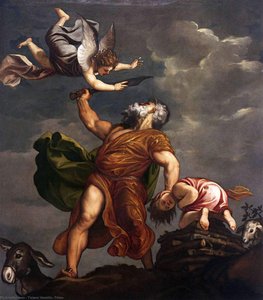 Sacrifice of Isaac
Obelisk Art History date: 2024-11-01 --- The Sacrifice of Isaac is an Italian Renaissance Oil on Canvas Painting created by Titian from 1542 to 1544. It lives at the Santa Maria della Salute in Italy. The image is in the Public Domain
The Renaissance witnessed a renewed interest in classical forms and humanism, yet the exploration of faith remained central to artistic production. Artists like Fra Angelico infused their work with a delicate piety, exemplified in his haunting “The Mockery of Christ.” This painting isn’t simply a depiction of suffering; it's a meditation on humility, betrayal, and the divine sacrifice. The composition, though seemingly straightforward, is laden with symbolism – the cold stone floor representing earthly hardship, the mocking figures embodying human cruelty, and Christ’s serene expression hinting at his unwavering faith. Simultaneously, Titian’s “Sacrifice of Isaac” presents a dramatically different approach. Painted decades later, it showcases the Renaissance mastery of oil painting—the rich textures, dynamic composition, and emotional intensity are breathtaking. However, beneath the technical brilliance lies a profound exploration of obedience, divine intervention, and the agonizing tension between faith and reason. Both artists, though distinct in style, demonstrate the Renaissance’s commitment to portraying religious narratives with both artistic skill and theological depth.
Pre-Raphaelite Brotherhood and the Quest for Chivalric Spirituality
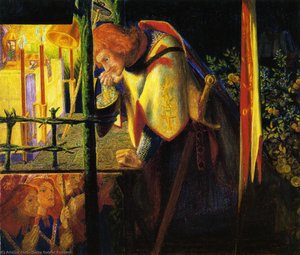 Sir Galahad at the Ruined Chapel
Delve into Dante Gabriel Rossetti's 'Sir Galahad at the Ruined Chapel,' a haunting watercolor capturing chivalry and spirituality amidst decaying grandeur. Explore Pre-Raphaelite artistry & symbolism.
In the mid-19th century, the Pre-Raphaelite Brotherhood rebelled against the perceived artificiality of academic art, seeking inspiration in the medieval world and early Renaissance masters. Their fascination with Arthurian legends wasn’t merely a romantic indulgence; it was a quest for a lost spirituality rooted in chivalry, honor, and devotion. Dante Gabriel Rossetti's “Sir Galahad at the Ruined Chapel” perfectly encapsulates this ethos. The painting depicts Sir Galahad, having witnessed the Holy Grail, kneeling amidst decaying grandeur. The ruined chapel symbolizes the fragility of earthly institutions and the enduring power of spiritual vision. Rossetti’s use of watercolor creates a haunting atmosphere, emphasizing the ethereal quality of Galahad's experience. The symbolism is layered – the sword representing his knightly virtue, the light filtering through the ruins signifying divine grace, and Galahad’s contemplative pose suggesting an internal transformation. The Pre-Raphaelites sought to revive a sense of genuine religious feeling through meticulous detail and evocative imagery.
Russian Symbolism: Nesterov and the Landscapes of Inner Life
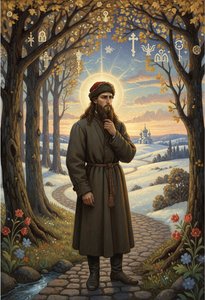 Mikhail Nesterov: Spiritual Quests & Symbolic Landscapes of Russian Symbolism
Explore the captivating world of Mikhail Nesterov, a pioneer of Russian Symbolism. Discover his spiritual themes, iconic paintings like 'The Hermit,' and lasting influence on Russian art history. Learn more at ArtsDot.
At the turn of the 20th century, Russian Symbolism emerged as a distinct artistic movement deeply concerned with spiritual themes. Artists like Mikhail Nesterov rejected Western materialism in favor of exploring inner states of consciousness and the mystical dimensions of Russian Orthodoxy. His iconic painting “The Hermit” exemplifies this approach. The image depicts a solitary monk immersed in prayer amidst a stark, symbolic landscape. Nesterov’s use of muted colors and simplified forms creates an atmosphere of profound stillness and contemplation. The landscape itself isn't merely a backdrop; it reflects the hermit’s internal world – the barren trees representing spiritual austerity, the distant light symbolizing divine illumination. Nesterov wasn’t interested in depicting literal religious scenes but rather in capturing the essence of spiritual experience—the longing for connection with the divine and the search for meaning in a chaotic world. His work often features figures lost in thought or prayer, embodying the Russian Symbolist emphasis on introspection and the power of faith.
Conclusion: Art as a Mirror to Humanity’s Spiritual Evolution
Throughout art history, the depiction of spiritual quests has taken myriad forms, reflecting the evolving beliefs, values, and aesthetic sensibilities of different cultures and eras. From the coded symbols of early Christianity to the dramatic narratives of the Renaissance and the introspective landscapes of Russian Symbolism, artists have consistently sought to visualize the invisible, grapple with existential questions, and express the ineffable. These works are not simply relics of the past; they remain potent reminders of humanity’s enduring search for meaning and connection. At ArtsDot.com, we believe that art has the power to transcend time and space, offering a glimpse into the deepest recesses of the human soul and inspiring contemplation on our own spiritual journeys.