 Preview
 Send
Send Share
Share
 Details

 Download
 Similars
 X-Ray
X-Ray Diaporama
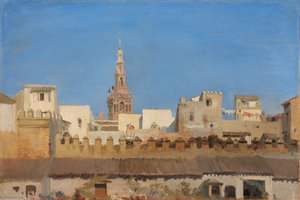
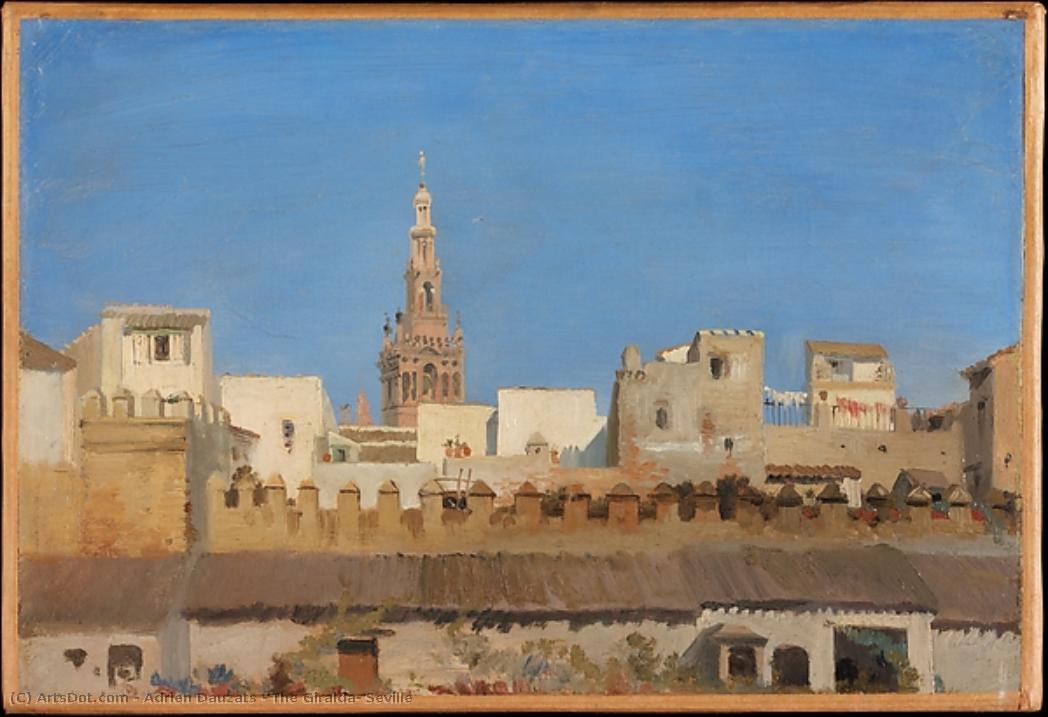
The Giralda, Seville
 Acrylic On Canvas
- WallArt
- Orientalist Painting
 1836
1836 21.0 x 30.0 cm
 Metropolitan Museum of Art
 Read More
Hand Made Oil Reproduction
Hand-painted oil on canvas in your size and frame, made to order by our artists. ( Buy Print Buy Image)




P118B $10

P118H $10

P118W $10

P438Z $10

P508JH $12

P508YH $12

P805H $10

P805Z $10

P919BZ $10

P919G $10

P919XJ $10

P959ZH $10

P968JZ $12

W106C $8

W218G $10

W218JH $8

W218Y $10

W307PJ $10

W316G $10

W316PJ $8

W316Y $10

W398PJ $8

W4111J $10

W500HY $15

W500JH $15

W692G $12

W849H $8

W940BG $15

W953PJ $8




Pick from our preset sizes that match the artwork's original proportions.

You may enter your own dimensions to fit a specific frame or space. If your selected size does not match the original image's proportions, we will either crop the artwork or extend the painting with additional hand-painted elements. A digital mockup will be sent for your approval before production begins.
Please note that the on-screen preview does not reflect the actual cropping or extension. Only the mockup will accurately show the final composition.
While custom sizes are available, we recommend selecting a dimension from the predefined list to preserve the original proportions.
After order, ArtsDot.com team will email client for instructions and provide a mockup preview
Worldwide Delivery () in 3/4 weeks instead of standard 5 weeks. (17 August). No compromise on quality.

Free Worldwide Express Shipping

High-Quality Linen Canvas

Full Shipping Insurance

Customs Tax Refund Guarantee

True Color Matching Guarantee

60-Day Return Policy (Defects Only)

100% Money-Back Guarantee

Bulk Discount Offer
 Glass option is only available in size under 110 CM

The Giralda, Seville
Reproduction Medium
Reproduction Size
-


Total Price
$ 263
Artwork Description
A Moment of Andalusian Grace: Adrien Dauzats’ “The Giralda, Seville”
Adrien Dauzats' "The Giralda, Seville" isn't merely a depiction of a cathedral tower; it’s a captured breath of 19th-century Spain, a fleeting impression of life unfolding beneath the watchful gaze of this iconic landmark. Painted in 1836, during his travels with Baron Isidore Taylor – a pivotal figure in introducing European artistic sensibilities to the burgeoning world of travel and exoticism – the canvas offers a remarkably intimate view of Seville’s heart. It's as if Dauzats has stepped directly from a bustling street corner, pausing to sketch this vibrant scene, imbuing it with an immediacy rarely found in grand historical paintings.

A Window into a Changing World
Dauzats’ work reflects the fascinating intersection of artistic trends and cultural exchange during this period. His travels with Baron Taylor were instrumental in broadening European appreciation for Eastern art and landscapes, influencing artists like Turner and Friedrich. The painting itself embodies the Romantic fascination with travel, documenting not just a place but also the experience of being *there*. It’s a testament to the burgeoning interest in Spain as a source of exotic beauty and historical grandeur – fueled by the ongoing expansion of Spanish colonial power and trade.
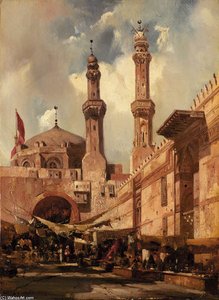
The Giralda, once the minaret of Seville's mosque, now dominates the composition. Its intricate details—the delicate arcades, the sculpted ornamentation—are rendered with meticulous precision, yet Dauzats doesn’t shy away from capturing the play of light and shadow, lending a sense of dynamism to the structure. The surrounding buildings, bathed in warm afternoon hues, contribute to the overall atmosphere of vibrant life. Notice how the artist has subtly incorporated everyday figures – merchants, laborers, perhaps even a young couple strolling along the street—creating a believable tableau of Seville’s daily rhythm.
The Language of Color and Light
Dauzats' technique is characterized by a loose, impressionistic style. He employs broken brushstrokes to capture the fleeting effects of light on the stone surfaces, creating a shimmering quality that is both captivating and remarkably realistic. The palette is rich and warm—deep ochres, burnt siennas, and hints of turquoise – evoking the heat and color of the Andalusian sun. The artist’s use of atmospheric perspective subtly recedes into the distance, drawing the viewer's eye towards the imposing silhouette of the Giralda.
Symbolism and Legacy
More than just a picturesque scene, “The Giralda, Seville” speaks to themes of cultural exchange, historical transformation, and the beauty of everyday life. The Giralda itself is a potent symbol—a testament to Seville’s layered history as a center of Islamic learning, Christian conquest, and ultimately, European influence. Dauzats' painting serves as a visual record of this complex legacy, inviting us to contemplate the enduring spirit of this remarkable city. Reproductions of this work offer a tangible connection to a pivotal moment in art history and a captivating glimpse into the soul of Seville.
Related Artworks
Artist Biography
A Life of Travel and Artistic Observation
Adrien Dauzats, born in Bordeaux, France in 1804, was a painter whose life unfolded as a compelling narrative of artistic exploration and meticulous observation. His father’s profession as a scenery painter at a local theatre sparked an early fascination with visual representation within young Adrien, laying the foundation for a career deeply rooted in capturing the world around him. He received his initial formal training under Lacour at the École de Dessin in Bordeaux, honing essential skills in drawing and composition that would serve him throughout his artistic journey. Even in these early stages, Dauzats demonstrated versatility, exhibiting genre subjects and interiors of churches while simultaneously practicing lithography – a testament to his burgeoning talent and willingness to explore diverse mediums.The Orient Beckons: Collaboration with Baron Taylor
A pivotal moment arrived when Dauzats embarked on expeditions to the Middle East alongside the intrepid travel writer, Baron Taylor, beginning around 1829. These journeys weren’t merely sightseeing tours; they were immersive experiences that took them through Egypt, Syria, Mount Sinai, Palestine, and beyond. Dauzats's primary role during these travels was to create illustrations for Taylor’s ambitious travel books – including *Voyages Pittoresques et Romantiques de l'ancienne France*, *Voyage Pittoresque en Espagne, en Portugal, et sur la côte d'Afrique*, and the expansive *La Syrie, I'Egypte, la Palestine et la Judée*. This collaboration proved transformative. Dauzats wasn’t simply recording what he saw; he was striving for a level of accuracy previously unseen in depictions of the Orient. He aimed to portray landscapes and cultural details with “scrupulous exactitude and impartiality,” setting him apart from contemporaries who often romanticized or exoticized their subjects. His experiences profoundly influenced his artistic style, leading him to produce works characterized by detailed renderings of architecture, local customs, and sweeping landscapes – a commitment to realism that defined his approach to Orientalist art. This period also saw the co-authorship with Alexandre Dumas Sr. of *Quinze Jours au Sinai*, a travelogue distinguished by Dauzats’s artistic vision, offering a unique perspective on the region.Spanish Sojourns and Algerian Commissions
Dauzats's travels weren’t limited to the Middle East. A trip to Spain with Baron Taylor in 1835-1837 introduced him to Pharamond Blanchard, who facilitated introductions to the influential de Madrazo family – a cornerstone of Spanish art at the time. He spent considerable time immersed in the Spanish artistic milieu, meeting prominent artists and developing a keen appreciation for Spanish painting traditions. This exposure broadened his artistic horizons and subtly influenced his evolving style. Later, in 1839, Dauzats received a prestigious commission from King Louis-Philippe to join a military and diplomatic expedition to Algeria. He was tasked with creating five watercolors depicting French military exploits – a significant undertaking that marked one of his final major voyages. This commission demonstrates the growing recognition of his talent and his ability to capture both the grandeur of landscapes and the drama of historical events.Legacy and the Unfinished Masterpiece
In 1868, Dauzats received a fascinating, yet ultimately incomplete, commission: to create illustrations based on characters from *One Thousand and One Nights*. He completed the initial sketch for *Sinbad the Sailor*, but his untimely death intervened before he could finish the project. This unfinished work became the subject of legal contention, with his estate refusing to release it due to a stipulation in his will prohibiting the public display of incomplete works. Despite this final chapter, Dauzats’s legacy as a pioneer of Orientalist art remains secure. He is remembered for his commitment to accuracy, his meticulous attention to detail, and his ability to capture the essence of distant lands with remarkable fidelity. Following his death, his sketchbooks, artworks, and extensive library were sold at auction in Paris, preserving a valuable record of his travels and artistic endeavors. Today, his works are held in esteemed institutions such as the Musée des Beaux-Arts d’Orléans, ensuring that his contributions to 19th-century art continue to be appreciated by generations to come. Dauzats stands as a testament to the power of travel, observation, and artistic dedication – an artist who sought not merely to depict the world, but to understand it with unwavering precision and impartiality.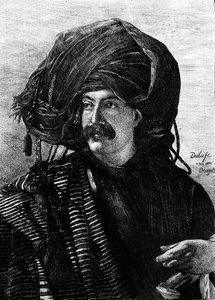
Adrien Dauzats
1804 - 1868 , France
Quick Facts
- Artistic Movement Or Style: Orientalism
- Artists Or Movements Influenced By This Artist: ['Early Orientalist artists']
- Date Of Birth: 1804
- Date Of Death: 1868
- Full Name: Adrien Dauzats
- Nationality: French
- Notable Artworks:
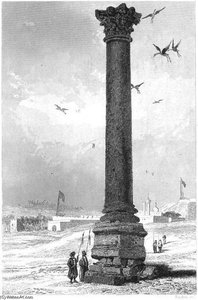
- Pompey's Pillar
- Well of Moses
- Beauvais Abbey Church
- Place Of Birth: Bordeaux, France
Related Articles
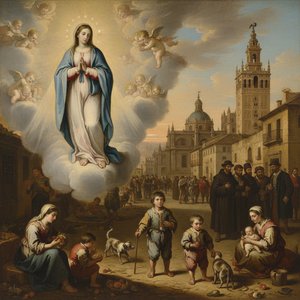
Bartolomé Esteban Murillo: Divine Light & Social Commentary in Golden Age Seville
Explore the captivating world of Bartolomé Esteban Murillo, a master of Spanish Baroque painting. Discover his luminous religious scenes, tender genre paintings & lasting legacy in Golden Age Seville. Learn more at ArtsDot.
The Shadow of Faith: Exploring Gothic Art's Spiritual Intensity & Architectural Innovation
Explore the spiritual intensity & architectural innovation of Gothic art! Discover the symbolism behind cathedrals, stained glass & master artists like Giotto and Monet. A deep dive into medieval history & artistic expression.
José Gutiérrez Solana: A Chronicle of Spanish Society Through Expressionist Vision
Explore the captivating world of José Gutiérrez Solana, a pivotal Spanish Expressionist painter. Discover his haunting depictions of early 20th-century Spain, influenced by Goya & El Greco. Learn about his key works and lasting legacy.
Monet's Masterpieces: 25 Iconic Artworks to Transform Your Home
Journey through 25 iconic Claude Monet masterpieces! Explore Impressionism’s beauty, from Water Lilies to Rouen Cathedral. Discover stunning art reproductions & curated decor ideas – explore the full collection online at ArtsDot.com.
Juan de Valdés Leal: Baroque Realism, Memento Mori & Theatricality of Spanish Grief
Explore the powerful Baroque realism of Juan de Valdés Leal (1622-1690). Discover his somber masterpieces, iconic 'In Ictu Oculi', and profound explorations of mortality. Museum-quality reproductions available at ArtsDot.