 Preview
 Send
Send Share
Share
 Details

 Download
 Similars
 X-Ray
X-Ray Diaporama
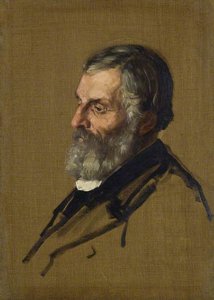
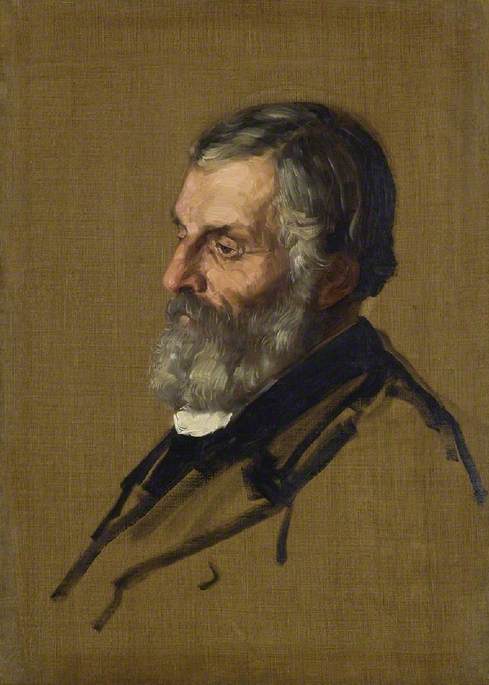
The Reverend Robert Burn
 Oil On Canvas
- WallArt
- Contemporary Realism
 1880
1880- 19th Century
 64.0 x 46.0 cm
 Fitzwilliam College
 Read More
Hand Made Oil Reproduction
Hand-painted oil on canvas in your size and frame, made to order by our artists. ( Buy Print Buy Image)




P118B $10

P118H $10

P118W $10

P438Z $10

P508JH $12

P508YH $12

P805H $10

P805Z $10

P919BZ $10

P919G $10

P919XJ $10

P959ZH $10

P968JZ $12

W106C $8

W218G $10

W218JH $8

W218Y $10

W307PJ $10

W316G $10

W316PJ $8

W316Y $10

W398PJ $8

W4111J $10

W500HY $15

W500JH $15

W692G $12

W849H $8

W940BG $15

W953PJ $8




Pick from our preset sizes that match the artwork's original proportions.

You may enter your own dimensions to fit a specific frame or space. If your selected size does not match the original image's proportions, we will either crop the artwork or extend the painting with additional hand-painted elements. A digital mockup will be sent for your approval before production begins.
Please note that the on-screen preview does not reflect the actual cropping or extension. Only the mockup will accurately show the final composition.
While custom sizes are available, we recommend selecting a dimension from the predefined list to preserve the original proportions.
After order, ArtsDot.com team will email client for instructions and provide a mockup preview
Worldwide Delivery () in 3/4 weeks instead of standard 5 weeks. (16 August). No compromise on quality.

Free Worldwide Express Shipping

High-Quality Linen Canvas

Full Shipping Insurance

Customs Tax Refund Guarantee

True Color Matching Guarantee

60-Day Return Policy (Defects Only)

100% Money-Back Guarantee

Bulk Discount Offer
 Glass option is only available in size under 110 CM

The Reverend Robert Burn
Reproduction Medium
Reproduction Size
-


Total Price
$ 263
Artwork Description
A Portrait of Quiet Dignity: Alphonse Legros’ “The Reverend Robert Burn”
Alphonse Legros' "The Reverend Robert Burn," painted in 1880, is more than just a portrait; it’s a carefully constructed tableau of Victorian sensibilities and the quiet contemplation of a man steeped in faith. This oil-on-canvas work, currently residing within The Fitzwilliam Museum’s collection, offers a glimpse into a bygone era – an era defined by meticulous detail, restrained emotion, and a profound respect for tradition. Legros, a French-British artist who later found his home in London, masterfully captures the essence of his subject, not merely through likeness but through a subtle orchestration of form, light, and color that speaks volumes about character and inner life.
The painting depicts an older gentleman, identified as “The Reverend Robert Burn,” seated in a simple chair. His face, etched with lines of experience and wisdom, is the focal point of the composition. Legros’s realism is immediately apparent; every wrinkle, every strand of grey hair, every slight asymmetry of the features is rendered with painstaking accuracy. Yet, it's not merely a photographic representation. The artist skillfully employs modeling – building up forms through layers of paint – to create a sense of volume and depth, giving the Reverend’s face a tangible presence that draws the viewer in. Notice how the light catches on his cheekbones, highlighting their structure and casting subtle shadows beneath his eyes, hinting at both age and a contemplative spirit.
The Academic Realism and its Roots
Legros' style firmly resides within the realm of academic realism, a movement that sought to emulate the techniques and subject matter of Renaissance masters. This approach prioritized meticulous observation, anatomical accuracy, and a commitment to depicting reality as it is perceived – without resorting to subjective interpretation or expressive distortion. His training at the Dijon art school and his early work as a house decorator instilled in him a deep understanding of materials and form, which he expertly translates onto canvas. The influence of 19th-century portraiture, particularly the works of David and Ingres, is evident in the painting’s formal structure – the balanced composition, the careful attention to detail, and the dignified pose of the subject.
Furthermore, Legros' journey as an artist reflects a broader shift in artistic identity. Initially trained in France, he later embraced British culture and was naturalized as a British subject. This transition is subtly reflected in his work – a blending of French technical skill with a distinctly English sensibility. The muted color palette, dominated by earthy browns, greys, and ochres, evokes the somber atmosphere of Victorian England, while the Reverend’s attire—a dark robe and simple furnishings—underscores the seriousness and solemnity of his role.
Symbolism and Emotional Resonance
Beyond its technical merits, “The Reverend Robert Burn” is rich in symbolic meaning. The subject's age and appearance immediately evoke associations with wisdom, experience, and faith – qualities traditionally associated with religious leaders. The Reverend’s gaze, directed slightly off-camera, suggests a quiet introspection, as if he is lost in thought or contemplating the mysteries of his beliefs. The simplicity of the setting—a plain chair and a dark background—further emphasizes the subject's inner world, stripping away any distractions and focusing attention on his character.
The painting’s emotional impact is one of quiet dignity and melancholy. It doesn’t shout for attention; instead, it invites contemplation and reflection. The subdued colors and careful rendering create a sense of stillness and solemnity, while the subject's face conveys a profound depth of feeling—a mixture of serenity, wisdom, and perhaps a hint of sadness. It is a portrait that lingers in the mind long after it has been viewed, prompting viewers to consider the complexities of human experience and the enduring power of faith.
A Legacy of Skill and Influence
Alphonse Legros’s “The Reverend Robert Burn” stands as a testament to his artistic skill and his ability to capture the essence of his subject. His work, alongside that of other Slade School teachers like Whistler and Rodin, played a pivotal role in shaping the British art scene during the late 19th century. Legros’s legacy extends beyond this single painting; he was also a dedicated teacher who nurtured the talents of numerous young artists, including several prominent women known as “The Slade Girls,” who went on to achieve considerable success in their own right. Reproductions of this evocative portrait continue to be appreciated for its technical mastery and profound emotional resonance, offering a window into a fascinating period of artistic and cultural history.
Related Artworks
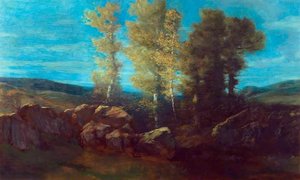
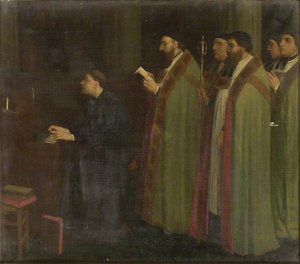
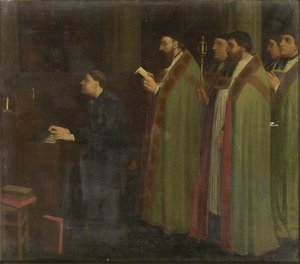
Artist Biography
A Life Bridging Nations: The Artistic Journey of Alphonse Legros
Alphonse Legros, born in Dijon, France, in 1837, was an artist whose life and work embodied a fascinating intersection of artistic movements and national identities. His path wasn’t one of immediate acclaim but rather a gradual unfolding of talent nurtured by dedicated study and a willingness to embrace evolving aesthetic ideals. From humble beginnings as the son of an accountant in Véronnes, young Alphonse found early inspiration in the rural landscapes surrounding his family, scenes that would later permeate much of his artistic output. His initial training began at the Dijon art school, apprenticed to a house decorator, a grounding experience that instilled a practical understanding of materials and form. This was followed by a period as a journeyman wall-painter in Lyon, honing his skills while contributing to larger decorative projects. These formative years weren’t merely about technical proficiency; they were about absorbing the world around him – the textures of rural life, the play of light on stone, the dignity of everyday labor—elements that would become hallmarks of his mature style.From Realism to Etching Revival: Artistic Development and Influences
Legros’s arrival in Paris in 1851 marked a turning point. He immersed himself in the vibrant artistic milieu, studying with Charles-Antoine Cambon, a scene painter, and attending the prestigious drawing school of Lecoq de Boisbaudran, where he encountered fellow artists like Auguste Rodin and Jules Dalou. This period saw his first forays into the Salon system, gaining recognition for portraits that caught the eye of influential figures like Champfleury, who championed the Realist movement led by Gustave Courbet. Legros’s early work, such as *L'Angelus* (1859), demonstrated a commitment to depicting scenes from everyday life with honesty and emotional depth. However, it was his exploration of etching that truly set him apart. He essentially taught himself this technique, captivated by its potential for capturing subtle nuances of tone and texture. This dedication would eventually lead him to become a pivotal figure in the British etching revival. In 1863, encouraged by James McNeill Whistler, Legros relocated to England, a decision that profoundly shaped his career. He quickly established himself as an influential teacher, first at the South Kensington School of Art and later as Slade Professor at University College London, nurturing generations of artists in the art of etching.A Master of Multiple Mediums: Painting, Sculpture, and Medals
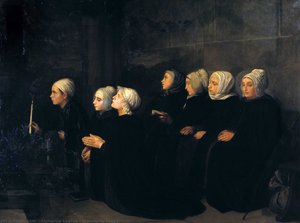
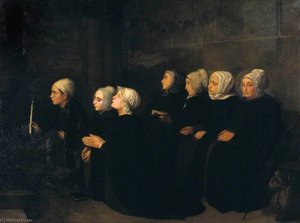
While Legros is often celebrated for his etchings, to define him solely by this medium would be a disservice to his multifaceted talent. He was equally adept as a painter and sculptor, and also created notable medals. His paintings frequently depicted scenes of religious devotion—interior church views with kneeling figures, capturing the quiet intensity of faith—and portraits that revealed a keen psychological insight into his subjects. These works are characterized by a restrained palette, meticulous detail, and a sense of solemnity. He wasn’t interested in grand narratives or flamboyant displays; instead, he focused on the intimate moments of human experience. His sculptural work, though less prolific than his paintings and etchings, demonstrated a similar commitment to realism and emotional depth. Furthermore, Legros's skill extended to the art of medal-making, producing pieces that were admired for their craftsmanship and artistic merit. He approached each medium with a dedication to technical mastery and a desire to convey profound meaning.Legacy and Historical Significance
Alphonse Legros died in Watford in 1911, leaving behind a rich legacy as both an artist and educator. His influence on the British art scene was considerable, particularly through his teaching at the Slade School of Art, where he instilled a rigorous approach to drawing and etching in countless students. He championed traditional artistic values—the importance of draftsmanship, careful observation, and technical skill—while also embracing new ideas and techniques. Legros’s work stands as a testament to the power of quiet contemplation and the enduring appeal of Realist aesthetics. His paintings and etchings can be found in prominent museums such as the Ashmolean Museum in Oxford and the Tate Gallery in London, ensuring that his artistic vision continues to inspire and captivate audiences today. He represents a bridge between French and British art traditions, embodying a commitment to both technical excellence and emotional honesty—qualities that continue to resonate with viewers and artists alike. His dedication to fostering artistic talent cemented his place as a pivotal figure in the development of modern British art.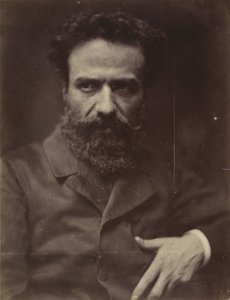
Alphonse Legros
1837 - 1911 , France
Quick Facts
- Artistic Movement Or Style: Realism
- Artists Or Movements Influenced By This Artist: ['Slade School artists']
- Artists Who Influenced This Artist:
- Gustave Courbet
- Charles-Antoine Cambon
- Date Of Birth: May 8, 1837
- Date Of Death: December 8, 1911
- Full Name: Alphonse Legros
- Nationality: French-British
- Notable Artworks:
- L'Angelus
- Interior with kneeling figures
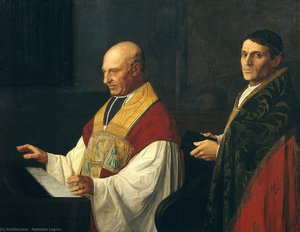
- Rehearsing the service
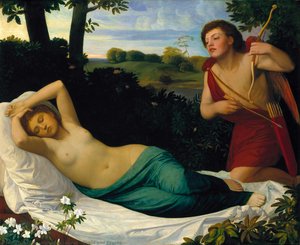
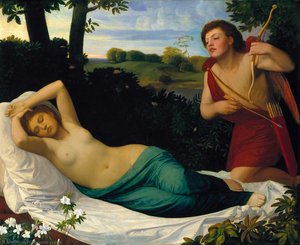
- Cupid and Psyche
- The Tinker
- Place Of Birth: Dijon, France
Related Articles
Academic Realism's Finest: 10 Masterpieces for Art Lovers & Home Decor
Explore 10 defining Academic Realism masterpieces by Bouguereau, Gérôme & Cabanel. Discover the stories behind these iconic paintings and bring timeless art into your home with museum-quality reproductions from ArtsDot.com. Explore the full collection online!

Academic Realism: Technique, History & Enduring Influence on Art
Explore the captivating world of Academic Realism! Discover key artists, techniques & its lasting impact on art history. Expert insights & high-quality reproductions at ArtsDot.

The Enduring Appeal of Realism: A Comprehensive Exploration of Representation in Art
Explore the captivating world of Realism! Discover key artists like Courbet, defining techniques & its lasting impact on art history. Expert insights and high-quality reproductions at ArtsDot.

Realism's Revolution: 10 Masterpieces That Changed Art |
Explore 10 defining Realism masterpieces – Courbet, Millet & more. Discover the stories behind these iconic paintings and their impact on art history. Find museum-quality reproductions for your home at !
Romantic Realism's Finest: 10 Masterpieces for Your Home | ArtsDot
Explore 10 defining masterpieces of Romantic Realism! Discover Courbet, Millet & Daumier's powerful paintings—capturing emotion and social realities. Find museum-quality reproductions for your home at ArtsDot.com.