 Preview
 Send
Send Share
Share
 Details

 Download
 Similars
 X-Ray
X-Ray Diaporama
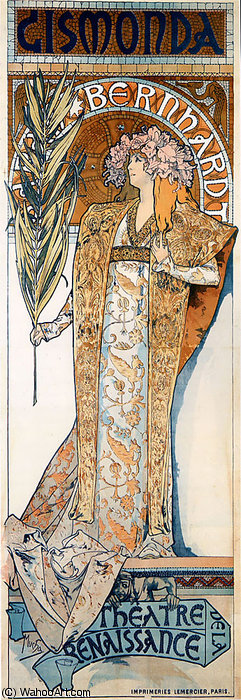
Gismonda
 Acrylic On Canvas
- WallArt
- Art Nouveau
 1894
1894 74.0 x 216.0 cm
 Read More
Hand Made Oil Reproduction
Hand-painted oil on canvas in your size and frame, made to order by our artists. ( Buy Print Buy Image)




P118B $10

P118H $10

P118W $10

P438Z $10

P508JH $12

P508YH $12

P805H $10

P805Z $10

P919BZ $10

P919G $10

P919XJ $10

P959ZH $10

P968JZ $12

W106C $8

W218G $10

W218JH $8

W218Y $10

W307PJ $10

W316G $10

W316PJ $8

W316Y $10

W398PJ $8

W4111J $10

W500HY $15

W500JH $15

W692G $12

W849H $8

W940BG $15

W953PJ $8




Pick from our preset sizes that match the artwork's original proportions.

You may enter your own dimensions to fit a specific frame or space. If your selected size does not match the original image's proportions, we will either crop the artwork or extend the painting with additional hand-painted elements. A digital mockup will be sent for your approval before production begins.
Please note that the on-screen preview does not reflect the actual cropping or extension. Only the mockup will accurately show the final composition.
While custom sizes are available, we recommend selecting a dimension from the predefined list to preserve the original proportions.
After order, ArtsDot.com team will email client for instructions and provide a mockup preview
Worldwide Delivery () in 3/4 weeks instead of standard 5 weeks. (17 August). No compromise on quality.

Free Worldwide Express Shipping

High-Quality Linen Canvas

Full Shipping Insurance

Customs Tax Refund Guarantee

True Color Matching Guarantee

60-Day Return Policy (Defects Only)

100% Money-Back Guarantee

Bulk Discount Offer
 Glass option is only available in size under 110 CM

Gismonda
Reproduction Medium
Reproduction Size
-


Total Price
$ 263
Artwork Description
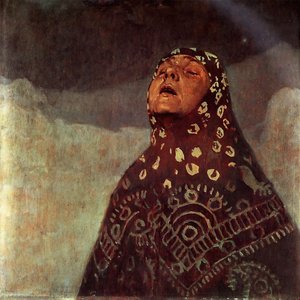
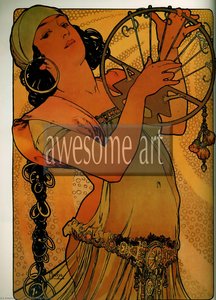
A Vision of Slavic Resilience: Alphonse Mucha’s Gismonda
Alphonse Maria Mucha's "Gismonda," completed in 1894, stands as a cornerstone of Art Nouveau aesthetics and embodies the spirit of Czech national identity during a turbulent period. More than just a portrait of a woman draped in opulent fabric—though undeniably striking—the painting delves into themes of strength, sorrow, and unwavering resolve against a backdrop of architectural grandeur. Mucha’s Parisian studio became a crucible for innovation, rejecting academic conventions to forge a path toward organic beauty and expressive dynamism.The Art Nouveau Aesthetic: Fluid Lines and Floral Flourishes
Mucha's signature style is instantly recognizable through its undulating curves—lines that mimic the flow of water or the petals of flowers—a deliberate departure from the rigid geometry favored by earlier artistic movements. The influence of artists like Pierre-Auguste Renoir and Gustave Moreau can be discerned in Mucha’s meticulous attention to detail, particularly his incorporation of botanical motifs. These blossoms aren't merely decorative; they serve as visual metaphors for femininity, fertility, and the enduring beauty of nature—concepts central to Art Nouveau’s broader philosophical agenda. The color palette is muted yet luminous, favoring shades of amber, olive green, and dusky rose to create an atmosphere of serene contemplation.Technical Mastery: Watercolor and Tempera on Canvas
“Gismonda” exemplifies Mucha's masterful technique, combining watercolor and tempera pigments on a canvas substrate. Watercolor provides the ethereal luminosity characteristic of Art Nouveau, capturing subtle gradations of color and diffusing light across the surface. Tempera, known for its durability and brilliance, lends solidity to the architectural elements—specifically the imposing building behind Gismonda—creating a harmonious contrast between delicacy and strength. Mucha painstakingly layered pigments, achieving remarkable tonal accuracy and textural richness. This meticulous process underscores his commitment to capturing not just visual appearance but also conveying emotional depth.Historical Context: Czech Nationalism Amidst Austro-Hungarian Rule
Painted during the Slavonic Uprising of 1893–94—a defiant assertion of Czech cultural autonomy against Habsburg dominion—the painting carries significant symbolic weight. Gismonda, representing Bohemia’s Queen Marie Valerie Wittelsbach, embodies resilience and dignity in the face of oppression. The architectural setting symbolizes the enduring legacy of Bohemian history and culture. Mucha's decision to blend traditional Czech motifs with Art Nouveau principles reflects a desire to express national pride while simultaneously embracing modern artistic sensibilities—a testament to the dynamism of Czech intellectual life at the turn of the century.Symbolism: Flowers, Light, and Female Idealization
The profusion of flowers—primarily lilies and orchids—is laden with symbolism. Lilies represent purity and resurrection, reflecting Marie Valerie’s unwavering faith amidst adversity. Orchids symbolize elegance and sophistication, mirroring Mucha's artistic vision. The diffused light emanating from the building illuminates Gismonda’s face, symbolizing enlightenment and spiritual grace—a recurring motif in Mucha’s oeuvre. Furthermore, Gismonda herself embodies the idealized feminine figure prevalent in Art Nouveau art: serene, contemplative, and possessing an inner strength that transcends outward appearances. She is a portrait not merely of a woman but of an ethos – one of unwavering courage and beauty amidst challenging circumstances.Emotional Impact: Contemplation and Remembrance
“Gismonda” compels viewers to pause and contemplate the complexities of human experience—the interplay between sorrow and fortitude, vulnerability and resilience. Mucha’s masterful composition draws the eye inward, inviting reflection on themes of loss, remembrance, and the enduring power of beauty. The painting's melancholic yet dignified atmosphere lingers long after viewing, serving as a poignant reminder of Czech history and artistic heritage. It is an artwork designed to inspire awe and provoke introspection—a timeless testament to Mucha’s artistic genius and Art Nouveau’s profound capacity for emotional resonance.Related Artworks

Artist Biography
Early Life and Education
- Born: July 15, 1860, in Ivanačice, Moravia (now part of the Czech Republic)
- Showed artistic talent from a young age.
- Studied at the Academy of Fine Arts in Prague but became disillusioned with traditional approaches.
- Moved to Paris in 1887 to pursue his own style.
Artistic Style and Notable Works
- Known for distinctive Art Nouveau style characterized by flowing lines, organic forms, and a sense of movement.
- Influenced by artists like Pierre-Auguste Renoir and Gustave Moreau.
- Notable Works:
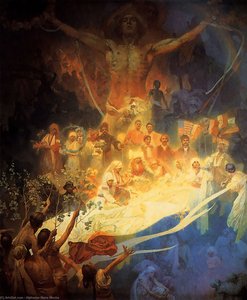
- The Slavonic Uprising - Showcases blending traditional Czech motifs with modern Art Nouveau elements.
- Salon des Cent
- Paintings inspired by works like The Daughters of Tespio by Gustave Moreau, and La Ribambelle des Gobelins by Piero Dorazio.
- Illustrations based on Young Farmers Breaking Flax by Sir Hubert von Herkomer.
- Frequently featured idealized women in flowing robes surrounded by lush flowers.
Career Highlights and Major Commissions
- Sarah Bernhardt Collaboration: Created posters and designs for the actress Sarah Bernhardt, starting with the poster for Gismonda (1894), which launched his career.
- Universal Exhibition in Paris (1900): His Art Nouveau style gained international recognition at this exhibition. He decorated the Bosnia and Herzegovina Pavilion and collaborated on the Austrian Pavilion.
- Charles Richard Crane Patronage: Received support from Charles Richard Crane, which enabled him to create the monumental series The Slav Epic (1912-30).
- Post-Independence Czechoslovakia: Designed postage stamps, banknotes, and government documents for newly independent Czechoslovakia.
Influences and Legacy
- Influenced by Czech artistic traditions and modern European art movements.
- His unique style paved the way for future generations of artists in Art Nouveau and Secessionism.
- Inspired other artists like Eva Prokopcová.
- Legacy extends beyond his artwork to influence design and aesthetics.
Later Life and Death
- Married Maruska (Marie/Maria) Chytilová in 1906.
- Visited the United States from 1906-1910, where their daughter Jaroslava was born.
- Died on July 14, 1939, in Prague, Czechoslovakia.
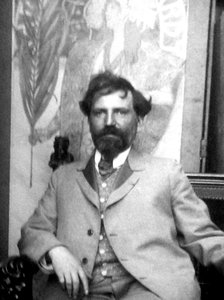
Alphonse Mucha
1860 - 1939 , Czech Republic
Quick Facts
- Artistic Movement Or Style: Art Nouveau
- Artists Or Movements Influenced By This Artist: ['Eva Prokopcová']
- Artists Who Influenced This Artist:
- Pierre-Auguste Renoir
- Gustave Moreau
- Dante Gabriel Rossetti
- Date Of Birth: July 15, 1860
- Date Of Death: 1939
- Full Name: Alphonse Maria Mucha
- Nationality: Czech
- Notable Artworks:
- Slavic Uprising
- Salon des Cent
- The Daughters of Tespio
- La Ribambelle des Gobelins
- Young Farmers Breaking Flax
- Place Of Birth: Brno, Czech Republic
Related Articles
Alphonse Mucha: A Comprehensive Exploration of Art Nouveau's Master of Decorative Symbolism
Explore the life & art of Alphonse Mucha, master of Art Nouveau! Discover his iconic posters, stunning illustrations, and the monumental Slav Epic. A comprehensive guide for collectors & enthusiasts.
Art Nouveau's Golden Age: 10 Masterpieces for Your Home |
Journey into Art Nouveau's golden age! Explore 10 masterpieces by Klimt, Mucha & more. Discover captivating stories behind iconic paintings, floral motifs & flowing lines. Find museum-quality art reproductions for your home at .
The Flowing Line & Flourishing Form: Exploring Art Nouveau's Aesthetic Legacy
Explore the captivating world of Art Nouveau! Discover its origins, key artists like Horta & Mucha, regional styles, innovative techniques, and lasting influence on architecture & design. A comprehensive guide for art enthusiasts.
25 Klimt Masterpieces: A Journey Through Iconic Art & Decor
Delve into the world of Gustav Klimt with our top 25 masterpieces! Explore his iconic paintings – 'The Kiss,' 'Portrait of Adele,' and more. Discover museum-quality reproductions & curated decor ideas. Explore the full collection online at ArtsDot.com.
The Enduring Appeal of Decorative Art: A Historical Survey of Ornamentation, Functionality & Cultural Significance
Explore the rich history of decorative arts with ArtsDot.com. Discover key movements, influential artists, and expert guidance for building a discerning collection. Learn about ornamentation, functionality & cultural significance.