 Preview
 Send
Send Share
Share
 Details

 Download
 Similars
 X-Ray
X-Ray Diaporama
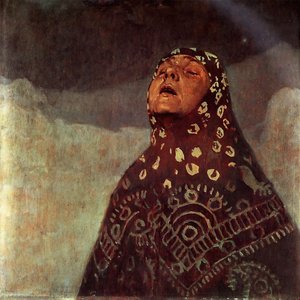
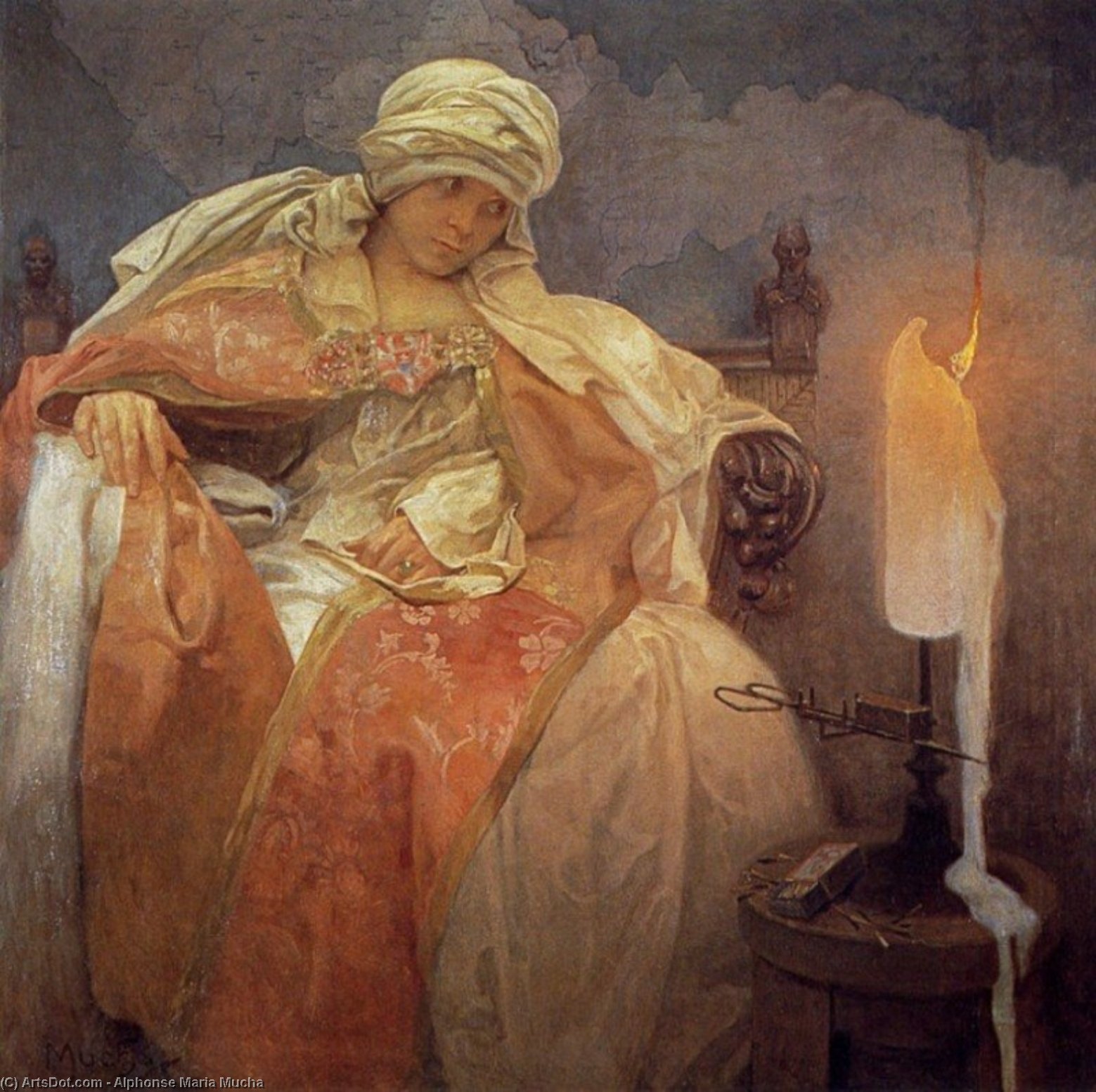
Woman with a Burning Candle

 Read More
Hand Made Oil Reproduction
Hand-painted oil on canvas in your size and frame, made to order by our artists. ( Buy Print Buy Image)




P118B $10

P118H $10

P118W $10

P438Z $10

P508JH $12

P508YH $12

P805H $10

P805Z $10

P919BZ $10

P919G $10

P919XJ $10

P959ZH $10

P968JZ $12

W106C $8

W218G $10

W218JH $8

W218Y $10

W307PJ $10

W316G $10

W316PJ $8

W316Y $10

W398PJ $8

W4111J $10

W500HY $15

W500JH $15

W692G $12

W849H $8

W940BG $15

W953PJ $8




Pick from our preset sizes that match the artwork's original proportions.

You may enter your own dimensions to fit a specific frame or space. If your selected size does not match the original image's proportions, we will either crop the artwork or extend the painting with additional hand-painted elements. A digital mockup will be sent for your approval before production begins.
Please note that the on-screen preview does not reflect the actual cropping or extension. Only the mockup will accurately show the final composition.
While custom sizes are available, we recommend selecting a dimension from the predefined list to preserve the original proportions.
After order, ArtsDot.com team will email client for instructions and provide a mockup preview
Worldwide Delivery () in 3/4 weeks instead of standard 5 weeks. (17 August). No compromise on quality.

Free Worldwide Express Shipping

High-Quality Linen Canvas

Full Shipping Insurance

Customs Tax Refund Guarantee

True Color Matching Guarantee

60-Day Return Policy (Defects Only)

100% Money-Back Guarantee

Bulk Discount Offer
 Glass option is only available in size under 110 CM

Woman with a Burning Candle
Reproduction Medium
Reproduction Size
-


Total Price
$ 263
Artwork Description
A Vision of Slavic Resilience: Alphonse Mucha’s Woman with a Burning Candle
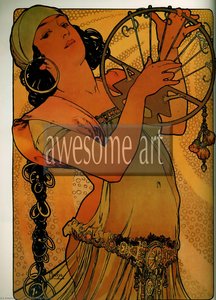
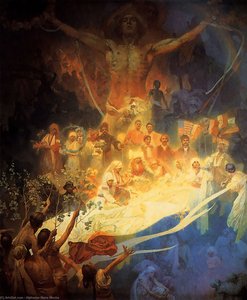
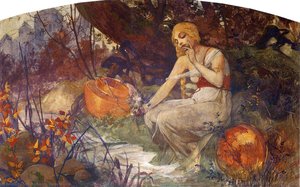
The painting “Woman with a Burning Candle,” created by Alphonse Maria Mucha in 1897, stands as a cornerstone of Art Nouveau aesthetics and embodies the spirit of Czech national identity during a turbulent period. More than just a beautiful depiction of femininity, it's a carefully constructed symbol laden with historical significance and artistic innovation—a testament to Mucha’s ability to fuse decorative elegance with profound emotional resonance. Mucha’s stylistic approach was radically different from the prevailing academic traditions of his time. Rejecting rigid formalism, he embraced organic forms inspired by nature – specifically Celtic spirals and flowing floral motifs – mirroring the burgeoning interest in folklore and pagan symbolism prevalent across Europe. This influence is immediately apparent in the woman's dress, which cascades downwards like a waterfall of blossoms, creating an illusion of movement that captures the dynamism characteristic of Art Nouveau. The artist skillfully employs hatching and cross-hatching techniques to build up tonal values, achieving remarkable depth and luminosity without resorting to traditional glazing methods. These meticulous brushstrokes convey not only visual beauty but also a palpable sense of stillness amidst the swirling patterns of decoration. The candle itself is arguably the painting’s most potent symbol. Traditionally representing enlightenment, faith, and divine illumination, it contrasts sharply with the woman's veiled gaze—a deliberate choice that speaks to the anxieties surrounding Czech independence following the Austro-Hungarian Compromise of 1867. The woman isn’t passively accepting her fate; she confronts an unseen force with unwavering determination. This duality reflects the broader struggle for cultural and political autonomy experienced by Bohemia during Mucha's era – a yearning for spiritual strength amidst external pressures. Furthermore, Mucha drew inspiration from Gustave Moreau’s “The Daughters of Tespio,” exploring themes of mythology and feminine power—a deliberate homage to artistic predecessors who championed expressive symbolism. Considered alongside Mucha’s other celebrated works like "The Slavonic Uprising," this painting exemplifies his commitment to portraying idealized female figures within a framework of stylized ornamentation. It's not merely decorative; it’s an invitation to contemplate the complexities of identity and resilience—qualities that resonated deeply with audiences at the time and continue to captivate viewers today. Mucha’s meticulous attention to detail, combined with his masterful manipulation of light and shadow, elevates “Woman with a Burning Candle” beyond mere visual pleasure into a profound meditation on artistic expression and cultural heritage. Its enduring appeal lies in its ability to communicate timeless themes of courage, contemplation, and the transformative power of beauty—making it an invaluable piece for collectors and interior designers seeking to infuse their spaces with inspiration.Related Artworks
Artist Biography
Early Life and Education
- Born: July 15, 1860, in Ivanačice, Moravia (now part of the Czech Republic)
- Showed artistic talent from a young age.
- Studied at the Academy of Fine Arts in Prague but became disillusioned with traditional approaches.
- Moved to Paris in 1887 to pursue his own style.
Artistic Style and Notable Works
- Known for distinctive Art Nouveau style characterized by flowing lines, organic forms, and a sense of movement.
- Influenced by artists like Pierre-Auguste Renoir and Gustave Moreau.
- Notable Works:
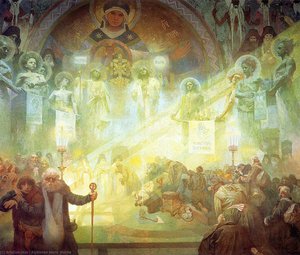
- The Slavonic Uprising - Showcases blending traditional Czech motifs with modern Art Nouveau elements.
- Salon des Cent
- Paintings inspired by works like The Daughters of Tespio by Gustave Moreau, and La Ribambelle des Gobelins by Piero Dorazio.
- Illustrations based on Young Farmers Breaking Flax by Sir Hubert von Herkomer.
- Frequently featured idealized women in flowing robes surrounded by lush flowers.
Career Highlights and Major Commissions
- Sarah Bernhardt Collaboration: Created posters and designs for the actress Sarah Bernhardt, starting with the poster for Gismonda (1894), which launched his career.
- Universal Exhibition in Paris (1900): His Art Nouveau style gained international recognition at this exhibition. He decorated the Bosnia and Herzegovina Pavilion and collaborated on the Austrian Pavilion.
- Charles Richard Crane Patronage: Received support from Charles Richard Crane, which enabled him to create the monumental series The Slav Epic (1912-30).
- Post-Independence Czechoslovakia: Designed postage stamps, banknotes, and government documents for newly independent Czechoslovakia.
Influences and Legacy
- Influenced by Czech artistic traditions and modern European art movements.
- His unique style paved the way for future generations of artists in Art Nouveau and Secessionism.
- Inspired other artists like Eva Prokopcová.
- Legacy extends beyond his artwork to influence design and aesthetics.
Later Life and Death
- Married Maruska (Marie/Maria) Chytilová in 1906.
- Visited the United States from 1906-1910, where their daughter Jaroslava was born.
- Died on July 14, 1939, in Prague, Czechoslovakia.
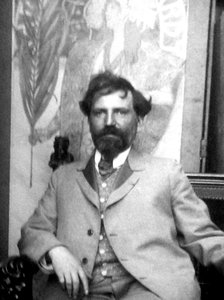
Alphonse Mucha
1860 - 1939 , Czech Republic
Quick Facts
- Artistic Movement Or Style: Art Nouveau
- Artists Or Movements Influenced By This Artist: ['Eva Prokopcová']
- Artists Who Influenced This Artist:
- Pierre-Auguste Renoir
- Gustave Moreau
- Dante Gabriel Rossetti
- Date Of Birth: July 15, 1860
- Date Of Death: 1939
- Full Name: Alphonse Maria Mucha
- Nationality: Czech
- Notable Artworks:
- Slavic Uprising
- Salon des Cent
- The Daughters of Tespio
- La Ribambelle des Gobelins
- Young Farmers Breaking Flax
- Place Of Birth: Brno, Czech Republic
Related Articles
Alphonse Mucha: A Comprehensive Exploration of Art Nouveau's Master of Decorative Symbolism
Explore the life & art of Alphonse Mucha, master of Art Nouveau! Discover his iconic posters, stunning illustrations, and the monumental Slav Epic. A comprehensive guide for collectors & enthusiasts.
Art Nouveau's Golden Age: 10 Masterpieces for Your Home |
Journey into Art Nouveau's golden age! Explore 10 masterpieces by Klimt, Mucha & more. Discover captivating stories behind iconic paintings, floral motifs & flowing lines. Find museum-quality art reproductions for your home at .
The Flowing Line & Flourishing Form: Exploring Art Nouveau's Aesthetic Legacy
Explore the captivating world of Art Nouveau! Discover its origins, key artists like Horta & Mucha, regional styles, innovative techniques, and lasting influence on architecture & design. A comprehensive guide for art enthusiasts.
Edward Burne-Jones: A Pre-Raphaelite Vision of Myth, Symbolism & Aesthetic Idealism
Discover the enchanting world of Edward Burne-Jones and the Pre-Raphaelite Brotherhood. Explore his mythical paintings, distinctive style, and lasting influence on Victorian art & the Aesthetic Movement. Expert analysis & high-quality reproductions at ArtsDot.
25 Klimt Masterpieces: A Journey Through Iconic Art & Decor
Delve into the world of Gustav Klimt with our top 25 masterpieces! Explore his iconic paintings – 'The Kiss,' 'Portrait of Adele,' and more. Discover museum-quality reproductions & curated decor ideas. Explore the full collection online at ArtsDot.com.