 Preview
 Send
Send Share
Share
 Details

 Download
 Similars
 X-Ray
X-Ray Diaporama
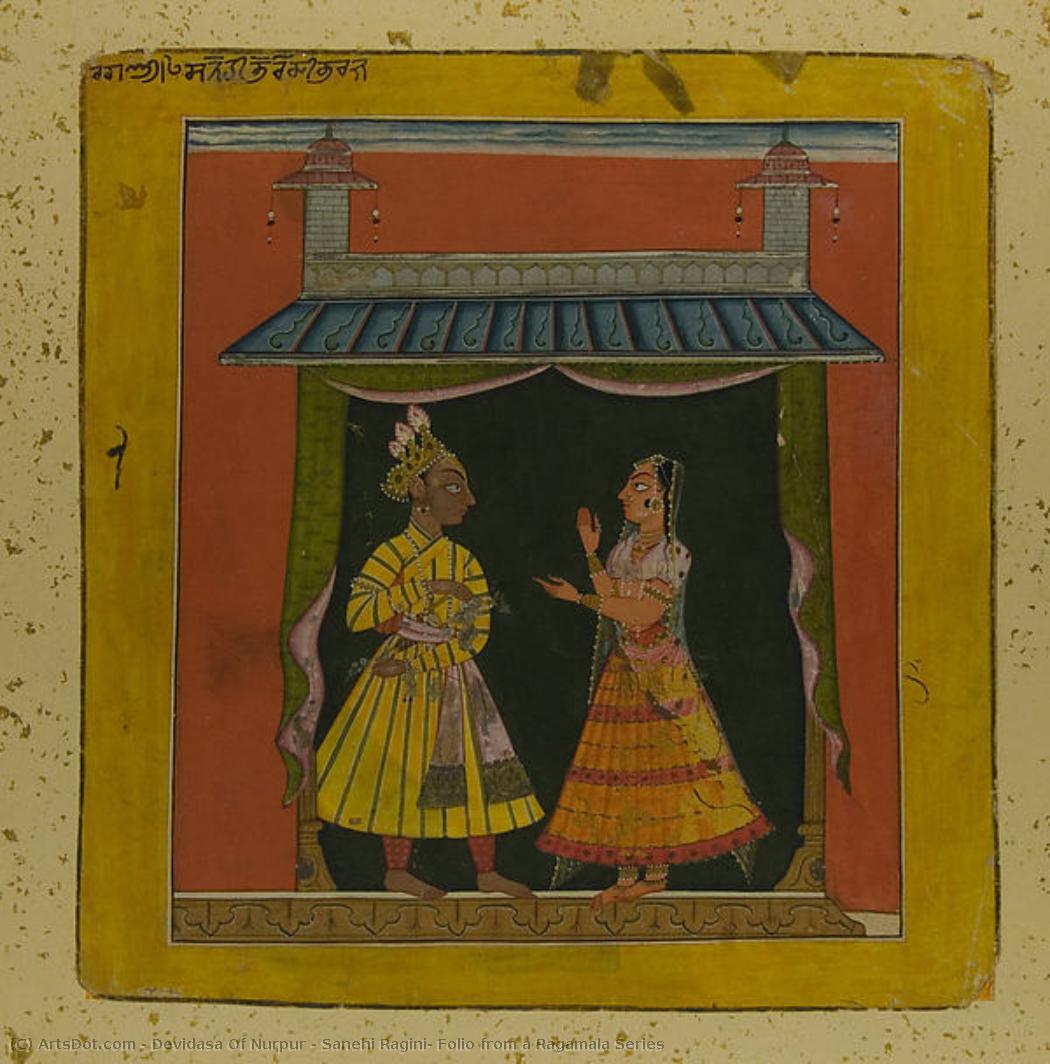
Sanehi Ragini: Folio from a Ragamala Series
 Gouache
- WallArt
- Pahari
 1690
1690- Early Modern
 18.0 x 16.0 cm
 Read More
Giclée / Art Print
Museum-quality giclée or canvas print with fast production and flexible finish options. ( Buy Hand Made Painting Buy Image)




P118B $10

P118H $10

P118W $10

P438Z $10

P508JH $12

P508YH $12

P805H $10

P805Z $10

P919BZ $10

P919G $10

P919XJ $10

P959ZH $10

P968JZ $12

W106C $8

W218G $10

W218JH $8

W218Y $10

W307PJ $10

W316G $10

W316PJ $8

W316Y $10

W398PJ $8

W4111J $10

W500HY $15

W500JH $15

W692G $12

W849H $8

W940BG $15

W953PJ $8




Pick from our preset sizes that match the artwork's original proportions.

You may enter your own dimensions to fit a specific frame or space. If your selected size does not match the original image's proportions, we will either crop the artwork or extend the image with a mirrored or solid-fill edge. A digital mockup will be sent for your approval before production begins.
Please note that the on-screen preview does not reflect the actual cropping or extension. Only the mockup will accurately show the final composition.
While custom sizes are available, we recommend selecting a dimension from the predefined list to preserve the original proportions.
Worldwide Delivery () in 2 weeks instead of standard 4/5 weeks. (22 August)

Free Worldwide Express Shipping

High-Quality Linen Canvas

Full Shipping Insurance

Customs Tax Refund Guarantee

True Color Matching Guarantee

60-Day Return Policy (Defects Only)

100% Money-Back Guarantee

Bulk Discount Offer
 Glass option is only available in size under 110 CM

Sanehi Ragini: Folio from a Ragamala Series
Giclée / Art Print
Reproduction Size
-


Total Price
$ 63
Collectible Description
A Poetic Encounter in Miniature
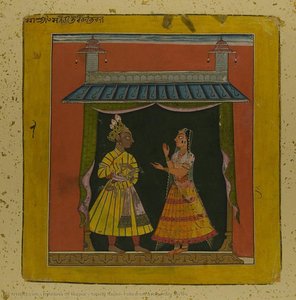
In the delicate realm of Pahari painting, few works capture the intimate tension of longing as exquisitely as Sanehi Ragini: Folio from a Ragamala Series. Created around 1690 by the master Devidasa of Nurpur, this miniature masterpiece invites the viewer into a private, suspended moment between two souls. The composition centers on a man and a woman, their figures rendered with the stylized grace characteristic of the Nurpur school. Clad in vibrant hues—a sun-drenched yellow for the gentleman and a deep, passionate red for the lady—they stand before a curtained stage, caught in a silent dialogue that feels both theatrical and profoundly personal. The setting, though minimalist, is rich with narrative potential; the presence of chairs and a subtle hint of a clock suggests a world where time is both passing and standing still, heightening the emotional stakes of their encounter.
The artistry of Devidasa is defined by a unique ability to blend the flat, abstract forms of the Punjab Hills tradition with an almost icon-like intensity. This folio exemplifies the Nurpur masters' signature technique: the use of thick, luscious pigments and polished colors that seem to glow from within. The background, often monochromatic and devoid of distracting landscape details, serves to push the figures toward the viewer, creating a sense of immediate presence. In some of his most celebrated works, Devidasa even incorporated tactile elements like the iridescent sheen of green beetle wings or raised dots of shell-lime white, techniques that transformed a mere painting into a three-dimensional object of devotion and beauty.
The Legacy of the Nurpur Masters
To understand this work is to understand a lineage of creative brilliance. Devidasa was part of a prestigious family workshop in Nurpur, Himachal Pradesh, following in the footsteps of his father, Kripal, and preceding his son, Golu. This three-generation saga of painting produced a corpus of work that is unparalleled in its spiritual and aesthetic depth. While many Indian paintings of this era focused on grand historical narratives, the Nurpur artists specialized in the Rasamanjari themes—cataloging the multifaceted nuances of love, from the sweetness of union to the ache of rejection. By associating the hero with the omnipresent god Krishna, Devidasa elevated these earthly romantic struggles into a divine meditation, turning each folio into a bridge between the human heart and the eternal.
For the discerning collector or interior designer, a high-quality reproduction of Sanehi Ragini offers more than just a decorative element; it provides a window into a sophisticated era of Indian history. The painting’s bold color palette and striking silhouettes make it a versatile centerpiece, capable of adding a layer of cultural depth and soulful elegance to a contemporary gallery wall or a classic study. It is an invitation to contemplate the timeless themes of connection and devotion, rendered with a technical mastery that has captivated art lovers for over three centuries.
Related Artworks
Artist Biography
The Lineage of Nurpur
Devidasa of Nurpur emerged from the vibrant artistic traditions of the Punjab Hills during a transformative era in Indian art history. Active between approximately 1680 and 1720, his life was deeply intertwined with the familial workshop culture that defined the period. He was the son of Kripal, a master artist whose influence shaped the foundation of the family's creative output. Growing up within this lineage, Devidasa was immersed from a young age in the rigorous training required to master the Pahari style. This apprenticeship allowed him to inherit not just technical skill, but a profound understanding of the cultural and spiritual narratives that would become the heartbeat of his work. His development was a seamless continuation of a legacy, blending the ancestral techniques of his father with his own burgeoning mastery of color and form.A Symphony of Color and Form
The aesthetic essence of Devidasa’s work lies in its breathtaking ability to balance abstraction with intricate detail. His paintings are quintessential examples of the Pahari school, characterized by a striking use of bright, saturated pigments and a deliberate sense of flatness that elevates the subject matter beyond mere representation. Through delicate, flowing lines, he captured the ethereal beauty of Hindu mythology and the intimate nuances of everyday life. There is a captivating tension in his compositions, where the refined, sophisticated influence of Mughal painting meets the bold, emotive energy of the Rajput tradition. This synthesis allowed him to create scenes that felt both structurally precise and spiritually resonant, using color not just as decoration, but as a tool to evoke deep emotional responses from the viewer.Masterpieces and Enduring Legacy
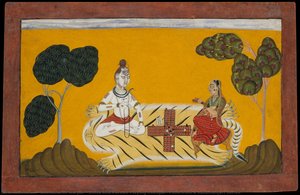
The brilliance of Devidasa’s artistry is most vividly realized in his celebrated series, such as the Rasamanjari. His masterpiece, Shiva and Parvati playing chaupar, stands as a testament to his ability to render divine intimacy through masterful composition. Other notable works, including the poignant Sanehi ragini and depictions of lovers caught in the throes of quarrel, showcase his skill in portraying complex human emotions through stylized forms. The historical significance of his work is preserved in some of the world's most esteemed galleries, with his paintings held in the permanent collections of the Metropolitan Museum of Art in New York and the Museum of Fine Arts, Boston. Beyond his individual achievements, Devidasa’s stylistic innovations left an indelible mark on the trajectory of Indian miniature painting, influencing subsequent masters such as Nainsukh and Sajnu, ensuring that his vision remains a vital part of the global art canon.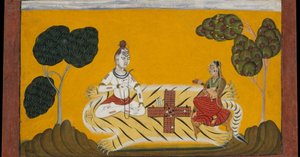
devidasa of nurpur
India
Quick Facts
- Artistic Movement Or Style: World Goes Pop
- Artists Or Movements Influenced By This Artist: ['Influenced by pop art movement']
- Artists Who Influenced This Artist: ['Influenced by diverse artists in The World Goes Pop exhibition']
- Date Of Death: Living
- Notable Artworks: ['Various works featured in The World Goes Pop exhibition']
- Place Of Birth: WahooArt
Related Articles
Raja Ravi Varma: Bridging Tradition & Modernity in 19th-Century Indian Art
Explore the life & art of Raja Ravi Varma, a pioneer who fused European techniques with Indian iconography. Discover his iconic paintings, lasting legacy, and influence on modern Indian art at ArtsDot.
Jan van Kessel the Elder: A Baroque Master of Floral Still Life & Miniature Portraiture
Discover the exquisite detail of Jan van Kessel the Elder's Baroque floral still lifes & captivating miniatures. Explore his artistic legacy, scientific precision, and lasting influence on 17th-century Flemish painting.

Jacob Lawrence: Narratives of Struggle, Resilience & Modernist Innovation
Explore the powerful narratives of Jacob Lawrence, a pivotal African American artist of the Harlem Renaissance. Discover his iconic 'Migration Series,' dynamic cubism style, and lasting impact on American art history.

Shadow Catcher: Edward S. Curtis & the Ethnographic Portraiture of a Vanishing West
Explore the life & work of Edward S. Curtis, the 'Shadow Catcher,' and his groundbreaking photographic documentation of Native American cultures. Discover iconic images from *The North American Indian* and a critical look at his lasting legacy.
Aaron Siskind: Deconstructing Reality – A Photographic Exploration of Texture, Form & the Abstract Landscape
Explore the transformative journey of Aaron Siskind, from social realism to pioneering abstract photography. Discover his iconic series & lasting influence on modern art. A guide for collectors.