 Preview
 Send
Send Share
Share
 Details

 Download
 Similars
 X-Ray
X-Ray Diaporama
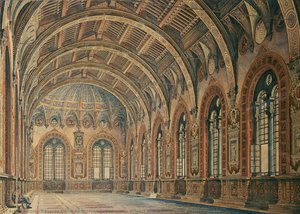
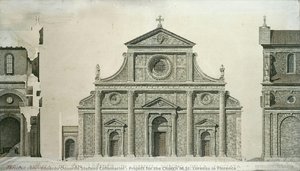
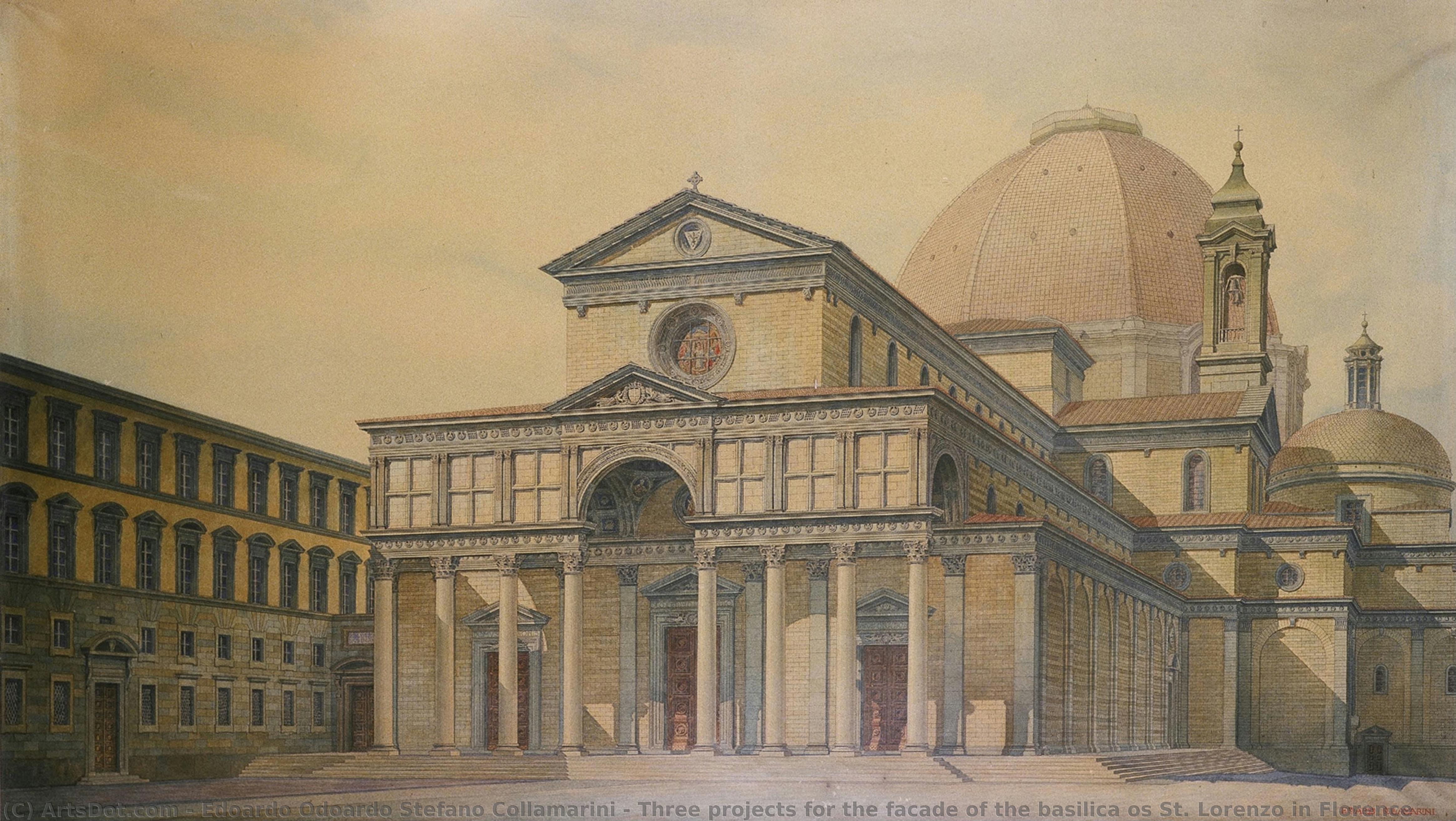
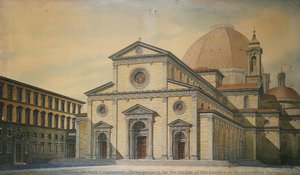
Three projects for the facade of the basilica os St. Lorenzo in Florence


 Read More
Giclée / Art Print
Museum-quality giclée or canvas print with fast production and flexible finish options. ( Buy Hand Made Painting Buy Image)




































Pick from our preset sizes that match the artwork's original proportions.

You may enter your own dimensions to fit a specific frame or space. If your selected size does not match the original image's proportions, we will either crop the artwork or extend the image with a mirrored or solid-fill edge. A digital mockup will be sent for your approval before production begins.
Please note that the on-screen preview does not reflect the actual cropping or extension. Only the mockup will accurately show the final composition.
While custom sizes are available, we recommend selecting a dimension from the predefined list to preserve the original proportions.
Worldwide Delivery () in 2 weeks instead of standard 4/5 weeks. (23 August)

Free Worldwide Express Shipping

High-Quality Linen Canvas

Full Shipping Insurance

Customs Tax Refund Guarantee

True Color Matching Guarantee

60-Day Return Policy (Defects Only)

100% Money-Back Guarantee

Bulk Discount Offer
 Glass option is only available in size under 110 CM

Three projects for the facade of the basilica os St. Lorenzo in Florence
Giclée / Art Print
Reproduction Size
-


Total Price
$ 63
Related Artworks


Artist Biography
The Visionary Architect of Sacred Spaces
Edoardo Odoardo Stefano Collamarini, born in the historic heart of Bologna in 1863, was far more than a mere designer of structures; he was an architect of Christian visions. His life, which concluded in his beloved Bologna in 1928, was defined by a profound intellectual engagement with the intersection of spiritual meaning and aesthetic grandeur. Collamarini possessed a rare ability to translate the intangible essence of faith into tangible, monumental forms, creating spaces that did not merely house worshippers but actively engaged their souls through light, proportion, and symbolic depth.
His artistic journey began within the prestigious halls of the Accademia di Belle Arti in Bologna. It was here that his early aptitude for architectural design blossomed, nurtured by a vibrant local atmosphere that celebrated both classical heritage and emerging modern sensibilities. However, Collamarini’s true education extended far beyond the classroom. He sought out mentors who challenged his perceptions, most notably the controversial restorer Alfonso Rubbiani. From Rubbiani, Collamarini inherited an appreciation for architectural theatricality—a daring willingness to manipulate space and style to evoke emotional responses. This influence, combined with a nuanced reading of Eugène Viollet-le-Duc’s theories on structural honesty, allowed him to develop a style that respected historical integrity while embracing the expressive potential of new materials.
A Synthesis of Tradition and Innovation
As his career progressed, Collamarini’s work became a sophisticated dialogue between the past and the present. While he drew heavily from the rich tapestry of Italian history, he avoided the trap of mere imitation. His approach was characterized by a careful curation of styles, blending elements of the Neo-Byzantine with the flowing, organic lines of Art Nouveau. This synthesis is perhaps most evident in his religious commissions, where he sought to create environments that felt both ancient and eternally contemporary.
His mastery was particularly evident in his detailed architectural studies and large-scale projects. His ability to manipulate perspective and detail can be seen in works such as:
- Three projects for the facade of the basilica of St. Lorenzo in Florence: A masterful Renaissance study executed in watercolor and pen, demonstrating a profound command over light and structural complexity.
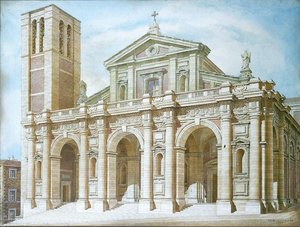
- The Church of St. Lorenzo in Florence: A testament to his ability to envision monumental religious architecture that commands presence through balanced design.
Beyond the grand facades, Collamarini’s early work decorating tombs in the Certosa di Bologna provided him with a foundational understanding of how architecture interacts with memory and mortality. These intimate, somber commissions prepared him for the monumental task of designing churches like the Sacro Cuore di Gesù, where his architectural language reached its most spiritual zenith.
Legacy of a Spiritual Craftsman
The historical significance of Edoardo Collamarini lies in his role as a bridge between eras. He stood at the crossroads of traditional craftsmanship and the burgeoning modern movement, proving that architecture could serve as a powerful medium for religious expression in a changing world. His work remains a vital chapter in the history of Italian architecture, representing a period when the built environment was used to capture the sublime.
Today, his legacy is preserved not only in the stone and mortar of the buildings he envisioned but in the enduring beauty of his architectural drawings. Through these works, we witness a creator who viewed every line and every arch as an opportunity to touch the divine, leaving behind a blueprint of how art and faith can inhabit the same physical space.
edoardo odoardo stefano collamarini
1863 - 1928 , Italy
Quick Facts
- Artistic Movement Or Style: Christian themes, Art Nouveau
- Artists Or Movements Influenced By This Artist: ['Art Nouveau']
- Artists Who Influenced This Artist:
- Viollet-le-Duc
- Giosuè Carducci
- Alfonso Rubbiani
- Date Of Birth: September 13, 1863
- Date Of Death: September 25, 1928
- Full Name: Edoardo Odoardo Stefano Collamarini
- Nationality: Italian
- Notable Artworks:
- Talon Chapel
- Sacro Cuore di Gesù
- Santuario della Madonna del Sangue
- Place Of Birth: Bologna, Italy
Related Articles

Watercolor Wonders: 10 Masterpieces That Redefined Art History | ArtsDot
Journey through 10 legendary watercolor masterpieces by Sargent, Turner & Homer! Explore iconic landscapes, portraits & floral art that redefined history. Find museum-quality reproductions and curated decor ideas at ArtsDot.com.

Ephemeral Visions: Exploring the Artistic Legacy & Contemporary Practice of Watercolor Painting
Explore the captivating world of watercolor painting! Discover its rich history, essential techniques, influential artists & collecting tips. A comprehensive guide for art enthusiasts from ArtsDot.

Ephemeral Visions: Exploring the History & Emotional Resonance of Watercolor Painting
Explore the captivating history of watercolor painting, from ancient techniques to modern masters like Kandinsky & Blake. Discover essential artists, collecting tips & the emotional power of this luminous medium. Expert insights for art enthusiasts.

Ephemeral Visions: Exploring the Artistic Legacy & Nuances of Watercolor Painting
Explore the captivating world of watercolor painting! Discover its rich history, essential techniques, influential artists & collecting tips from art experts. A comprehensive guide for enthusiasts.

The Eloquent Line: Exploring the Artistic Significance of Sketches Across Movements and Media
Explore the profound artistic significance of sketches throughout history. From Renaissance masters to modern innovators like Van Gogh & Guston, discover how these foundational works reveal technique, emotion, and vision. Learn more at ArtsDot.