 Preview
 Send
Send Share
Share
 Details

 Download
 Similars
 X-Ray
X-Ray Diaporama
Jean Baptiste Isabey


 Read More
Giclée / Art Print
Museum-quality giclée or canvas print with fast production and flexible finish options. ( Buy Hand Made Painting Buy Image)




P118B $10

P118H $10

P118W $10

P438Z $10

P508JH $12

P508YH $12

P805H $10

P805Z $10

P919BZ $10

P919G $10

P919XJ $10

P959ZH $10

P968JZ $12

W106C $8

W218G $10

W218JH $8

W218Y $10

W307PJ $10

W316G $10

W316PJ $8

W316Y $10

W398PJ $8

W4111J $10

W500HY $15

W500JH $15

W692G $12

W849H $8

W940BG $15

W953PJ $8




Pick from our preset sizes that match the artwork's original proportions.

You may enter your own dimensions to fit a specific frame or space. If your selected size does not match the original image's proportions, we will either crop the artwork or extend the image with a mirrored or solid-fill edge. A digital mockup will be sent for your approval before production begins.
Please note that the on-screen preview does not reflect the actual cropping or extension. Only the mockup will accurately show the final composition.
While custom sizes are available, we recommend selecting a dimension from the predefined list to preserve the original proportions.
Worldwide Delivery () in 2 weeks instead of standard 4/5 weeks. (21 August)

Free Worldwide Express Shipping

High-Quality Linen Canvas

Full Shipping Insurance

Customs Tax Refund Guarantee

True Color Matching Guarantee

60-Day Return Policy (Defects Only)

100% Money-Back Guarantee

Bulk Discount Offer
 Glass option is only available in size under 110 CM

Jean Baptiste Isabey
Giclée / Art Print
Reproduction Size
-


Total Price
$ 63
Collectible Description
Jean Baptiste Isabey: A Window into Napoleonic France
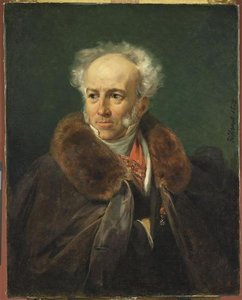
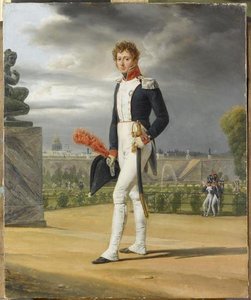
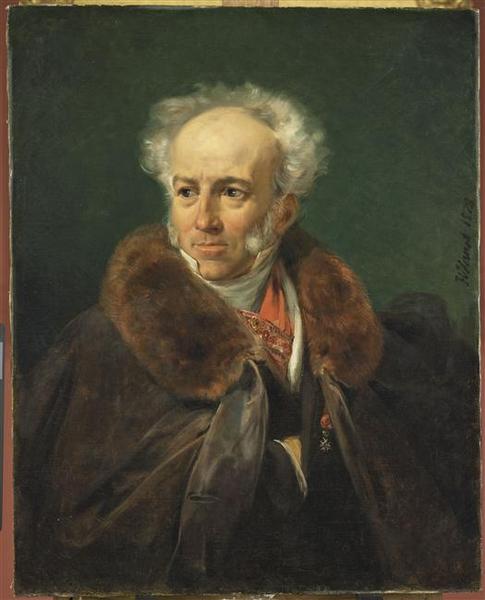
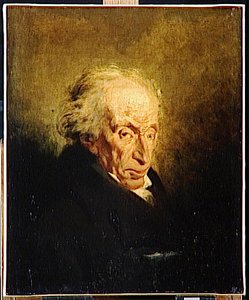
The portrait of Jean Baptiste Isabey, rendered with remarkable detail by Emile Horace Vernet, offers more than just a likeness; it’s a carefully constructed window into the world of early 19th-century France – a nation grappling with the legacy of revolution and the burgeoning grandeur of Napoleon's empire. Vernet, a master of capturing dynamic movement and dramatic lighting, doesn’t simply depict a man; he embodies an era, imbuing Isabey with a quiet dignity that speaks volumes about his status and the complexities of his time.
The subject himself, Jean Baptiste Isabey, was a prominent figure – a celebrated miniature painter who served as official artist to the royal court. His attire—a richly draped coat, adorned with subtle yet significant medals—immediately establishes his position within the social hierarchy. The fur collar, a hallmark of the period, adds an element of opulence and formality, hinting at both wealth and military service, reflecting Isabey’s likely involvement in official ceremonies and commissions during the Napoleonic era. The muted palette – dominated by earthy browns, deep greens, and creamy whites – creates a sense of understated elegance, typical of portraiture from this period, allowing the subject's features to remain sharply defined.
A Study in Vernet’s Technique
Vernet’s masterful technique is immediately apparent. He employs a layered approach, building up textures with meticulous brushstrokes – particularly evident in the rendering of the fur collar and the fabric of the coat. The subtle blending creates an illusion of depth and realism, while the careful attention to detail—the delicate wrinkles on Isabey's skin, the precise lines defining his face—demonstrates Vernet’s commitment to accuracy. The lighting is soft and diffused, casting a gentle glow across the subject’s features without creating harsh shadows, contributing to the portrait’s overall sense of calm and composure.
The composition itself adheres to a classic three-quarter pose, with Isabey turned slightly towards the viewer, engaging in direct eye contact. This creates an intimate connection between the observer and the subject, drawing us into his world. The background, a deliberately muted green, serves as a subtle counterpoint to the richness of the figure’s clothing, ensuring that his presence remains firmly centered within the frame. The relatively flat perspective, characteristic of portraits from this era, reinforces the focus on Isabey himself, emphasizing his importance and status.
Symbolism and Historical Context
Beyond a simple portrait, Vernet's work is steeped in symbolism reflective of its time. The medals adorning Isabey’s coat are not merely decorative; they represent recognition for service to the state – likely military or political achievements during Napoleon’s reign. The overall atmosphere suggests a man accustomed to privilege and influence, yet also possessing a certain gravitas and quiet self-assurance. This portrait captures a pivotal moment in French history—a nation rebuilding itself after revolution, embracing imperial ambition, and seeking to establish a new order.
Further research reveals that Isabey’s career was intimately linked with the artistic patronage of Napoleon himself. The artist's work served as visual propaganda, glorifying the emperor and his achievements. The portrait exemplifies this trend, presenting Isabey not just as an individual but as a symbol of French excellence and loyalty. (See links below for further information on both Isabey and Vernet.)
A Timeless Masterpiece
The portrait of Jean Baptiste Isabey is more than just a beautiful work of art; it’s a valuable historical document, offering a glimpse into the social, political, and artistic landscape of Napoleonic France. Its enduring appeal lies in Vernet's technical skill, his ability to capture both the outward appearance and inner character of his subject, and the profound sense of history that permeates every brushstroke. Reproductions of this piece offer an exceptional opportunity to bring a touch of elegance and historical significance into any setting.
- Artist: Emile Jean Horace Vernet
- Date: Unknown (circa 1820s)
- Medium: Oil on Canvas
Louvre Museum Link | Wikipedia - Vernet | Wikipedia - Isabey
Related Artworks
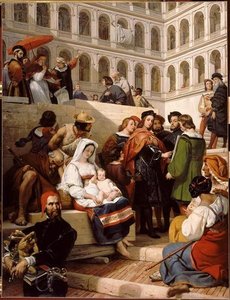
Artist Biography
Émile Jean-Horace Vernet: A Life in Paint
Early Life and Family Legacy
Émile Jean-Horace Vernet was born on June 30, 1789, in Paris, France – remarkably, within the Louvre Palace while his parents resided there during the French Revolution. He came from a distinguished artistic lineage; his father was Carle Vernet, also a renowned painter, and his grandfather was Claude Joseph Vernet, celebrated for his marine landscapes. This familial background profoundly shaped his early exposure to art and laid the foundation for his own career.Artistic Development and Early Influences
Vernet quickly developed a preference for depicting contemporary life rather than adhering to the high-minded seriousness of academic Classicism. He rejected idealized representations, favoring a more realistic and vernacular style. During Napoleon Bonaparte’s reign, he began portraying French soldiers with a newfound familiarity, diverging from the grand, Davidian approach. Early works like “The Taking of an Entrenched Camp” showcased his developing character and directness. His artistic development was also influenced by observing the realities of war and military life firsthand.Rise to Prominence During the Restoration
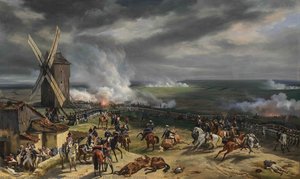
The Bourbon Restoration brought Vernet significant recognition. He secured a series of commissions from the Duc d'Orleans (the future King Louis-Philippe) for battle paintings. Critics were impressed by his speed and accuracy, noting that his works combined historical detail with compelling landscapes. His “Four Battles” series – including “The Battle of Jemappes,” “The Battle of Montmirail,” “The Battle of Hanau,” and “The Battle of Valmy” – established him as a leading battle painter of the era.Director of the French Academy in Rome
Vernet’s talent and reputation led to his appointment as director of the French Academy in Rome from 1829 to 1835. This period allowed him to study classical art and architecture, further refining his skills and broadening his artistic horizons. However, he remained committed to representing contemporary subjects upon his return to France.Patronage Under Louis-Philippe and the Second Empire
King Louis-Philippe became a prolific patron of Vernet, commissioning him to decorate the entire Constantine room at the Palace of Versailles within three years. These paintings depicted French colonization in Algeria, portraying scenes of military conquest and “civilizing” efforts. After the Revolution of 1848, Napoléon III also became a supporter, continuing Vernet’s commissions during the Second Empire. He continued to depict heroic representations of the French army, maintaining his commitment to realism.The Crimean War and Later Years
Vernet accompanied the French army during the Crimean War, producing paintings such as “The Battle of the Alma.” While not as well-received as his earlier works, these pieces demonstrated his dedication to documenting contemporary events. He famously refused a request to remove an unpopular general from one of his paintings, stating his commitment to historical truth.Major Achievements and Historical Significance
- Vernet’s realistic depictions of soldiers and battle scenes revolutionized military painting in France.
- His work provides valuable insights into 19th-century French society, politics, and colonial endeavors.
- He skillfully blended historical accuracy with artistic flair, creating compelling and visually striking compositions.
- His paintings served as powerful propaganda tools, shaping public perception of the French army and its campaigns.
Legacy
Émile Jean-Horace Vernet died in Paris on January 17, 1863. His work continues to be studied and admired for its historical significance and artistic merit. He is also a curious footnote in popular culture as the alleged relative of Sherlock Holmes (according to Arthur Conan Doyle’s story “The Adventure of the Greek Interpreter”). Vernet's legacy lies in his ability to capture the spirit of 19th-century France through vivid, realistic, and often dramatic depictions of war, colonialism, and everyday life.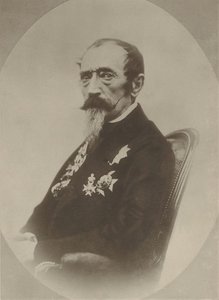
emile jean horace vernet
1789 - 1863
Quick Facts
- Birth Date: 1789
- Death Date: 1863
- Influenced By:
- Carle Vernet
- Claude Joseph Vernet
- Movement:
- Romanticism
- Orientalism
- Name: Émile Jean-Horace Vernet
- Nationality: French
- Notable Works:
- The Battle of Valmy
- Polish Prometheus
- The Artist's Studio
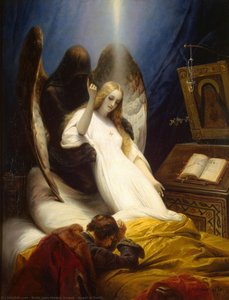
- Angel of Death
Related Articles
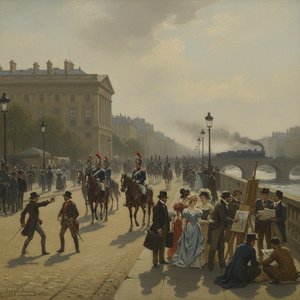
Émile Jean Horace Vernet: Romantic Realism & Depicting 19th-Century Life
Explore the life & art of Émile Jean Horace Vernet, a master of Romantic Realism. Discover his captivating battle scenes, portraits, and Orientalist works – a window into 19th-century France. Learn about his techniques & enduring legacy.
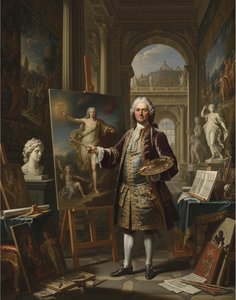
Charles Le Brun: Master of French Baroque Classicism & His Enduring Legacy
Explore the life & art of Charles Le Brun, master of French Baroque Classicism. Discover his royal commissions, influence on Versailles, and enduring legacy through detailed analysis & stunning artworks.
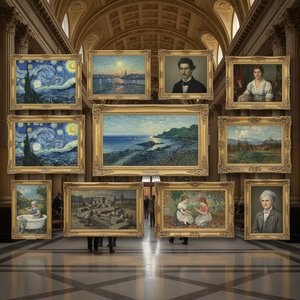
19th Century Masterpieces: 10 Paintings That Defined an Era | ArtsDot
Journey through 19th century art with ArtsDot! Explore 10 iconic paintings – from Monet & Renoir to Courbet – and discover the stories behind Romanticism, Realism & Impressionism. Find museum-quality reproductions for your home decor. Explore the full collection online!
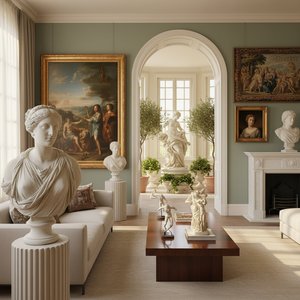
Neo-Classicism's Greatest Hits: 10 Masterpieces for Your Home |
Journey through Neo-Classicism's finest! Explore 10 iconic masterpieces by David, Ingres & Canova. Discover art history, techniques & timeless beauty – perfect for inspiring your home decor. Find museum-quality reproductions at
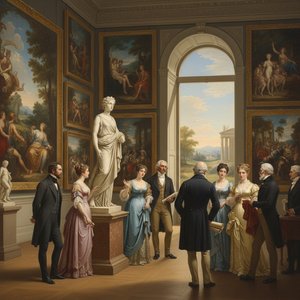
Academic Classicism: A Revival of Form & Narrative in 19th-Century Art
Explore the revival of Academic Classicism in 19th-century art. Discover key artists like David & Duplessis, the influence of the French Académie, and its lasting legacy. Expert insights for collectors & enthusiasts.