 Preview
 Send
Send Share
Share
 Details

 Download
 Similars
 X-Ray
X-Ray Diaporama
Saint Francis
 Oil On Canvas
- WallArt
- Baroque
 1604
1604- Renaissance
 90.0 x 78.0 cm
 Metropolitan Museum of Art
 Read More
Hand Made Oil Reproduction
Hand-painted oil on canvas in your size and frame, made to order by our artists. ( Buy Print Buy Image)




P118B $10

P118H $10

P118W $10

P438Z $10

P508JH $12

P508YH $12

P805H $10

P805Z $10

P919BZ $10

P919G $10

P919XJ $10

P959ZH $10

P968JZ $12

W106C $8

W218G $10

W218JH $8

W218Y $10

W307PJ $10

W316G $10

W316PJ $8

W316Y $10

W398PJ $8

W4111J $10

W500HY $15

W500JH $15

W692G $12

W849H $8

W940BG $15

W953PJ $8




Pick from our preset sizes that match the artwork's original proportions.

You may enter your own dimensions to fit a specific frame or space. If your selected size does not match the original image's proportions, we will either crop the artwork or extend the painting with additional hand-painted elements. A digital mockup will be sent for your approval before production begins.
Please note that the on-screen preview does not reflect the actual cropping or extension. Only the mockup will accurately show the final composition.
While custom sizes are available, we recommend selecting a dimension from the predefined list to preserve the original proportions.
After order, ArtsDot.com team will email client for instructions and provide a mockup preview
Worldwide Delivery () in 3/4 weeks instead of standard 5 weeks. (29 August). No compromise on quality.

Free Worldwide Express Shipping

High-Quality Linen Canvas

Full Shipping Insurance

Customs Tax Refund Guarantee

True Color Matching Guarantee

60-Day Return Policy (Defects Only)

100% Money-Back Guarantee

Bulk Discount Offer
 Glass option is only available in size under 110 CM

Saint Francis
Reproduction Medium
Reproduction Size
-


Total Price
$ 263
A Vision of Devotion: The Spiritual Intensity of Barocci’s Saint Francis
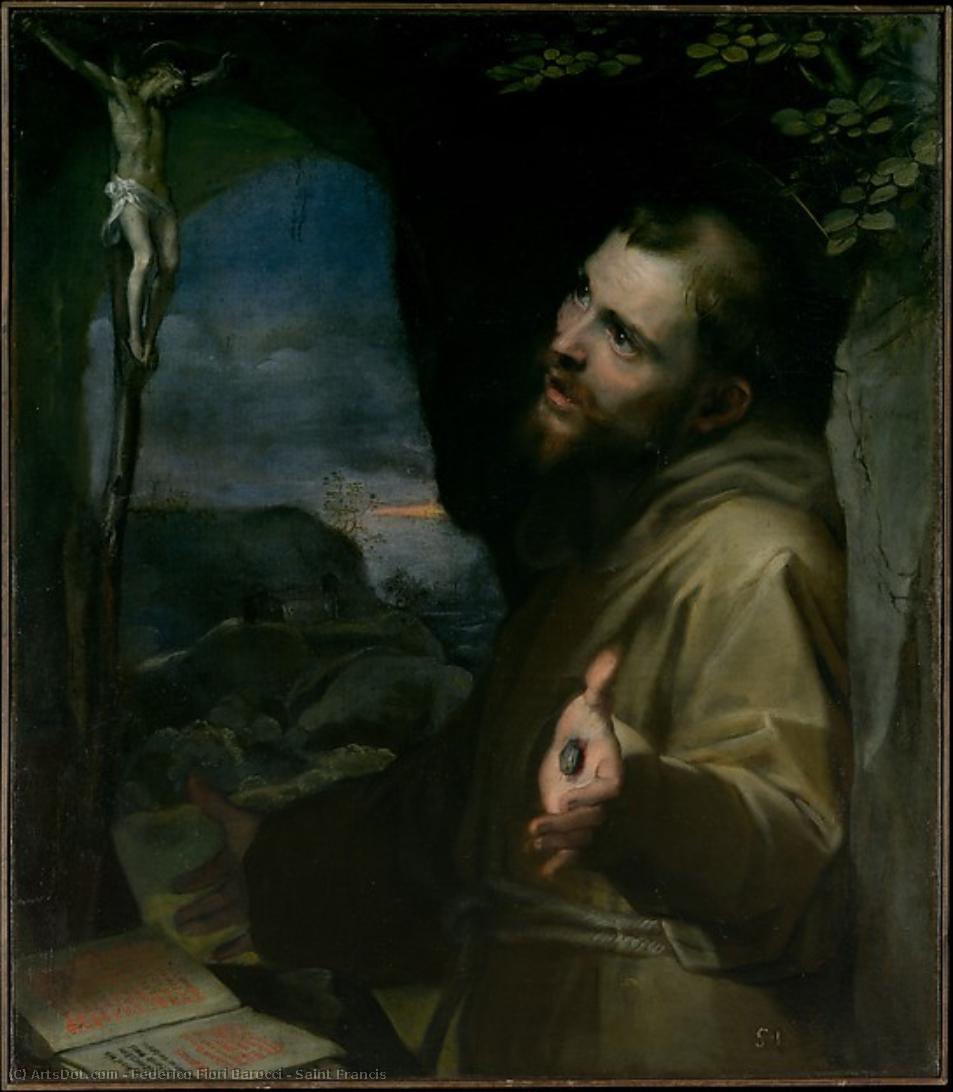
In the quiet, shadowed recesses of a grotto on Mount La Verna, Federico Fiori Barocci captures a moment of profound spiritual intersection. His masterpiece, Saint Francis, is not merely a portrait of a holy man, but a visceral meditation on the thin veil between earthly suffering and divine grace. As the viewer encounters this work, they are immediately drawn into the intense gaze of Saint Francis, whose eyes are uptethered from the world around him, fixed instead upon the distant, harrowing silhouette of the crucifixion. This is a painting that breathes with the weight of faith, inviting anyone who stands before it—whether an art enthusiast or a collector seeking a centerpiece of profound character—to participate in this silent, sacred dialogue.
The composition is a masterclass in the Mannerist tradition, utilizing dynamic diagonal lines to orchestrate a sense of movement and psychological tension. Barocci eschews the static balance of the High Renaissance in favor of an arrangement that pulls the eye upward and across the canvas, mirroring the saint's own spiritual ascent. The rugged landscape, characterized by its stormy skies and distant, nestled villages, provides a dramatic backdrop that emphasizes the solitude of the saint’s experience. Through this deliberate use of flattened perspective and expressive forms, Barocci ensures that the emotional impact remains paramount, prioritizing the internal landscape of the soul over mere topographical accuracy.
Mastery of Light and the Alchemy of Oil
Technically, the work serves as a testament to Barocci’s extraordinary command over the medium of oil on canvas. He employs sophisticated glazing techniques—the delicate layering of translucent colors—to achieve a luminous depth that seems to glow from within the fabric itself. This luminosity is particularly striking in the rendering of the saint's skin tones and the heavy, rhythmic folds of his drapery, where light and shadow dance in a complex chiaroscuro. Such meticulous attention to texture creates a palpable sense of volume, making the physical presence of Saint Francis feel almost tangible within the frame.
The color palette is intentionally muted and earthy, dominated by deep blues, rich browns, and warm ochres. This somber tonality serves a dual purpose: it anchors the painting in the naturalistic reality of the Italian landscape while simultaneously heightening the dramatic impact of the light hitting the central figures. For the interior designer or curator, this sophisticated use of color offers a timeless elegance, providing a focal point that commands attention through subtlety rather than garishness. The interplay of light and shadow does more than define shape; it illuminates the very essence of the Franciscan spirit—a blend of humility and divine fervor.
Symbolism and the Legacy of the Stigmata
Beyond its aesthetic brilliance, the painting is steeped in the profound symbolism of the Franciscan order. The presence of the stigmata—the visible wounds of Christ on the saint's body—serves as the narrative heartbeat of the piece. These marks are not merely wounds; they are symbols of an unbreakable bond between the human and the divine, representing a shared journey of sacrifice and empathy. As Saint Francis reaches toward the cross, his gesture becomes a universal emblem of longing and spiritual connection, making the artwork deeply resonant for those moved by themes of compassion and resilience.
To possess a reproduction of this work is to bring more than just decoration into a space; it is to invite a sense of contemplative peace and historical grandeur. Barocci’s ability to blend the stylistic complexities of Mannerism with an almost palpable naturalism creates a bridge between eras, foreshadowing the emotive power of the Baroque period. This painting remains a vital piece of art history, offering a window into a moment of eternal devotion that continues to inspire awe, reflection, and a deep appreciation for the transformative power of faith.
Related Artworks
Artist Biography
Early Life and Training
- Born: Urbino, Italy (1535)
- Died: 1612
- Federico Fiori Barocci, an Italian Renaissance painter and printmaker, was born in 1535 in Urbino, Italy.
- His original name was Federico Fiori, and he was nicknamed "il Baroccio," which means a two-wheel cart drawn by oxen in northwestern Italian dialects.
- Barocci received his earliest apprenticeship with his father, Ambrogio Barocci, a sculptor of some local eminence.
- He was then apprenticed with the painter Battista Franco in Urbino. This training laid the foundation for his future success.
Artistic Career and Influences
- Barocci's work was highly esteemed and influential, foreshadowing the Baroque style of Peter Paul Rubens.
- He worked in the pre-eminent studio of Taddeo and Federico Zuccari in Rome, where he was exposed to various artistic influences.
- His first notable work was a "St. Margaret" executed for the confraternity of the Holy Sacrament.
- He was invited by Pope Pius IV to assist in the decoration of the Vatican Belvedere Palace at Rome, where he painted the Virgin Mary and infant, with several saints and a ceiling in fresco, representing the Annunciation.
- Barocci's style was characterized by a mix of Mannerism and Baroque elements.
Notable Works and Legacy
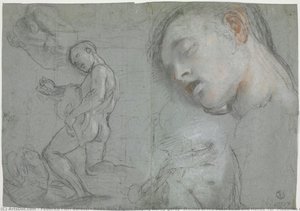
- Five Studies of Male Figure and two of His Right Hand and Arm (Uffizi Gallery, Florence, Italy) - A testament to Barocci’s skill in capturing the human form.
- Composition Study (for “Circumcision”, Paris, Musée du Louvre) – Demonstrates his ability to balance composition and emotion.
- Man’s Head (for “Calling of Saint Andrew”, Bruxelles, Musées Royaux des Beaux-Arts de Belgique) - Showcases Barocci's attention to detail and expression.
- The Nativity (1597 oil painting at the Prado).
- Madonna del Popolo (Uffizi Gallery, Florence, Italy).
- The Madonna of the Cat (La Madonna del Gatto)
- Annunciation (1582)
Artistic Impact and Followers
- Barocci's influence can be seen in the work of various artists, including Peter Paul Rubens, who was inspired by Barocci’s dramatic and emotive brushwork.
- His legacy continues to be celebrated through his numerous works, now housed in museums such as the Uffizi Gallery (Florence, Italy) and the Musée du Louvre (Paris, France).
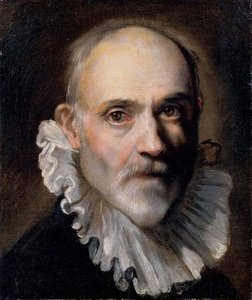
Federico Fiori Barocci
1535 - 1612 , Italy
Quick Facts
- Artistic Movement Or Style: Renaissance, Baroque
- Artists Or Movements Influenced By This Artist: ['Peter Paul Rubens']
- Artists Who Influenced This Artist: ['Battista Franco']
- Date Of Birth: 1535
- Date Of Death: 1612
- Full Name: Federico Fiori Barocci
- Nationality: Italian
- Notable Artworks:
- The Nativity
- Madonna del Popolo
- Annunciation
- Stigmatization of Saint Francis
- Rest on the Flight to Egypt
- Place Of Birth: Urbino, Italy
Related Articles
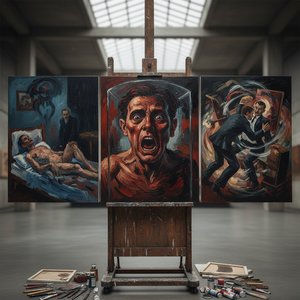
Francis Bacon's Masterpieces: Exploring 25 Iconic Paintings | ArtsDot
Delve into the haunting world of Francis Bacon with ArtsDot. Explore 25 iconic paintings, from his visceral portraits to powerful triptychs. Discover the stories behind these masterpieces & find museum-quality art reproductions for your home. Explore the full collection online!

Baroque Masterpieces: 10 Paintings That Defined an Era |
Journey through the drama & grandeur of Baroque art! Explore 10 masterpieces by Caravaggio, Rembrandt, Rubens & more. Discover stunning oil paintings, rich colors & timeless stories. Find museum-quality reproductions at .

Baroque Drama: Bringing Opulence & Emotion into Contemporary Interiors
Explore the opulent world of Baroque interior design! Discover key elements, modern applications & how to bring dramatic elegance into your home with 's authentic reproductions.
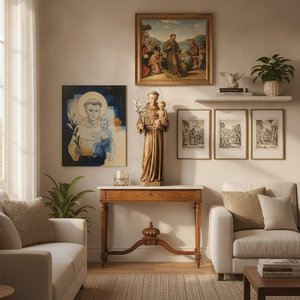
Discover the Divine: Inspiring Saint Anthony Artworks to Elevate Your Home Decor
Transform your home with the profound beauty of Saint Anthony artworks. Explore exquisite Baroque reproductions by Murillo and Zurbarán, hand-painted on 100% cotton canvas to bring divine serenity and timeless elegance to your interior design.

The Dramatic Flourish: Exploring the Baroque Movement's Enduring Legacy in Art History
Explore the dramatic world of Baroque art! Discover iconic artists like Caravaggio & Rubens, defining techniques, and its lasting impact on art history. Expert insights for collectors & enthusiasts at ArtsDot.