 Preview
 Send
Send Share
Share
 Details

 Download
 Similars
 X-Ray
X-Ray Diaporama
Christmas Night
 Oil
Oil- WallArt
- Impressionism
 19th Century
 83.0 x 101.0 cm
 Read More
Hand Made Oil Reproduction
Hand-painted oil on canvas in your size and frame, made to order by our artists. ( Buy Print Buy Image)




P118B $10

P118H $10

P118W $10

P438Z $10

P508JH $12

P508YH $12

P805H $10

P805Z $10

P919BZ $10

P919G $10

P919XJ $10

P959ZH $10

P968JZ $12

W106C $8

W218G $10

W218JH $8

W218Y $10

W307PJ $10

W316G $10

W316PJ $8

W316Y $10

W398PJ $8

W4111J $10

W500HY $15

W500JH $15

W692G $12

W849H $8

W940BG $15

W953PJ $8




Pick from our preset sizes that match the artwork's original proportions.

You may enter your own dimensions to fit a specific frame or space. If your selected size does not match the original image's proportions, we will either crop the artwork or extend the painting with additional hand-painted elements. A digital mockup will be sent for your approval before production begins.
Please note that the on-screen preview does not reflect the actual cropping or extension. Only the mockup will accurately show the final composition.
While custom sizes are available, we recommend selecting a dimension from the predefined list to preserve the original proportions.
After order, ArtsDot.com team will email client for instructions and provide a mockup preview
Worldwide Delivery () in 3/4 weeks instead of standard 5 weeks. (17 August). No compromise on quality.

Free Worldwide Express Shipping

High-Quality Linen Canvas

Full Shipping Insurance

Customs Tax Refund Guarantee

True Color Matching Guarantee

60-Day Return Policy (Defects Only)

100% Money-Back Guarantee

Bulk Discount Offer
 Glass option is only available in size under 110 CM

Christmas Night
Reproduction Medium
Reproduction Size
-


Total Price
$ 263
Artwork Description
A Quiet Radiance: The Intimacy of Christmas Night
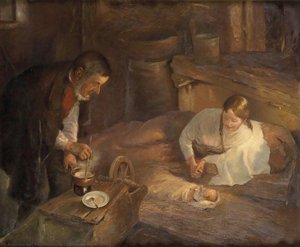
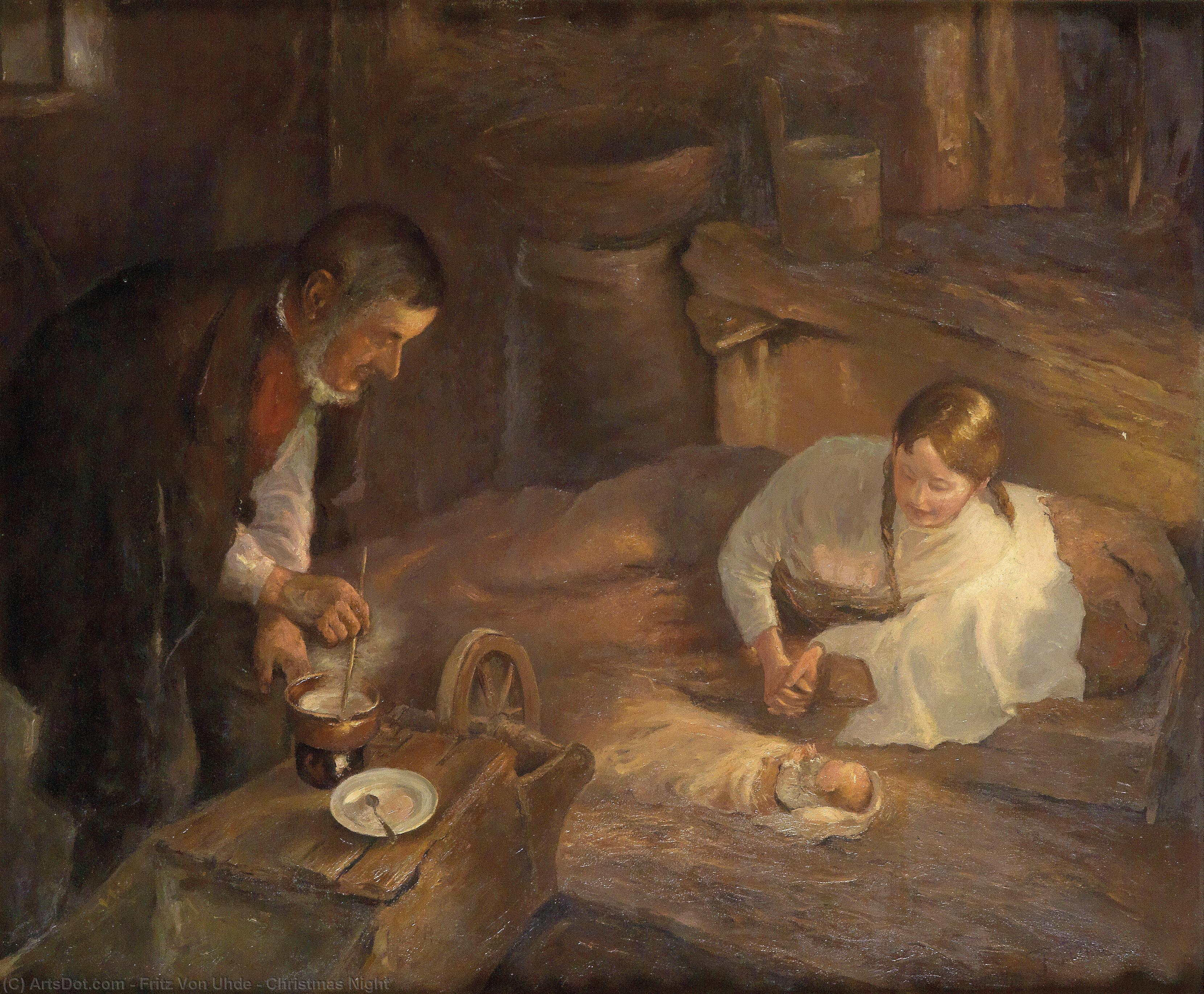
In the soft, flickering glow of Fritz von Uhde’s Christmas Night, we are invited into a sanctuary of profound domestic peace. This evocative masterpiece captures a fleeting moment of stillness within a family gathering, where the weight of the world seems to dissolve into the warmth of a shared holiday. The composition centers on a tender scene: a woman cradling her infant upon a bed, her presence serving as the emotional anchor of the room. Around her, the subtle movements of other figures—a person standing nearby, others positioned at the periphery—create a sense of lived-in reality. It is not merely a depiction of a holiday; it is an exploration of the sacredness found within the mundane, where the simple act of being together becomes a form of quiet worship.
The room itself is a character in this narrative, filled with the humble artifacts of daily life that lend the scene its authentic, grounded atmosphere. A cup rests near the center, a bowl sits to the left, and a small spoon catches the light in the corner, while a bottle stands poised in the upper reaches of the frame. These scattered objects are not mere clutter; they are the textures of existence, grounding the spiritual significance of Christmas in the tangible reality of a home. For the collector or interior designer, this painting offers a unique ability to infuse a space with a sense of "hygge"—that much-coveted feeling of cozy contentment and soulful security.
The Intersection of Realism and Impressionist Light
Fritz von Uhde was a pioneer of his era, a master who navigated the delicate boundary between the gritty truth of Realism and the luminous, atmospheric possibilities of Impressionism. In Christmas Night, we see this technical mastery on full display. Rather than relying on the rigid, studio-bound lighting of the traditional academy, Uhde employs a technique that suggests the soft, diffused light of an indoor evening, perhaps filtered through candlelight or a low hearth. His brushwork is deliberate yet fluid, capturing the way light clings to fabric and skin, creating a sense of volume and warmth that feels almost tactile.
As one of the first German artists to champion plein-air sensibilities within genre painting, Uhde brings an unprecedented naturalism to this interior scene. He avoids the overly dramatic or theatrical, opting instead for a subtle play of shadows and highlights that mimics the way our eyes truly perceive a dim room. This approach creates a profound emotional resonance; the viewer does not feel like an intruder looking through a window, but rather a silent participant sitting in the corner of the room, breathing in the same quiet air as the subjects. For those seeking to decorate with art that possesses both depth and light, this piece serves as a perfect focal point, offering a sophisticated interplay of shadow and warmth.
A Legacy of Devotion and Human Connection
To understand the soul of Christmas Night, one must look to the artist’s own background. Raised in a Lutheran environment and deeply influenced by his family's connection to the arts, Uhde possessed a unique ability to depict religious themes through a humanistic lens. He did not paint grand, distant biblical epics; instead, he found the divine in the everyday. In this work, the "Christmas" of the title is not found in grand decorations or external spectacle, but in the quiet, rhythmic pulse of family devotion and the protection of the new generation.
This painting resonates deeply with the modern collector because its themes are universal and timeless. It speaks to the enduring human need for connection, safety, and the celebration of life's smallest miracles. Whether placed in a grand living room or a quiet study, a high-quality reproduction of this work brings with it an aura of contemplative grace. It is an investment in an atmosphere of peace, providing a visual anchor that reminds all who view it of the enduring beauty found in the quietest moments of our lives.
Related Artworks
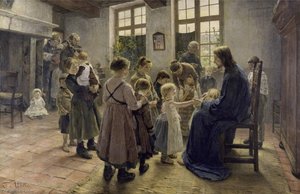
Artist Biography
Early Life and Artistic Influences
Fritz von Uhde (born Friedrich Hermann Carl Uhde; 22 May 1848 – 25 February 1911) was a German painter of genre and religious subjects. His style lay between Realism and Impressionism, marking him as one of the first artists to champion plein-air painting in Germany—a bold departure from the studio tradition dominant at the time. Born in Wolkenburg, Saxony, Uhde’s familial background instilled within him a deep appreciation for artistic pursuits. His father, a part-time painter himself, and his maternal grandfather, director of the Royal Museums in Dresden, nurtured an environment rich in visual culture. From a young age, Uhde demonstrated a fervent fascination with art at Gymnasium, where he excelled academically and found solace in creative expression. Notably, his family’s Lutheran faith profoundly shaped his worldview and artistic sensibilities.Academic Training and Military Service
Driven by this passion, Uhde enrolled at the Dresden Academy of Fine Arts in 1866, encountering a prevailing artistic spirit markedly different from his own inclinations. Dissatisfied with the academy’s conservative approach, he swiftly abandoned formal studies to join the army, serving as horsemanship instructor to the regiment of the assembled guard and achieving the rank of Lieutenant in 1868. This military experience broadened his perspective and honed his observational skills—skills that would prove invaluable later in his artistic endeavors. The encounter with painter Makart in Vienna in 1876 proved pivotal, sparking a desire for independent artistic exploration and ultimately leading to his departure from the army in 1877.The Pursuit of Artistic Independence and Parisian Influences
Determined to forge his own path, Uhde relocated to Munich in 1877, immersing himself in the vibrant artistic milieu of the Bavarian capital and enrolling at the Academy there. Seeking inspiration from Dutch Old Masters—particularly Rembrandt—he diligently studied their techniques and compositional strategies. He also found mentorship under Lilla Cabot Perry, whose influence extended beyond mere stylistic imitation; Perry encouraged Uhde to embrace a more expressive use of color, reflecting the burgeoning Impressionist movement. Despite facing rejection from prestigious studios like Piloty’s or Lindenschmit’s, Uhde persevered in his quest for artistic recognition, traveling to Paris in 1879 where he continued his studies under Mihály Munkácsy's guidance.The Impressionist Breakthrough and Munich Secession
A transformative journey to the Netherlands in 1882 decisively altered Uhde’s artistic trajectory, prompting him to abandon the dark chiaroscuro favored by Munich artists in favor of a colorism deeply rooted in Impressionist principles. Encouraged by fellow artist Adolf Hölzel, Uhde experimented with plein-air painting—capturing landscapes and scenes directly from nature—a technique championed by luminaries like Claude Monet and Pierre Auguste Renoir. His iconic painting “The Singer” (1880), exhibited at the Paris Salon, garnered honorable mention and signaled a breakthrough moment in his artistic career. Recognizing the need for artistic renewal beyond academic confines, Uhde co-founded the Munich Secession in 1890 alongside Ludwig Dill and Lovis Corinth—a collective dedicated to challenging established conventions and advocating for a more liberated aesthetic vision.Later Years and Legacy
Throughout his later years, Uhde continued to produce masterful paintings characterized by profound psychological depth and symbolic resonance. His work achieved considerable acclaim during his lifetime, earning him honorary membership in the academies of Munich, Dresden, and Berlin. He became the first President of the Secession, solidifying his role as a leader within the German avant-garde. Considered one of the most important artists of the 20th century, Fritz von Uhde’s enduring influence can be seen in the works of subsequent generations of painters—artists who embraced his pioneering spirit and championed the expressive power of color and observation.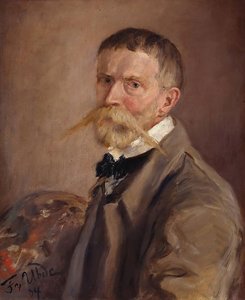
Fritz von Uhde
1848 - 1911
Quick Facts
- Artistic Movement Or Style: Impressionism
- Artists Or Movements Influenced By This Artist: ['Vincent van Gogh']
- Artists Who Influenced This Artist:
- Rembrandt
- Makart
- Date Of Birth: May 22, 1848
- Date Of Death: February 25, 1911
- Full Name: Fritz Hermann Carl Uhde
- Nationality: German
- Notable Artworks:
- The Singer
- Fishermen's Children
- Place Of Birth: Wolkenburg, Saxony
Related Articles
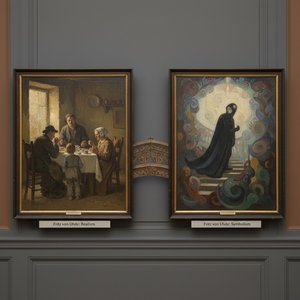
Fritz von Uhde: Bridging Realism & Symbolism in Late 19th-Century German Painting
Explore the captivating world of Fritz von Uhde, a pivotal German painter bridging Realism & Symbolism. Discover his plein-air techniques, religious themes, and influence on modern art. Learn about this fascinating artist at ArtsDot.
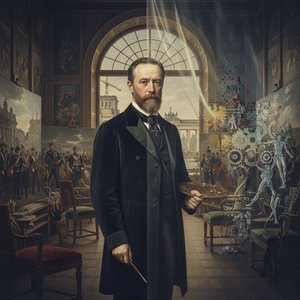
Anton von Werner: Imperial Painter, Historical Witness & Shifting German Identity
Explore the life & work of Anton von Werner, Imperial Germany's leading painter. Discover his dramatic depictions of war, unification, and court life – a fascinating insight into 19th-century German history & art.
Impressionism's Masterpieces: 10 Paintings That Defined a Movement | ArtsDot
Journey through Impressionism's heart with 10 iconic paintings by Monet, Renoir & Degas. Explore light, color & the stories behind these masterpieces. Find museum-quality art reproductions and elevate your home decor on ArtsDot.com.
Post-Impressionism's 10 Defining Masterpieces: Art for Your Home |
Journey through Post-Impressionism's 10 defining masterpieces – Van Gogh, Monet & more. Explore iconic paintings, art history & find museum-quality reproductions for your home at . Discover all masterpieces online!
Fleeting Moments & Radiant Light: Exploring the Enduring Legacy of Impressionism
Explore the captivating world of Impressionism! Discover its history, key artists like Monet & Renoir, defining techniques, and lasting impact on modern art. Expert insights for collectors.