 Preview
 Send
Send Share
Share
 Details

 Download
 Similars
 X-Ray
X-Ray Diaporama
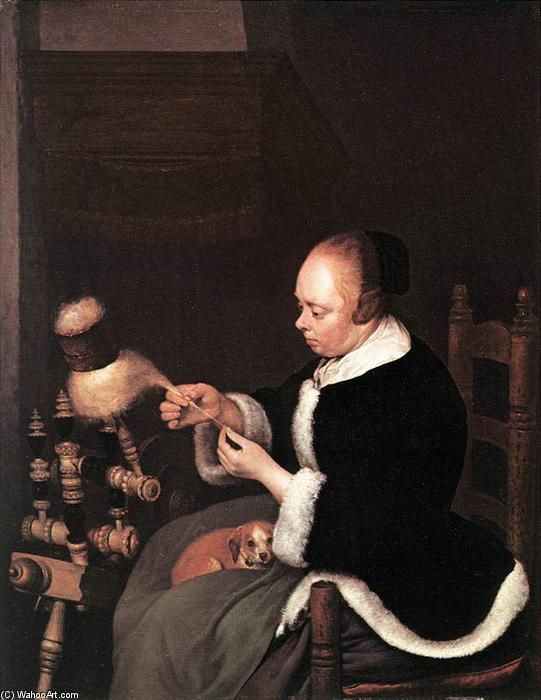
A Woman Spinning


 Read More
Hand Made Oil Reproduction
Hand-painted oil on canvas in your size and frame, made to order by our artists. ( Buy Print Buy Image)




P118B $10

P118H $10

P118W $10

P438Z $10

P508JH $12

P508YH $12

P805H $10

P805Z $10

P919BZ $10

P919G $10

P919XJ $10

P959ZH $10

P968JZ $12

W106C $8

W218G $10

W218JH $8

W218Y $10

W307PJ $10

W316G $10

W316PJ $8

W316Y $10

W398PJ $8

W4111J $10

W500HY $15

W500JH $15

W692G $12

W849H $8

W940BG $15

W953PJ $8




Pick from our preset sizes that match the artwork's original proportions.

You may enter your own dimensions to fit a specific frame or space. If your selected size does not match the original image's proportions, we will either crop the artwork or extend the painting with additional hand-painted elements. A digital mockup will be sent for your approval before production begins.
Please note that the on-screen preview does not reflect the actual cropping or extension. Only the mockup will accurately show the final composition.
While custom sizes are available, we recommend selecting a dimension from the predefined list to preserve the original proportions.
After order, ArtsDot.com team will email client for instructions and provide a mockup preview
Worldwide Delivery () in 3/4 weeks instead of standard 5 weeks. (17 August). No compromise on quality.

Free Worldwide Express Shipping

High-Quality Linen Canvas

Full Shipping Insurance

Customs Tax Refund Guarantee

True Color Matching Guarantee

60-Day Return Policy (Defects Only)

100% Money-Back Guarantee

Bulk Discount Offer
 Glass option is only available in size under 110 CM

A Woman Spinning
Reproduction Medium
Reproduction Size
-


Total Price
$ 263
Artwork Description
A Moment Frozen in Time: Gerard ter Borch’s “A Woman Spinning”
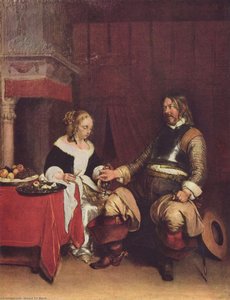
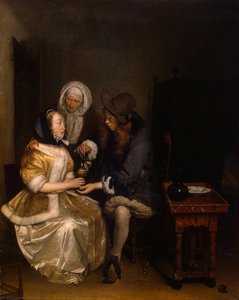
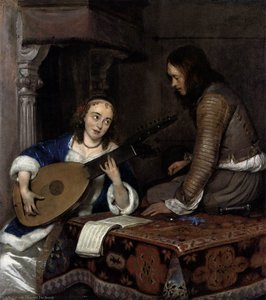
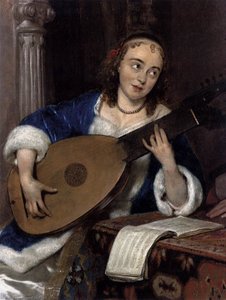
Gerard ter Borch's "A Woman Spinning," painted circa 1653, isn’t merely a depiction of domestic labor; it’s a profound study of human connection and the quiet dignity of everyday life. Within the dimly lit confines of a Dutch interior – a space hinting at both wealth and restraint – ter Borch captures a scene brimming with subtle emotion and an almost palpable sense of intimacy. The painting immediately draws the eye to the central figure, a woman seated in a simple wooden chair, her hands deftly manipulating a spindle and yarn. Her posture is relaxed yet focused, suggesting a meditative state entirely absorbed in her task – a testament to the skill and patience required for this traditionally female occupation. It’s a scene that transcends its apparent simplicity, offering a glimpse into the heart of 17th-century Dutch society.The Master of Psychological Realism
Ter Borch was a pivotal figure in the development of Dutch genre painting, a movement that shifted the focus from grand historical narratives to intimate portrayals of ordinary people. Unlike many of his contemporaries who favored dramatic compositions and idealized figures, ter Borch meticulously observed and rendered the nuances of human behavior. He wasn’t interested in creating heroic scenes; instead, he sought to capture the subtle expressions, gestures, and interactions that defined everyday life. “A Woman Spinning” exemplifies this approach perfectly. The artist's mastery lies not just in his technical skill – the delicate rendering of textures like the wool yarn, the worn wood of the chair, and the woman’s clothing – but also in his ability to convey a complex range of emotions through seemingly simple details. The slight furrow of her brow, the gentle curve of her hand, all speak volumes about her inner state.A Window into Dutch Domesticity
To understand the painting fully, it's crucial to consider its historical context. 17th-century Holland was a prosperous nation fueled by trade and industry, yet beneath the veneer of wealth lay a deeply ingrained social hierarchy. The domestic sphere – particularly the home – held immense significance, representing stability, family values, and the continuity of tradition. Spinning yarn wasn’t simply a chore; it was an essential part of the household economy, providing clothing for the family and contributing to its overall well-being. Ter Borch's depiction offers a rare and intimate view into this world, revealing the quiet dignity and resourcefulness of women who sustained their families through their labor. The presence of the small dog nestled at her feet adds another layer of warmth and companionship, reinforcing the sense of domestic tranquility.Symbolism and Light: Ter Borch’s Signature Style
Ter Borch's use of light is particularly noteworthy. He employs a muted palette – predominantly browns, grays, and ochres – to create a sense of subdued drama. The light source appears to be coming from an unseen window on the left, casting long shadows across the room and illuminating the woman’s face and hands with a soft, ethereal glow. This careful manipulation of light not only enhances the realism of the scene but also imbues it with a profound emotional resonance. The darkness surrounding the figure emphasizes her centrality, drawing the viewer's attention to her solitary activity and inner thoughts. The composition itself is carefully balanced, creating a sense of stability and harmony – reflecting the values that were so highly prized in Dutch society.A Timeless Portrait of Human Connection
“A Woman Spinning” transcends its historical context to offer a timeless meditation on human connection, labor, and the beauty of everyday life. It’s a painting that invites us to slow down, observe closely, and appreciate the quiet dignity of those who sustain our world. More than just a portrait, it's a poignant reminder of the enduring power of simple acts – like spinning yarn – to connect us to our past, to each other, and to ourselves. It remains a captivating example of ter Borch’s unparalleled ability to capture the essence of human experience with remarkable sensitivity and skill.Related Artworks
Artist Biography
**a pioneer of dutch genre painting**
gerard ter borch, a prominent figure in the dutch golden age, left an indelible mark on the art world with his genre paintings. born in december 1617 and passing away on december 8, 1681, ter borch's life was a testament to his artistic prowess.**early life and influences**
ter borch's early life is not well-documented, but it is known that he traveled extensively throughout europe, including london, germany, france, spain, and italy. this exposure broadened his artistic horizons, influencing his unique style. his sister, gesina ter borch, also pursued a career in painting, further solidifying the family's artistic inclinations.**notable works and achievements**
- **the letter**: a masterpiece showcasing ter borch's skill in capturing texture and light. - **the gallant conversation**: engraved by johann georg wille, this piece exemplifies the artist's ability to convey nuanced emotions. - **man on horseback (1634)**: an early work demonstrating ter borch's emerging talent. - **adrian pauw's arrival in münster (1646)**: a significant piece that highlights the artist's narrative capabilities.**museums and collections featuring ter borch's work**
- the hermitage: with six of his works, it boasts one of the largest collections. - berlin museum: features six pieces, showcasing ter borch's international appeal. - getty center: three of his paintings are part of this esteemed collection.**legacy and impact**
ter borch's influence on dutch painters like gabriel metsu, gerrit dou, eglon van der neer, and johannes vermeer is well-documented. his innovative approach to genre painting has made him a pivotal figure in the history of art.- for more on ter borch's life and works, visit https://ArtsDot.com/@/gerard-ter-borch
- explore the museum boijmans van beuningen rotterdam, netherlands, featuring some of ter borch's contemporaries at https://ArtsDot.com/@@/a@d3arrk-museum-boijmans-van-beuningen-rotterdam-netherlands
- learn more about the dutch golden age and its notable artists at https://en.wikipedia.org/wiki/dutch_golden_age
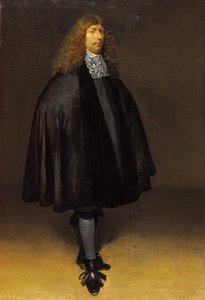
Gerard ter Borch
1617 - 1681 , Netherlands
Quick Facts
- Artistic Movement Or Style: Genre painting
- Artists Or Movements Influenced By This Artist: ['Diego Velázquez']
- Artists Who Influenced This Artist:
- Gabriel Metsu
- Gerrit Dou
- Eglon van der Neer
- Johannes Vermeer
- Date Of Birth: December 1617
- Date Of Death: 8 December 1681
- Full Name: Gerard ter Borch
- Nationality: Dutch
- Notable Artworks:
- The Letter
- The Gallant Conversation
- Man on horseback
- Adrian Pauw's arrival in Münster
- Place Of Birth: Zwolle, Netherlands
Related Articles
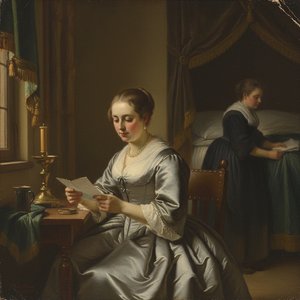
Gerard ter Borch: Intimacy & Light in the Dutch Golden Age
Explore the captivating world of Gerard ter Borch, a master of Dutch Golden Age genre painting. Discover his intimate scenes, masterful light, and lasting influence on art history. Learn more at ArtsDot.

Golden Age Reflections: Dutch Baroque Painting & Cultural Innovation
Explore the Dutch Golden Age of painting! Discover key artists like Vermeer & ter Borch, their innovative techniques, and the rich cultural context behind these Baroque masterpieces. Learn about collecting & appreciating this iconic art period.

Dutch Masters: 10 Golden Age Paintings That Still Inspire |
Journey into the Dutch Golden Age! Explore 10 iconic paintings by Rembrandt, Vermeer & Hals. Discover the stories behind these Baroque masterpieces and find museum-quality art reproductions to elevate your home decor on .

Illuminating Innovation: Exploring the Dutch Golden Age of Painting
Explore the Dutch Golden Age of painting with ArtsDot. Discover Rembrandt, Vermeer & other Masters. Learn about key characteristics, iconic artworks, and lasting influence. Expert insights for collectors & enthusiasts.
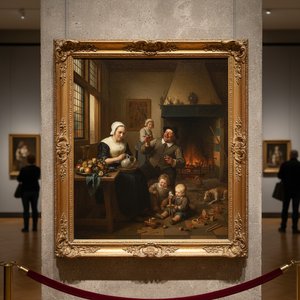
Genre Painting: A Window into Daily Life & Societal Values of the Dutch Golden Age
Explore the captivating world of Dutch Golden Age genre painting! Discover realistic depictions of daily life, masterful artists like Ostade & Metsu, and hidden symbolism. Learn about this influential art movement with ArtsDot.