 Preview
 Send
Send Share
Share
 Details

 Download
 Similars
 X-Ray
X-Ray Diaporama
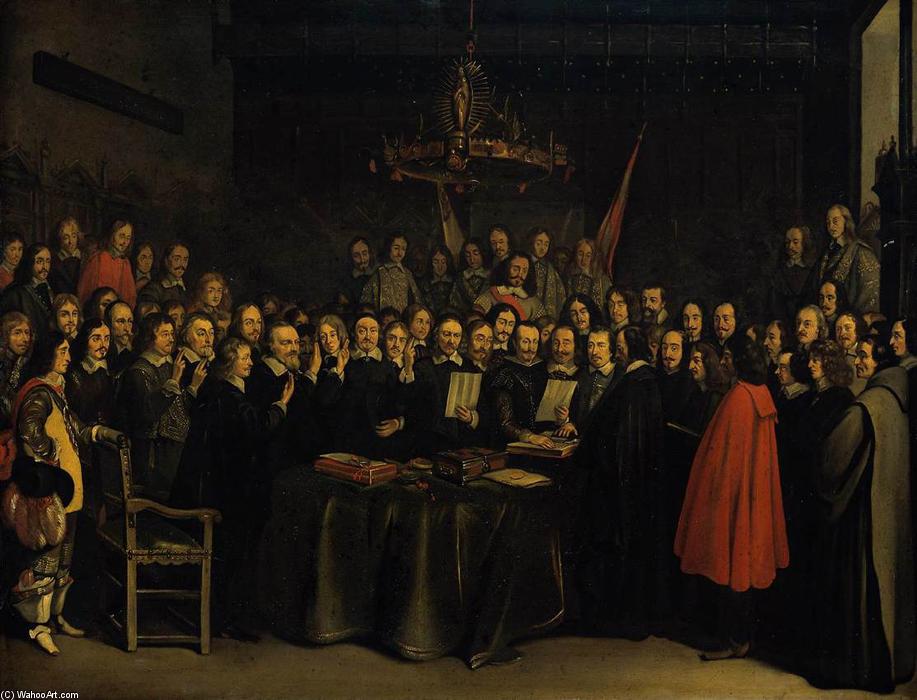
The Ratification of the Treaty of Münster, 15 May 1648
 Acrylic On Canvas
- WallArt
- Dutch Golden Age
 1648
1648 46.0 x 60.0 cm
 Rijksmuseum
 Read More
Giclée / Art Print
Museum-quality giclée or canvas print with fast production and flexible finish options. ( Buy Hand Made Painting Buy Image)




P118B $10

P118H $10

P118W $10

P438Z $10

P508JH $12

P508YH $12

P805H $10

P805Z $10

P919BZ $10

P919G $10

P919XJ $10

P959ZH $10

P968JZ $12

W106C $8

W218G $10

W218JH $8

W218Y $10

W307PJ $10

W316G $10

W316PJ $8

W316Y $10

W398PJ $8

W4111J $10

W500HY $15

W500JH $15

W692G $12

W849H $8

W940BG $15

W953PJ $8




Pick from our preset sizes that match the artwork's original proportions.

You may enter your own dimensions to fit a specific frame or space. If your selected size does not match the original image's proportions, we will either crop the artwork or extend the image with a mirrored or solid-fill edge. A digital mockup will be sent for your approval before production begins.
Please note that the on-screen preview does not reflect the actual cropping or extension. Only the mockup will accurately show the final composition.
While custom sizes are available, we recommend selecting a dimension from the predefined list to preserve the original proportions.
Worldwide Delivery () in 2 weeks instead of standard 4/5 weeks. (3 September)

Free Worldwide Express Shipping

High-Quality Linen Canvas

Full Shipping Insurance

Customs Tax Refund Guarantee

True Color Matching Guarantee

60-Day Return Policy (Defects Only)

100% Money-Back Guarantee

Bulk Discount Offer
 Glass option is only available in size under 110 CM

The Ratification of the Treaty of Münster, 15 May 1648
Giclée / Art Print
Reproduction Size
-


Total Price
$ 63
A Moment of Negotiation: Gerard ter Borch’s “The Ratification of the Treaty of Münster”
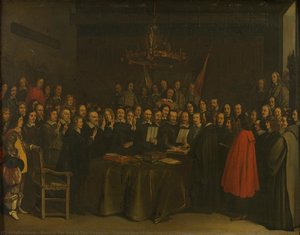
Gerard ter Borch's "The Ratification of the Treaty of Münster, 15 May 1648" isn’t merely a historical painting; it’s a meticulously crafted tableau vivant, a frozen moment brimming with political tension and subtle human drama. Completed in 1648, just as the tumultuous Peace of Westphalia concluded decades of devastating warfare across Europe, this work offers an intimate glimpse into the complex negotiations that reshaped the continent's map – and its future. The scene unfolds within the imposing yet restrained setting of a town hall, likely in Münster, Germany, where representatives from France, Spain, and the Dutch Republic gathered to formally sign the treaty that brought an end to the Eighty Years’ War. Ter Borch masterfully captures not just the physical presence of these dignitaries, but also their psychological states – a delicate balance of authority, apprehension, and perhaps even weary satisfaction.A Masterclass in Dutch Genre Painting
Ter Borch was a pivotal figure in the development of Dutch genre painting, a movement that shifted away from grand historical narratives towards depictions of everyday life with remarkable realism and psychological depth. Unlike many of his contemporaries who favored heroic or dramatic subjects, Ter Borch focused on capturing the nuances of human interaction within domestic settings – a letter being read, a conversation unfolding, a gentleman contemplating a book. This intimate approach is powerfully evident in “The Ratification,” where he eschews overt displays of power and instead concentrates on the subtle gestures, expressions, and interactions that reveal the characters’ inner lives. His skill lies not just in rendering accurate likenesses, but in conveying an atmosphere of quiet intensity – a sense that something significant is about to unfold, or has just concluded.Light, Texture, and the Language of Gesture
Technically, Ter Borch's work is characterized by his extraordinary ability to render light and texture with unparalleled precision. He employed a layered technique, building up thin glazes of paint to create an illusion of depth and luminosity. Notice how the light streams through the windows, illuminating faces and highlighting folds in clothing – details that contribute significantly to the painting’s overall realism. Crucially, Ter Borch was also a master of gesture. The figures aren't posed stiffly; they are caught mid-action, their hands raised, eyes lowered, bodies subtly angled towards one another. These gestures communicate volumes—a deliberate exchange of words, a moment of contemplation, the weight of responsibility. The careful arrangement of these small details creates a compelling narrative that transcends mere representation.Symbolism and the Weight of History
Beyond its immediate depiction of the treaty signing, “The Ratification” is rich in symbolic detail. The presence of two copies of the treaty – one held by each delegation – underscores the importance of this agreement. The books scattered across the table suggest intellectual discourse and the weighty deliberations that preceded it. The expressions on the faces of the figures—a mixture of solemnity, cautious optimism, and perhaps a touch of weariness—reflect the profound impact of decades of war and conflict. Ter Borch subtly reminds us that behind every treaty, every political agreement, lies a complex web of human emotions, ambitions, and sacrifices. The painting serves as a poignant reminder of the fragility of peace and the enduring consequences of conflict.A Timeless Reflection on Human Nature
“The Ratification of the Treaty of Münster” is more than just a historical record; it’s a profound meditation on human nature—on our capacity for both diplomacy and discord, for reason and emotion. Ter Borch's ability to capture the quiet drama of everyday life, combined with his masterful technical skill, makes this painting a timeless masterpiece. Reproductions offer an accessible way to appreciate the artistry and insight contained within this remarkable work, allowing viewers to connect with a pivotal moment in European history and contemplate the enduring complexities of human interaction.Related Artworks

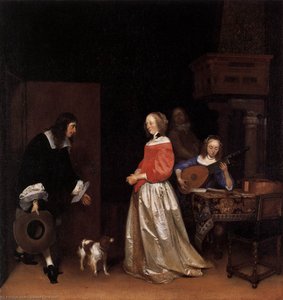
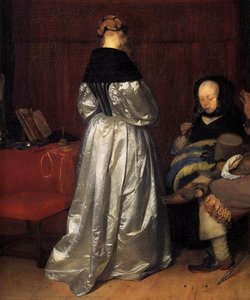
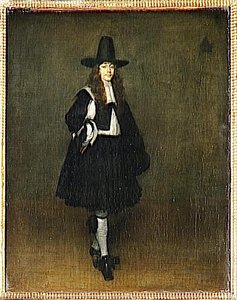
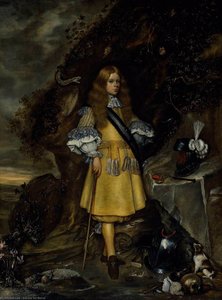
Artist Biography
**a pioneer of dutch genre painting**
gerard ter borch, a prominent figure in the dutch golden age, left an indelible mark on the art world with his genre paintings. born in december 1617 and passing away on december 8, 1681, ter borch's life was a testament to his artistic prowess.**early life and influences**
ter borch's early life is not well-documented, but it is known that he traveled extensively throughout europe, including london, germany, france, spain, and italy. this exposure broadened his artistic horizons, influencing his unique style. his sister, gesina ter borch, also pursued a career in painting, further solidifying the family's artistic inclinations.**notable works and achievements**
- **the letter**: a masterpiece showcasing ter borch's skill in capturing texture and light. - **the gallant conversation**: engraved by johann georg wille, this piece exemplifies the artist's ability to convey nuanced emotions. - **man on horseback (1634)**: an early work demonstrating ter borch's emerging talent. - **adrian pauw's arrival in münster (1646)**: a significant piece that highlights the artist's narrative capabilities.**museums and collections featuring ter borch's work**
- the hermitage: with six of his works, it boasts one of the largest collections. - berlin museum: features six pieces, showcasing ter borch's international appeal. - getty center: three of his paintings are part of this esteemed collection.**legacy and impact**
ter borch's influence on dutch painters like gabriel metsu, gerrit dou, eglon van der neer, and johannes vermeer is well-documented. his innovative approach to genre painting has made him a pivotal figure in the history of art.- for more on ter borch's life and works, visit https://ArtsDot.com/@/gerard-ter-borch
- explore the museum boijmans van beuningen rotterdam, netherlands, featuring some of ter borch's contemporaries at https://ArtsDot.com/@@/a@d3arrk-museum-boijmans-van-beuningen-rotterdam-netherlands
- learn more about the dutch golden age and its notable artists at https://en.wikipedia.org/wiki/dutch_golden_age
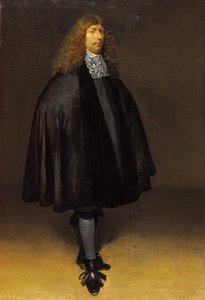
Gerard ter Borch
1617 - 1681 , Netherlands
Quick Facts
- Artistic Movement Or Style: Genre painting
- Artists Or Movements Influenced By This Artist: ['Diego Velázquez']
- Artists Who Influenced This Artist:
- Gabriel Metsu
- Gerrit Dou
- Eglon van der Neer
- Johannes Vermeer
- Date Of Birth: December 1617
- Date Of Death: 8 December 1681
- Full Name: Gerard ter Borch
- Nationality: Dutch
- Notable Artworks:
- The Letter
- The Gallant Conversation
- Man on horseback
- Adrian Pauw's arrival in Münster
- Place Of Birth: Zwolle, Netherlands
Related Articles
Gerard ter Borch: Intimacy & Light in the Dutch Golden Age
Explore the captivating world of Gerard ter Borch, a master of Dutch Golden Age genre painting. Discover his intimate scenes, masterful light, and lasting influence on art history. Learn more at ArtsDot.

Golden Age Reflections: Dutch Baroque Painting & Cultural Innovation
Explore the Dutch Golden Age of painting! Discover key artists like Vermeer & ter Borch, their innovative techniques, and the rich cultural context behind these Baroque masterpieces. Learn about collecting & appreciating this iconic art period.

Dutch Masters: 10 Golden Age Paintings That Still Inspire |
Journey into the Dutch Golden Age! Explore 10 iconic paintings by Rembrandt, Vermeer & Hals. Discover the stories behind these Baroque masterpieces and find museum-quality art reproductions to elevate your home decor on .

Illuminating Innovation: Exploring the Dutch Golden Age of Painting
Explore the Dutch Golden Age of painting with ArtsDot. Discover Rembrandt, Vermeer & other Masters. Learn about key characteristics, iconic artworks, and lasting influence. Expert insights for collectors & enthusiasts.
Illuminating Realism: Exploring the Dutch Golden Age of Painting (1600-1700)
Explore the Dutch Golden Age of painting (1600-1700) with ArtsDot. Discover Rembrandt, Vermeer & other masters. Learn about techniques, history & find museum-quality reproductions.