 Preview
 Send
Send Share
Share
 Details

 Download
 Similars
 X-Ray
X-Ray Diaporama
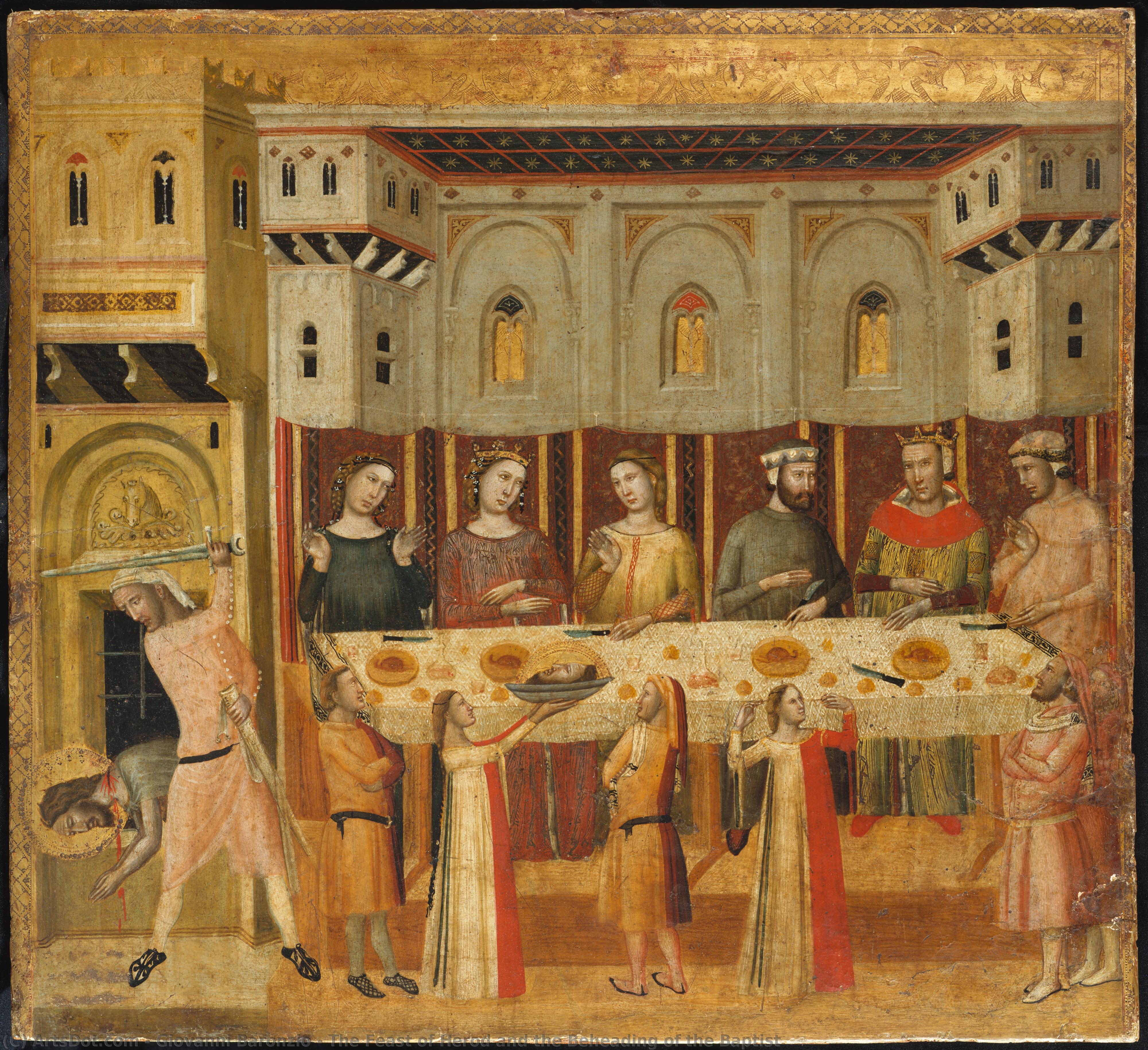
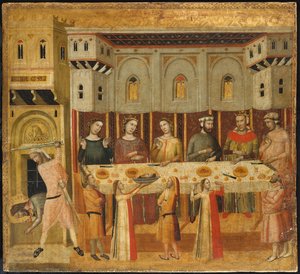
The Feast of Herod and the Beheading of the Baptist
 Tempera On Panel
- Proto-Renaissance
 1330
1330 44.0 x 50.0 cm
 Metropolitan Museum of Art
 Read More
Hand Made Oil Reproduction
Hand-painted oil on canvas in your size and frame, made to order by our artists. ( Buy Print Buy Image)




P118B $10

P118H $10

P118W $10

P438Z $10

P508JH $12

P508YH $12

P805H $10

P805Z $10

P919BZ $10

P919G $10

P919XJ $10

P959ZH $10

P968JZ $12

W106C $8

W218G $10

W218JH $8

W218Y $10

W307PJ $10

W316G $10

W316PJ $8

W316Y $10

W398PJ $8

W4111J $10

W500HY $15

W500JH $15

W692G $12

W849H $8

W940BG $15

W953PJ $8




Pick from our preset sizes that match the artwork's original proportions.

You may enter your own dimensions to fit a specific frame or space. If your selected size does not match the original image's proportions, we will either crop the artwork or extend the painting with additional hand-painted elements. A digital mockup will be sent for your approval before production begins.
Please note that the on-screen preview does not reflect the actual cropping or extension. Only the mockup will accurately show the final composition.
While custom sizes are available, we recommend selecting a dimension from the predefined list to preserve the original proportions.
After order, ArtsDot.com team will email client for instructions and provide a mockup preview
Worldwide Delivery () in 3/4 weeks instead of standard 5 weeks. (16 August). No compromise on quality.

Free Worldwide Express Shipping

High-Quality Linen Canvas

Full Shipping Insurance

Customs Tax Refund Guarantee

True Color Matching Guarantee

60-Day Return Policy (Defects Only)

100% Money-Back Guarantee

Bulk Discount Offer
 Glass option is only available in size under 110 CM

The Feast of Herod and the Beheading of the Baptist
Reproduction Medium
Reproduction Size
-


Total Price
$ 263
Artwork Description
A Dramatic Echo from the Italian Renaissance
To stand before Giovanni Baronzio's "The Feast of Herod and the Beheading of the Baptist" is to step directly into the charged atmosphere of fourteenth-century Rimini. This tempera on panel, dating to 1330, is far more than a mere depiction of martyrdom; it is a masterful convergence of narrative drama, profound religious symbolism, and groundbreaking artistic technique. Baronzio, a key figure in the vibrant, yet often overlooked, school of Romagna, channels the monumental spirit inherited from Giotto di Bondone while imbuing the scene with a refined, almost lyrical grace. The sheer energy captured within this panel speaks to an era when religious storytelling reached breathtaking heights of emotional realism.
The Narrative Heart: Power and Peril
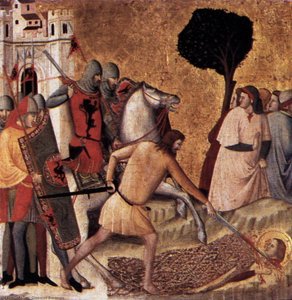
The composition unfolds around a moment of ultimate transgression—the brutal climax following a lavish feast held in the palace of King Herod. One can almost smell the rich spices mingling with the metallic tang of impending violence. At the center, the drama is palpable: the request, the dance, and finally, the cold steel of the sword poised for action. The gathering crowd, numbering at least thirteen figures, serves as a complex tapestry of humanity—some draped in the finery suggesting nobility, others embodying the watchful curiosity of common folk. These onlookers are not passive; their varied gazes and postures suggest complicity, shock, and morbid fascination, drawing the viewer into the moral ambiguity of the event itself.
Mastery in Tempera and Perspective
Technically, the work is a testament to Baronzio's skill. Executed in tempera on panel, the medium allows for an exquisite luminosity and detail that remains startling even today. Observe the intricate rendering of the textiles—the vibrant reds and whites adorning Salome’s attire contrast sharply with the somber tones of the background architecture. Furthermore, Baronzio employs a sophisticated understanding of spatial relationships. The overlapping planes and daring perspective guide the eye deep into the scene, giving the illusion that the viewer is standing right within the castle courtyard, witnessing the unfolding tragedy firsthand.
Symbolism Woven into the Scene
The symbolism here is rich and multi-layered. Beyond the immediate violence, the painting speaks to themes of divine justice confronting earthly power. The presence of scattered bowls and cups hints at the preceding revelry—a temporary distraction from a deeper moral reckoning. This panel is understood as part of an extensive series detailing the life of Saint John the Baptist, suggesting that this scene was intended for a grand altarpiece setting. It invites contemplation on sacrifice, obedience, and the enduring power of truth against royal decree.
Bringing Sacred Drama Home
For the collector or designer seeking art with profound narrative weight, this reproduction offers an unparalleled connection to the early Italian Renaissance spirit. While its original scale was substantial, owning a high-quality rendition allows one to integrate such monumental storytelling into a modern space. It is a piece that demands attention, sparking conversations about history, faith, and the enduring tension between spectacle and sanctity.
Related Artworks
Artist Biography
Giovanni Baronzio: A Rimini Master of the Fourteenth Century
The name Giovanni Baronzio, often rendered as Giovanni da Rimini, represents a pivotal figure in the artistic landscape of late medieval Italy – specifically, the burgeoning school of painting centered around the city of Rimini. While shrouded in some historical ambiguity, and initially misidentified with other artists, modern scholarship has firmly established Baronzio as a distinct and remarkably talented painter active during the second quarter of the 14th century. His legacy lies not in grand, monumental works, but rather in a series of exquisitely detailed panels and frescoes that offer a compelling glimpse into the evolving artistic traditions of Romagna and Marche – regions deeply influenced by the innovations of Giotto di Bondone.
Born around 1320 (though his precise birthdate remains elusive), Baronzio’s early life is largely undocumented. What we know with certainty is that he emerged as a painter during a period of intense artistic ferment, inheriting and adapting the stylistic principles of Giotto while simultaneously forging his own unique visual language. The documentary evidence pointing to him as an artist comes primarily from a deed dated 1343, which identifies “Iohanne Baroncio pictore” – John Baronzio, painter – as a witness. This single record provides the foundation for understanding his career and artistic identity.
The Influence of Giotto and the Rimini School
Baronzio’s work is inextricably linked to the legacy of Giotto di Bondone, who had established a workshop in Rimini around 1300. Giotto's influence on the Riminese school was profound, shaping its approach to composition, color, and figural representation. Baronzio, like his contemporaries Giuliano, Pietro, and Giovanni da Rimini, absorbed these principles, yet he didn’t simply replicate them; instead, he skillfully integrated them into a distinctly local style. This involved a careful attention to detail, a refined use of color palettes – often employing muted earth tones and delicate blues and greens – and an emphasis on creating a sense of depth and realism within the confines of panel painting.
The “polyptych representing the Madonna and Child Enthroned with Saints” (now in the Galleria Nazionale delle Marche, Palazzo Ducale, Urbino) stands as the cornerstone of our understanding of Baronzio’s oeuvre. This monumental work, dating from around 1340-45, showcases his technical skill and artistic sensibility. It also provides a crucial starting point for reconstructing his broader body of work, which includes scenes from the life of Christ, devotional panels, and likely numerous altarpieces that have unfortunately vanished or remain unattributed.
Key Works and Artistic Techniques
Among Baronzio’s most celebrated works are the “Scenes from the Life of Christ” (circa 1345), now housed in the Metropolitan Museum of Art in New York. These panels, originally part of a diptych, demonstrate his ability to capture dramatic moments and convey profound emotion through carefully rendered figures and evocative compositions. The use of light and shadow is particularly noteworthy, creating a sense of volume and realism that was characteristic of Giotto’s style.
Baronzio's artistic approach can be characterized by several key features: meticulous attention to detail, a refined chromatic sensibility, and an adherence to established Riminese iconography. He skillfully employed decorative patterns and intricate details – a hallmark of the local school’s tradition – while simultaneously demonstrating a remarkable command of perspective and spatial relationships. His work is not overly stylized or manneristic; rather, it possesses a quiet dignity and understated elegance.
Legacy and Historical Significance
Giovanni Baronzio's contribution to the artistic heritage of Romagna and Marche is significant, though often overshadowed by the more prominent figures of Giotto and his immediate disciples. He represents a crucial link in the chain of artistic transmission, preserving and developing the stylistic innovations of the early 14th century. His work provides valuable insights into the evolving artistic practices of the period and demonstrates the enduring influence of Giotto’s legacy on the region's painting traditions.
Despite the scarcity of surviving works, Baronzio’s art continues to fascinate scholars and art enthusiasts alike. His meticulous attention to detail, his refined use of color, and his skillful integration of established iconography make him a compelling figure in the history of Italian Renaissance painting – a master whose quiet brilliance deserves renewed recognition.
giovanni baronzio
1362
Quick Facts
- Artistic Movement Or Style: Riminese School
- Artists Or Movements Influenced By This Artist: ['Giotto']
- Artists Who Influenced This Artist: ['Giotto']
- Date Of Death: 1362
- Full Name: Giovanni Baronzio
- Nationality: Italian
- Notable Artworks:
- Madonna and Child Enthroned
- Scenes from Christ Life
- Place Of Birth: Rimini, Italy
Related Articles

Giotto's Masterpieces: 25 Renaissance Artworks for Your Home | ArtsDot
Explore 25 breathtaking artworks by Giotto di Bondone, a Renaissance master. Discover the stories behind iconic frescoes & paintings like the Scrovegni Chapel cycle. Find museum-quality Giotto reproductions and elevate your home decor with ArtsDot.com.
Proto-Renaissance Masters: 10 Artworks That Changed History | ArtsDot
Journey back to the dawn of Renaissance art! Explore 10 iconic Proto-Renaissance masterpieces by Giotto, Cimabue & Duccio. Discover their stories, techniques & lasting impact. Find museum-quality reproductions for your home at ArtsDot.com
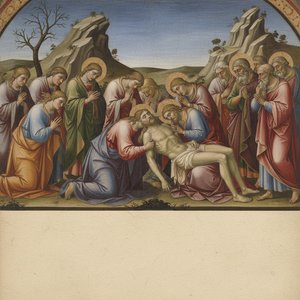
Giotto di Bondone: Revolutionizing Late Medieval Painting through Narrative Innovation
Explore the revolutionary art of Giotto di Bondone! Discover his groundbreaking techniques, iconic frescoes like those in the Arena Chapel, and lasting impact on Renaissance painting. A deep dive for art enthusiasts.
The Dawn of a New Vision: Proto-Renaissance Art & the Seeds of Artistic Revolution
Explore the Proto-Renaissance – the pivotal era bridging medieval and Renaissance art. Discover Giotto's revolutionary frescoes & the artistic innovations that shaped a new vision. Expert insights from ArtsDot.
Mario Sironi: A Poetic of Modern Italian Identity Through Symbolism & Social Commentary
Explore the profound works of Mario Sironi, a key figure in Italian Modernism. Discover his evolution from Futurism to Metaphysical painting and his powerful social commentary. Learn about his legacy at ArtsDot.