 Preview
 Send
Send Share
Share
 Details

 Download
 Similars
 X-Ray
X-Ray Diaporama
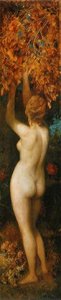
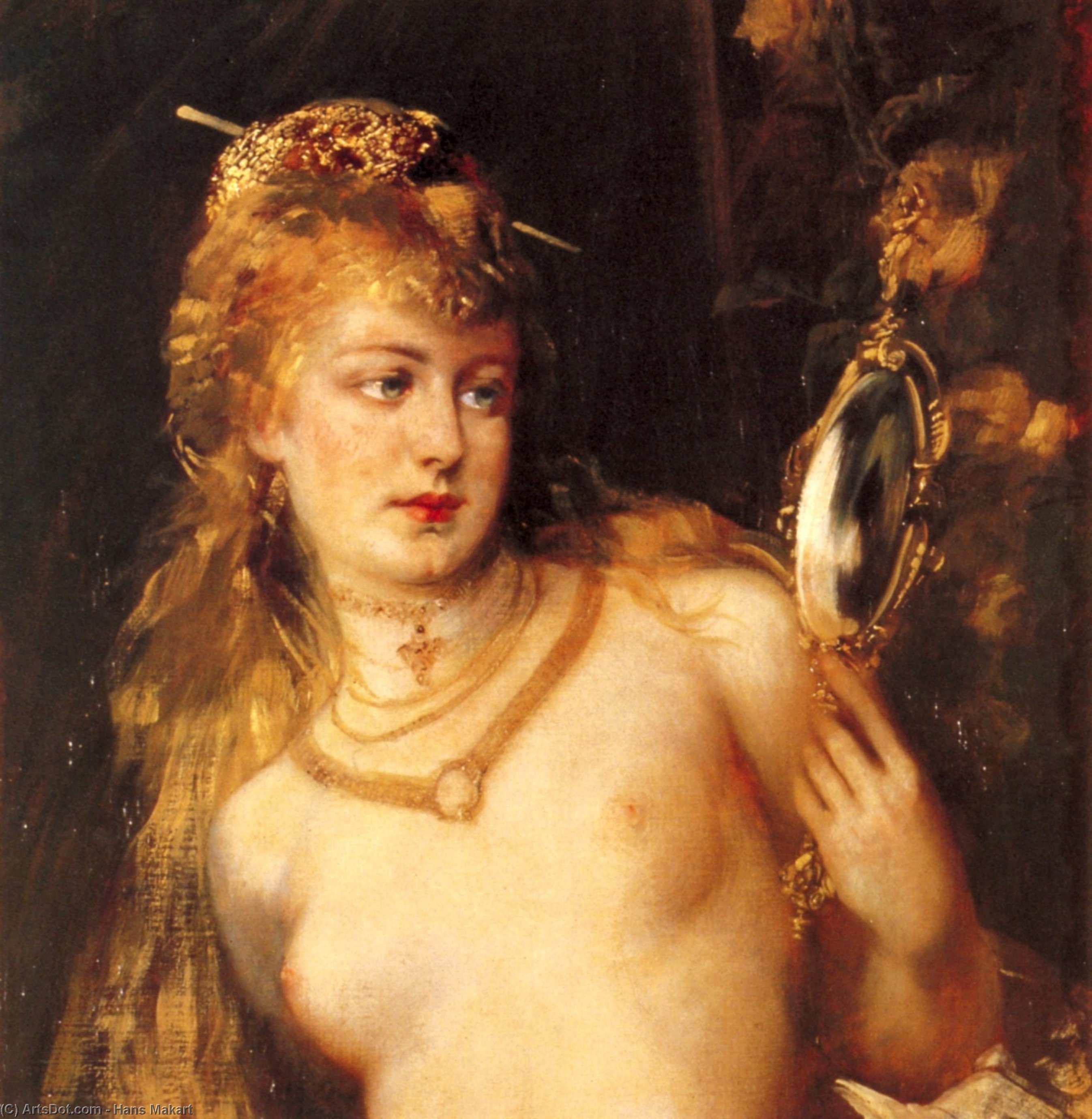
Gesicht (Detail)
 Acrylic On Canvas
- WallArt
- Academic Art
 1879
1879 314.0 x 70.0 cm
 Austrian Gallery Belvedere
 Read More
Hand Made Oil Reproduction
Hand-painted oil on canvas in your size and frame, made to order by our artists. ( Buy Print Buy Image)




































Pick from our preset sizes that match the artwork's original proportions.

You may enter your own dimensions to fit a specific frame or space. If your selected size does not match the original image's proportions, we will either crop the artwork or extend the painting with additional hand-painted elements. A digital mockup will be sent for your approval before production begins.
Please note that the on-screen preview does not reflect the actual cropping or extension. Only the mockup will accurately show the final composition.
While custom sizes are available, we recommend selecting a dimension from the predefined list to preserve the original proportions.
After order, ArtsDot.com team will email client for instructions and provide a mockup preview
Worldwide Delivery () in 3/4 weeks instead of standard 5 weeks. (16 August). No compromise on quality.

Free Worldwide Express Shipping

High-Quality Linen Canvas

Full Shipping Insurance

Customs Tax Refund Guarantee

True Color Matching Guarantee

60-Day Return Policy (Defects Only)

100% Money-Back Guarantee

Bulk Discount Offer
 Glass option is only available in size under 110 CM

Gesicht (Detail)
Reproduction Medium
Reproduction Size
-


Total Price
$ 263
Artwork Description
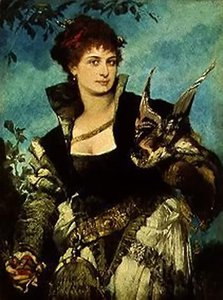
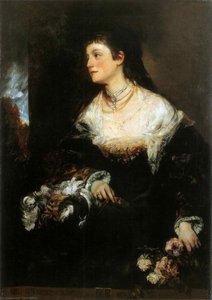
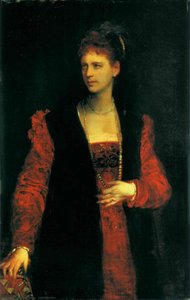
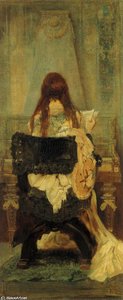
A Portrait of Contemplation: Hans Makart’s ‘Gesicht (Detail)’
The Austrian landscape painter Hans Makart remains an enigmatic figure in art history, celebrated for his opulent canvases and profoundly influential style—the Makartstil. Yet, amidst the grandeur of his monumental works depicting biblical narratives and mythological scenes, one painting stands apart for its quiet intimacy: ‘Gesicht (Detail,’ completed in 1879 and currently residing at the Österreichische Galerie Belvedere in Vienna. This deceptively simple portrait transcends mere representation; it delves into themes of introspection and psychological complexity, cementing Makart’s place as a pioneer of emotive art.The Artist's Vision: Makartstil Defined
Makartstil—literally “Makart style”—was more than just a technique; it was an aesthetic philosophy. Rejecting the rigid formalism of academic painting, Makart embraced bold color palettes and dramatic lighting to convey emotion directly to the viewer. He eschewed meticulous detail in favor of capturing fleeting moments of feeling, prioritizing atmosphere and expressive brushstrokes above precise anatomical accuracy. This approach stemmed from Makart’s fascination with Symbolism and Impressionism—movements that sought to capture subjective experience rather than objective reality—influences he skillfully blended into his own distinctive oeuvre. The artist deliberately avoided photographic realism, opting instead for a painterly illusion that prioritized emotional resonance.A Woman Lost in Reflection
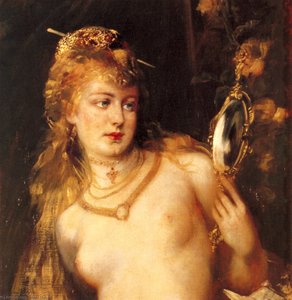
The subject of ‘Gesicht (Detail)’ is a woman gazing intently at her reflection in a mirror. Her pose exudes stillness and contemplation—a deliberate choice by Makart to convey the inner turmoil often hidden beneath outward appearances. The woman’s attire, adorned with shimmering jewelry, speaks to both vanity and adornment, highlighting the complexities of female identity during the Victorian era. However, it is Makart's masterful manipulation of color and texture that truly elevates this portrait. He employs a rich tapestry of hues—deep reds, golds, and blues—to create an ethereal luminescence around the woman’s face and hair, emphasizing her gaze and suggesting a profound connection with her own thoughts.Symbolism Within Simplicity
The mirror itself serves as a potent symbol within the painting. Traditionally representing duality – mind versus body, appearance versus reality – it compels viewers to confront questions of self-awareness and inner truth. Makart’s use of chiaroscuro—the dramatic interplay between light and shadow—further reinforces this symbolic dimension. The stark contrast illuminates the woman's face while enveloping her surroundings in darkness, creating a visual metaphor for the hidden depths of consciousness. Furthermore, the subtle brushstrokes contribute to an overall sense of melancholy and introspection, mirroring the contemplative mood of the subject herself.Legacy and Enduring Appeal
Makart’s influence extended far beyond his own lifetime, establishing him as a cornerstone of Viennese art history and inspiring subsequent generations of artists. The Makartstil continues to resonate with contemporary audiences who appreciate its expressive power and ability to evoke emotion. Reproductions of ‘Gesicht (Detail)’ adorn homes and galleries worldwide, testament to the painting’s timeless beauty and enduring psychological insight—a captivating reminder that true artistry lies not merely in depicting what is seen but in conveying what is felt.Related Artworks
Artist Biography
Hans Makart: A Life in Opulence and Influence
- Born: May 28, 1840, Salzburg, Austria
- Died: October 3, 1884, Vienna, Austria
- Nationality: Austrian
- Movement: Academic Art, Makartstil
Early Life and Training
- Hans Makart's artistic journey began in Salzburg, where he was born into a family with connections to the Habsburg court. Initially showing promise, he enrolled at the Vienna Academy between 1850 and 1851. However, his struggles with draughtsmanship led to his departure from the academy.
- Recognizing his passion for color, Makart studied under Karl Theodor von Piloty in Munich from 1861 to 1865. This period was crucial in shaping his artistic style and developing his distinctive use of vibrant hues.
- Further travels to London, Paris, and Rome broadened his exposure to European art movements and techniques, enriching his artistic perspective.
Artistic Style and Major Works
- Makartstil: Makart's signature style, known as "Makartstil," was characterized by opulent decoration, vibrant colors, and a theatrical flair. It significantly influenced the visual arts in Austria-Hungary and beyond.
- Early Recognition: His early works like Lavoisier in Prison demonstrated his emerging sense of color, while The Knight and the Water Nymphs showcased his decorative talents.
- Rise to Fame: Paintings such as Modern Amoretti and The Plague in Florence solidified his reputation as a leading artist. The purchase of Romeo and Juliet by the Austrian Emperor for the Vienna Museum further cemented his status.
- Notable Works:
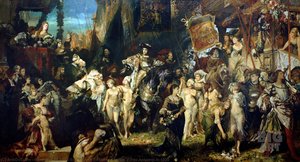
- The Entrance of Emperor Charles V into Antwerp in 1520
- Modern Amoretti
- The Plague in Florence
- Romeo and Juliet
Influence, Legacy, and the Makart Parade
- Influences: Makart drew inspiration from Karl Theodor von Piloty, European art movements (including Symbolism and Art Nouveau), and masters like Peter Paul Rubens.
- Social Figure: His luxurious studio in Vienna became a prominent social hub, attracting royalty, politicians, artists, and writers.
- The Makart Parade: A defining moment in his career was the design of the pageant for the silver wedding anniversary of Emperor Franz Joseph I and Empress Elisabeth of Bavaria (Sisi) in 1879. This elaborate spectacle, known as the "Makart Parade," showcased his talent for costume and set design and captivated the public.
- Professor at the Vienna Academy: In 1879, Makart was appointed a professor at the Vienna Academy, solidifying his position within the artistic establishment.
- Influence on Klimt: He profoundly influenced Gustav Klimt, who would later become a leading figure in the Vienna Secession movement and Art Nouveau.
Later Life and Historical Significance
- Makart's untimely death in 1884 at the age of 44 marked the end of an era. His extensive collection of antiques and art was auctioned off, dispersing his legacy across various collections.
- Despite criticisms from some academic circles regarding historical accuracy, Makart’s impact on Viennese culture and artistic trends remains undeniable. He embodied a period of opulent grandeur and aesthetic innovation.
- His work continues to be appreciated for its vibrant colors, decorative richness, and the unique atmosphere he created, solidifying his place as a significant figure in 19th-century Austrian art.
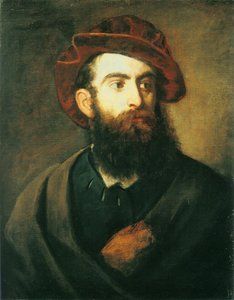
Hans Makart
1840 - 1884 , Austria
Quick Facts
- Artistic Movement Or Style: Academic history painting
- Artists Or Movements Influenced By This Artist:
- Gustav Klimt
- Art Nouveau
- Artists Who Influenced This Artist:
- Karl Theodor von Piloty
- Johann Fischbach
- Date Of Birth: May 28, 1840
- Date Of Death: October 3, 1884
- Full Name: Hans Makart
- Nationality: Austrian
- Notable Artworks:
- Lavoisier in Prison
- Modern Amoretti
- The Plague in Florence
- Romeo and Juliet
- Place Of Birth: Salzburg, Austria
Related Articles
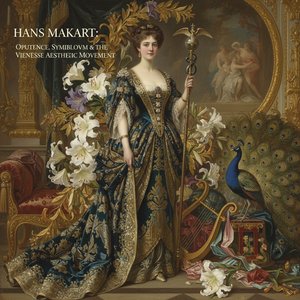
Hans Makart: Opulence, Symbolism & the Viennese Aesthetic Movement
Explore the opulent world of Hans Makart, a pivotal figure in Austrian art history. Discover his influence on Klimt & the Vienna Secession, signature style, and investment potential. Expert insights for collectors.
The Vienna Secession: A Rebellion of Form & Spirit in Fin-de-Siècle Art
Discover the revolutionary Vienna Secession art movement! Explore Klimt, Olbrich & more. Learn about its history, characteristics & lasting influence on modern art. High-quality reproductions available.

Baroque Drama: Bringing Opulence & Emotion into Contemporary Interiors
Explore the opulent world of Baroque interior design! Discover key elements, modern applications & how to bring dramatic elegance into your home with 's authentic reproductions.

The Dramatic Flourish: Exploring the Baroque Movement's Enduring Legacy in Art History
Explore the dramatic world of Baroque art! Discover iconic artists like Caravaggio & Rubens, defining techniques, and its lasting impact on art history. Expert insights for collectors & enthusiasts at ArtsDot.

Baroque Masterpieces: 10 Paintings That Defined an Era |
Journey through the drama & grandeur of Baroque art! Explore 10 masterpieces by Caravaggio, Rembrandt, Rubens & more. Discover stunning oil paintings, rich colors & timeless stories. Find museum-quality reproductions at .