 Preview
 Send
Send Share
Share
 Details

 Download
 Similars
 X-Ray
X-Ray Diaporama
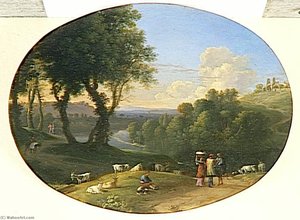
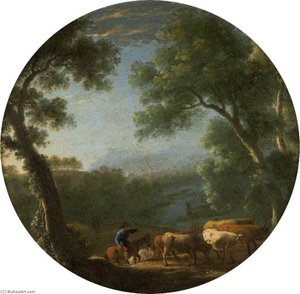
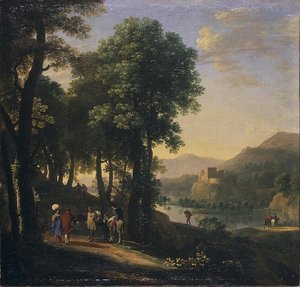
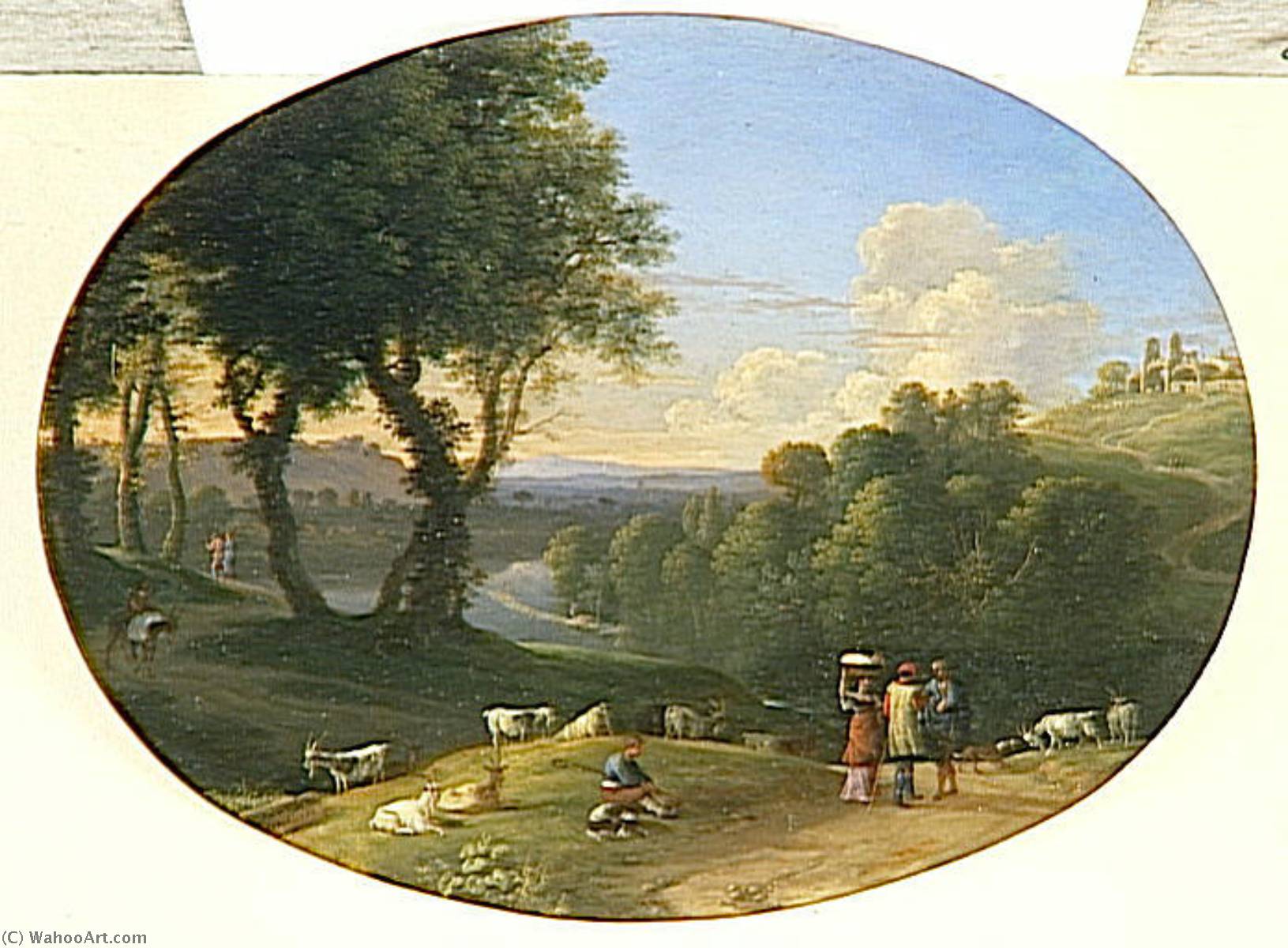
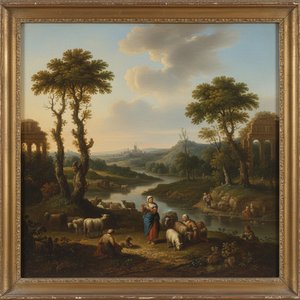
PAYSAGE AVEC CHEVRES ET PATRES


 Read More
Giclée / Art Print
Museum-quality giclée or canvas print with fast production and flexible finish options. ( Buy Hand Made Painting Buy Image)




P118B $10

P118H $10

P118W $10

P438Z $10

P508JH $12

P508YH $12

P805H $10

P805Z $10

P919BZ $10

P919G $10

P919XJ $10

P959ZH $10

P968JZ $12

W106C $8

W218G $10

W218JH $8

W218Y $10

W307PJ $10

W316G $10

W316PJ $8

W316Y $10

W398PJ $8

W4111J $10

W500HY $15

W500JH $15

W692G $12

W849H $8

W940BG $15

W953PJ $8




Pick from our preset sizes that match the artwork's original proportions.

You may enter your own dimensions to fit a specific frame or space. If your selected size does not match the original image's proportions, we will either crop the artwork or extend the image with a mirrored or solid-fill edge. A digital mockup will be sent for your approval before production begins.
Please note that the on-screen preview does not reflect the actual cropping or extension. Only the mockup will accurately show the final composition.
While custom sizes are available, we recommend selecting a dimension from the predefined list to preserve the original proportions.
Worldwide Delivery () in 2 weeks instead of standard 4/5 weeks. (24 August)

Free Worldwide Express Shipping

High-Quality Linen Canvas

Full Shipping Insurance

Customs Tax Refund Guarantee

True Color Matching Guarantee

60-Day Return Policy (Defects Only)

100% Money-Back Guarantee

Bulk Discount Offer
 Glass option is only available in size under 110 CM

PAYSAGE AVEC CHEVRES ET PATRES
Giclée / Art Print
Reproduction Size
-


Total Price
$ 63
Collectible Description
A Pioneer of Sunlit Landscapes: Herman van Swanevelt and the Birth of the Italianate Landscape
Herman van Swanevelt (1603-1655) stands as a monumental figure in Baroque art, specifically recognized for his groundbreaking contribution to landscape painting. Unlike many of his contemporaries who favored dark, dramatic compositions, Swanevelt championed a luminous aesthetic—a style profoundly influenced by the ideals of Renaissance Italy and meticulously executed with unparalleled skill. His canvases capture not merely scenery but an idealized vision of rural tranquility, establishing him as one of the earliest practitioners of what would become known as the Italianate landscape tradition. This artistic movement sought to emulate the grandeur and serenity of Tuscan villas and gardens, prioritizing harmonious color palettes and diffused light—a stylistic shift that foreshadowed the monumental achievements of Claude Lorrain and Nicolas Poussin.Detailed Observation: Composition and Technique
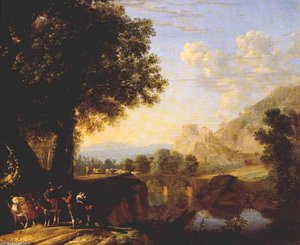
The oval format of “Paysage avec chèvres et pâtres” immediately establishes a sense of grandeur and balance. Swanevelt’s masterful technique is evident in every brushstroke, demonstrating an astonishing command of chiaroscuro—the dramatic interplay between light and shadow—a hallmark of Baroque painting. Lines delineate the contours of figures, trees, and hills with remarkable precision, creating depth and volume that draws the viewer into the scene. Organic shapes dominate – rounded hills mirroring the gentle curves of tree trunks and animal bodies – complemented by subtle geometric elements visible in distant buildings. The artist’s meticulous layering of glazes builds up texture and luminosity, capturing the shimmering quality of sunlight filtering through foliage and illuminating clothing with breathtaking realism. Careful attention to perspective reinforces this illusion of depth, diminishing objects as they recede into the misty background.Symbolism and Emotional Resonance
Beyond its visual beauty, “Paysage avec chèvres et pâtres” resonates with profound symbolic meaning. The depiction of shepherds tending livestock embodies themes of pastoral harmony and rural simplicity—values cherished during the Baroque era as a counterpoint to the anxieties of urban life. The tranquil landscape serves as a metaphor for spiritual contemplation and communion with God, reflecting the religious fervor prevalent in seventeenth-century Europe. Swanevelt’s use of muted greens, browns, blues, and ochre tones contributes to an atmosphere of serenity and peace, inviting viewers to immerse themselves in the idyllic beauty of the countryside. The painting's luminous quality evokes feelings of warmth, comfort, and nostalgia—capturing a timeless vision of rural life that continues to inspire artists and collectors alike.Provenance and Artistic Legacy
Acquired by Fisch in 1817 alongside another landscape masterpiece (“Paysage” INV 1874), “Paysage avec chèvres et pâtres” now resides within the Musée du Louvre’s Département des Peintures, specifically in Salle 845 – La Hollande et l’Italie. Its history underscores Swanevelt's enduring influence on subsequent generations of painters who sought to emulate his masterful technique and idealized vision of nature. The painting exemplifies the culmination of Renaissance ideals blended with Baroque innovation—a testament to Herman van Swanevelt’s pivotal role in shaping European art history.A Reproduction Worthy of Distinction
ArtsDot offers exceptional reproductions of “Paysage avec chèvres et pâtres,” meticulously crafted by skilled artisans using archival pigments and printing methods. Each print captures the essence of Swanevelt's original artwork, faithfully reproducing its luminous colors and textural nuances—allowing you to experience the beauty and tranquility of this Baroque masterpiece in your own home. Explore our collection today!Related Artworks
Artist Biography
A Pioneer of Sunlit Landscapes: The Life and Art of Herman van Swanevelt
Born in Woerden, Netherlands, in 1603, Herman van Swanevelt emerged as a pivotal figure in the evolution of landscape painting during the Baroque period. Descended from a family with artistic roots—his ancestor was the renowned Lucas van Leyden—Swanevelt embarked on a journey that would lead him to redefine idyllic landscapes and profoundly influence artists like Claude Lorrain. The identity of his early teacher remains somewhat elusive, though recent scholarship suggests a possible apprenticeship under Willem Buytewech. His initial signed works appeared in Paris by 1623, hinting at an early ambition and willingness to seek artistic opportunities beyond his homeland. However, it was his relocation to Rome in 1629 that truly ignited his creative vision.Rome and the Birth of the Italianate Landscape
The Roman landscape proved transformative for Swanevelt. It was here he pioneered a new style characterized by sunlit ‘contrejours’—scenes bathed in light, often depicting the times of day with remarkable sensitivity. This innovation marked a departure from traditional landscapes laden with biblical or mythological narratives; Swanevelt focused on capturing the inherent beauty and tranquility of nature itself. He quickly became immersed in the vibrant artistic community, joining the ranks of the Bentvueghels—a society of Dutch and Flemish artists working in Rome—adopting the alias “heremiet” (hermit), perhaps reflecting his preference for solitary observation and contemplation. Swanevelt’s work flourished alongside that of Paul Bril, Cornelis van Poelenburch, Pieter van Laer, and ultimately Claude Lorrain, establishing him as a key figure in the classical phase of the "italianate landscape" genre. His talent did not go unnoticed by prominent patrons; he received commissions from the esteemed Barberini family, Pope Urban VIII, and even contributed to projects for Philip IV of Spain’s magnificent Buen Retiro Palace in Madrid, demonstrating his rising reputation and artistic significance.A Bridge Between Generations and Artistic Influences
Swanevelt's artistic development during the 1630s ran parallel to—and at times even anticipated—that of Claude Lorrain. He refined his idyllic landscape style, drawing inspiration from artists like Cornelis van Poelenburgh while forging a unique path. His importance lies not only in his individual achievements but also in his role as a crucial link between the first generation of Dutch Italianate painters – figures such as Bartholomeus Breenbergh and Van Poelenburch – and those who followed, imitating his monumental compositions and masterful treatment of southern sunlight. Even when he later turned to depicting Dutch scenery after returning to Paris in 1641—a move punctuated by occasional visits back to Woerden—he retained the characteristic luminosity that defined his Italian period. His acceptance into the Académie Royale de peinture et de sculpture in 1651 further solidified his standing within the French art world, and he contributed murals to significant locations like the sacristy of Santa Maria sopra Minerva and Palazzo Pamphili.Legacy and Rediscovery
Herman van Swanevelt’s legacy extends beyond his prolific output of paintings and etchings—including “The Birth of Adonis” (1654), now held in the Utah Museum of Fine Arts' permanent collection. He was a true innovator, recognized for pioneering sunlit ‘contrejours’ and establishing a new standard for idyllic landscapes. His influence on Claude Lorrain is undeniable, shaping the direction of landscape painting for generations to come. Though his work experienced a period of relative obscurity in the late 19th century, it has undergone a significant re-evaluation in recent decades, with scholars and art enthusiasts alike appreciating the quality, sensitivity, and enduring impact of his vision. Swanevelt’s contribution lies in bridging early landscape traditions with the classical ideals of the Baroque era, leaving an indelible mark on the history of art and continuing to inspire awe and admiration today.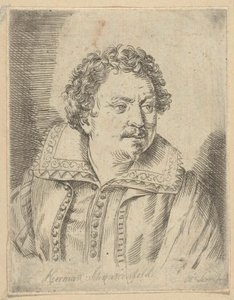
Herman van Swanevelt
1604 - 1655 , Netherlands
Quick Facts
- Artistic Movement Or Style: Baroque, Italianate landscape
- Artists Or Movements Influenced By This Artist: ['Claude Lorrain']
- Artists Who Influenced This Artist:
- Willem Buytewech
- Cornelis van Poelenburgh
- Date Of Birth: 1604
- Date Of Death: 1655
- Full Name: Herman van Swanevelt
- Nationality: Dutch
- Notable Artworks:
- Landscape with Tall Rocks
- Italian Landscape w/ Bridge
- An italianate landscape...
- Place Of Birth: Woerden, Netherlands
Related Articles
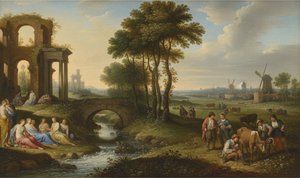
Cornelis van Poelenburch: Bridging Mannerism & the Dutch Baroque Landscape
Discover Cornelis van Poelenburch, a pivotal Dutch Baroque landscape painter bridging Mannerism & Italianate styles. Explore his life, key works, and lasting influence on 17th-century art with ArtsDot.

Dutch Baroque Masters: 10 Paintings That Shaped an Era | ArtsDot
Journey through the Golden Age with our guide to the Top 10 Dutch Baroque masterpieces! Explore iconic paintings by Rembrandt, Vermeer & Frans Hals. Find museum-quality art reproductions and elevate your home decor at ArtsDot.com.

Rembrandt's Masterpieces: Explore 25 Iconic Paintings & Prints | ArtsDot
Journey through Rembrandt van Rijn's 25 most iconic paintings & etchings. Explore Dutch Golden Age masterpieces, dramatic chiaroscuro, and timeless portraits. Find museum-quality art reproductions to elevate your home decor on ArtsDot.com.
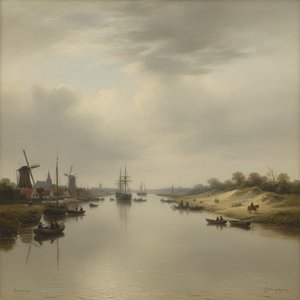
Jan van Goyen: Master of Dutch Landscape & Atmospheric Perspective
Discover Jan van Goyen, the master of Dutch landscape painting. Explore his subtle technique, atmospheric realism & lasting influence on art history. Learn about this 17th-century pioneer at ArtsDot.
Nicolaes Berchem: Dutch Golden Age Pastoralism & the Evolution of Landscape Painting
Explore the captivating world of Nicolaes Berchem, a leading Dutch Golden Age painter. Discover his idyllic landscapes, masterful technique & lasting influence on art history. Learn more at ArtsDot.