 Preview
 Send
Send Share
Share
 Details

 Download
 Similars
 X-Ray
X-Ray Diaporama
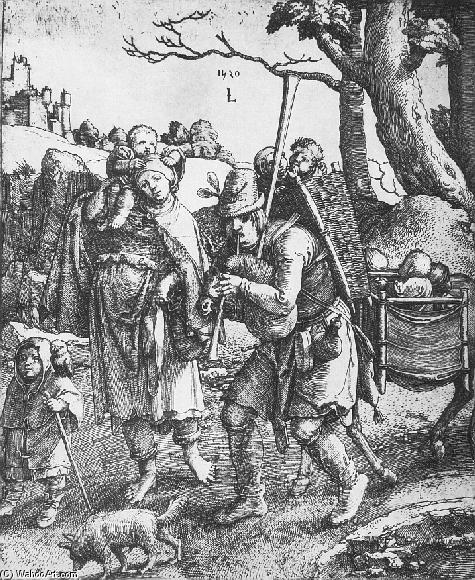
Wandering Beggars
 Acrylic On Canvas
- WallArt
- Northern Renaissance
 1520
1520 150.0 x 182.0 cm
 Rijksmuseum
 Read More
Giclée / Art Print
Museum-quality giclée or canvas print with fast production and flexible finish options. ( Buy Hand Made Painting Buy Image)




P118B $10

P118H $10

P118W $10

P438Z $10

P508JH $12

P508YH $12

P805H $10

P805Z $10

P919BZ $10

P919G $10

P919XJ $10

P959ZH $10

P968JZ $12

W106C $8

W218G $10

W218JH $8

W218Y $10

W307PJ $10

W316G $10

W316PJ $8

W316Y $10

W398PJ $8

W4111J $10

W500HY $15

W500JH $15

W692G $12

W849H $8

W940BG $15

W953PJ $8




Pick from our preset sizes that match the artwork's original proportions.

You may enter your own dimensions to fit a specific frame or space. If your selected size does not match the original image's proportions, we will either crop the artwork or extend the image with a mirrored or solid-fill edge. A digital mockup will be sent for your approval before production begins.
Please note that the on-screen preview does not reflect the actual cropping or extension. Only the mockup will accurately show the final composition.
While custom sizes are available, we recommend selecting a dimension from the predefined list to preserve the original proportions.
Worldwide Delivery () in 2 weeks instead of standard 4/5 weeks. (17 August)

Free Worldwide Express Shipping

High-Quality Linen Canvas

Full Shipping Insurance

Customs Tax Refund Guarantee

True Color Matching Guarantee

60-Day Return Policy (Defects Only)

100% Money-Back Guarantee

Bulk Discount Offer
 Glass option is only available in size under 110 CM

Wandering Beggars
Giclée / Art Print
Reproduction Size
-


Total Price
$ 63
Collectible Description
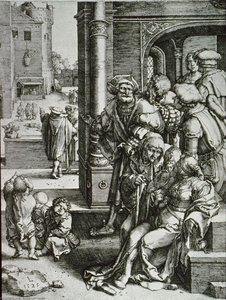
A Portrait of Poverty and Resilience: Exploring Lucas van Leyden’s “Wandering Beggars”
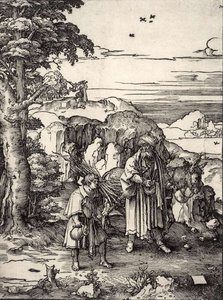
The engraving "Wandering Beggars" by Lucas van Leyden, created in 1520 during the height of the Northern Renaissance, transcends mere depiction; it's a poignant meditation on social realities and human dignity rendered with breathtaking precision. More than just an image, it’s a testament to Van Leyden’s unparalleled skill as both painter and printmaker—a mastery that continues to captivate audiences centuries later.Composition and Narrative Depth
At first glance, the scene presents itself as straightforward: a group of impoverished individuals traversing a landscape dominated by a distant castle perched atop a hill. However, Van Leyden's genius lies in his masterful compositional choices. The diagonal line formed by the beggars’ movement draws the viewer’s eye upwards towards the castle—a symbol often interpreted as representing aspiration and unattainable ideals – yet simultaneously grounding the figures within the harsh realities of their circumstances. Scattered trees and shrubs serve as framing elements, enhancing the sense of depth and contributing to the overall narrative atmosphere. The inclusion of animals—a dog, a cat, and a bird—adds an element of realism and subtly reinforces the theme of vulnerability amidst a challenging environment.The Art of Engraving: Technique and Detail
Van Leyden’s technique exemplifies the exacting standards of Northern Renaissance engraving. Executed on copper plate, the image was painstakingly etched with fine lines using mezzotint – a process that allowed for exceptional tonal control. This meticulous approach resulted in an astonishing level of detail—noticeable in the folds of clothing, the expressions on the beggars' faces, and the intricate textures of foliage. Hatching and cross-hatching techniques were skillfully employed to create subtle gradations of shading, capturing the diffused light of an overcast day and emphasizing the contours of form. The resulting monochrome print possesses a remarkable luminosity achieved through careful manipulation of ink density.Historical Context and Societal Commentary
“Wandering Beggars” emerged during a period marked by significant social upheaval—the Reformation was reshaping Europe’s religious landscape, and anxieties about poverty and social justice were palpable. Van Leyden's work reflects this intellectual climate, prompting viewers to confront uncomfortable truths about the human condition. The depiction of beggars wasn’t merely an aesthetic exercise; it served as a powerful commentary on societal inequalities and the plight of marginalized communities—a subject that resonated deeply with humanist thinkers of the time.Symbolism and Emotional Resonance
Beyond its formal qualities, “Wandering Beggars” communicates profound emotional resonance. The distant castle embodies hope amidst despair, representing ambitions pursued despite obstacles. Simultaneously, it underscores the vulnerability inherent in human existence – a vulnerability mirrored in the weary postures and expressions of the beggars themselves. Van Leyden’s masterful rendering captures not only the visual appearance of poverty but also its psychological impact—a reminder that beauty can coexist with sorrow and that art possesses the capacity to provoke contemplation on fundamental questions about morality and compassion.A Legacy of Precision and Emotion
Lucas van Leyden's "Wandering Beggars" stands as a cornerstone of Northern Renaissance engraving, demonstrating an unparalleled fusion of artistic skill and intellectual engagement. Its enduring appeal lies in its ability to convey complex ideas with breathtaking clarity—a testament to Van Leyden’s legacy as one of the most influential artists of his era and a timeless masterpiece that continues to inspire admiration for its technical brilliance and emotional depth.Related Artworks
Artist Biography
early life and training
lucas van leyden, a dutch painter and printmaker, was born in 1494 in leiden, netherlands. he was the son of huygh jacobsz, a painter, and began his artistic training under his father's guidance. later, he joined the workshop of cornelis engelbrechtsz in 1508, where he refined his skills.artistic development
lucas van leyden was among the first dutch exponents of genre painting and a highly accomplished engraver. his early work, characterized by half-length figures (c. 1506-1512), showcases his precocious originality. as he matured, his landscapes developed, and he became skilled in engraving at a remarkably young age. the earliest known print by him, mohammed and the murdered monk (1508), demonstrates his mastery of the medium.notable works and style
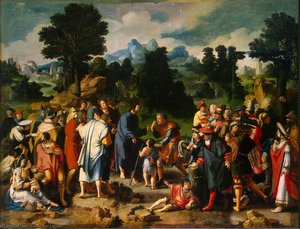
seventeen paintings surely attributed to lucas van leyden survive, including:- the healing of the blind man of jericho, a masterpiece showcasing multiple figures against wooded landscapes.
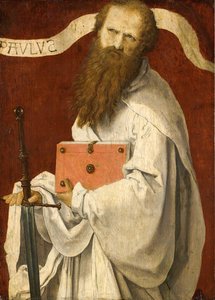
- saint paul, attr. leyden, exemplifying his engraving prowess.
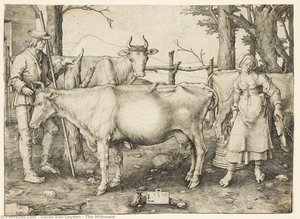
- the milkmaid (engraving, 1510), highlighting his early skill in the medium.
museum collections and online presence
lucas van leyden's works can be found in various museums, including the van gogh museum (netherlands), which houses an extensive collection of his engravings and paintings. online platforms like ArtsDot.com offer a comprehensive selection of his works, allowing art enthusiasts to explore his oeuvre in detail.legacy
lucas van leyden's contributions to dutch genre painting and engraving are undeniable. his innovative style and technical skill have made him a celebrated figure in the art world. as a pioneer of dutch art, his legacy continues to inspire artists and art lovers alike.- view lucas van leyden's artworks on ArtsDot.com
- explore the van gogh museum (netherlands) collection online
- discover more about dutch art and its pioneers on ArtsDot.com's blog
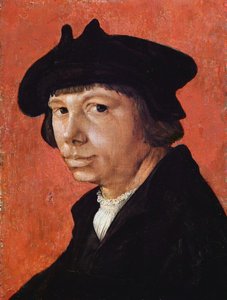
Lucas van Leyden
1494 - 1533 , Netherlands
Quick Facts
- Artistic Movement Or Style: Early Netherlandish Renaissance
- Artists Or Movements Influenced By This Artist: ['German Renaissance']
- Artists Who Influenced This Artist: ['Albrecht Dürer']
- Date Of Birth: Leiden, Netherlands (1494)
- Date Of Death: 1533
- Full Name: Lucas Hugensz van Leyden
- Nationality: Dutch
- Notable Artworks:
- The Healing of the Blind Man of Jericho
- Saint Paul
- The Milkmaid
- Place Of Birth: Leiden
Related Articles
Van Gogh's Masterpieces: Explore 25 Iconic Paintings & Art for Your Home
Journey through Vincent van Gogh's 25 most iconic paintings! Explore 'Starry Night', 'Sunflowers,' and more—discover the stories, techniques & emotions behind these Post-Impressionist masterpieces. Find museum-quality art reproductions for your home at ArtsDot.com.
Lucas van Leyden: Innovation & Intimacy in Early Netherlandish Printmaking
Explore the groundbreaking prints of Lucas van Leyden, a Dutch master bridging Gothic detail & Renaissance innovation. Discover his rare works, investment potential, and legacy for discerning collectors.

Beyond the Horizon: 10 Landscape Masterpieces for Your Home Decor
Journey through 10 breathtaking landscape paintings by Monet, Van Gogh & more! Explore iconic artworks, artistic techniques & find inspiration for your home decor. Museum-quality reproductions at ArtsDot.com. Discover all masterpieces on ArtsDot.com

Rembrandt's Masterpieces: Explore 25 Iconic Paintings & Prints | ArtsDot
Journey through Rembrandt van Rijn's 25 most iconic paintings & etchings. Explore Dutch Golden Age masterpieces, dramatic chiaroscuro, and timeless portraits. Find museum-quality art reproductions to elevate your home decor on ArtsDot.com.
Engraving's Golden Age: 10 Masterpieces That Redefined Art | ArtsDot
Journey through art history with our Top 10 Legendary Engravings! Explore masterpieces by Dürer, Rembrandt & Goya. Discover the stories behind these iconic prints and find museum-quality reproductions for your home at ArtsDot.com.