 Preview
 Send
Send Share
Share
 Details

 Download
 Similars
 X-Ray
X-Ray Diaporama
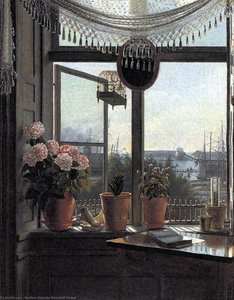
View from the Artist's Window
 Oil On Canvas
- WallArt
- Danish Golden Age
 1825
1825 38.0 x 30.0 cm
 Statens Museum For Kunst
 Read More
Hand Made Oil Reproduction
Hand-painted oil on canvas in your size and frame, made to order by our artists. ( Buy Print Buy Image)




P118B $10

P118H $10

P118W $10

P438Z $10

P508JH $12

P508YH $12

P805H $10

P805Z $10

P919BZ $10

P919G $10

P919XJ $10

P959ZH $10

P968JZ $12

W106C $8

W218G $10

W218JH $8

W218Y $10

W307PJ $10

W316G $10

W316PJ $8

W316Y $10

W398PJ $8

W4111J $10

W500HY $15

W500JH $15

W692G $12

W849H $8

W940BG $15

W953PJ $8




Pick from our preset sizes that match the artwork's original proportions.

You may enter your own dimensions to fit a specific frame or space. If your selected size does not match the original image's proportions, we will either crop the artwork or extend the painting with additional hand-painted elements. A digital mockup will be sent for your approval before production begins.
Please note that the on-screen preview does not reflect the actual cropping or extension. Only the mockup will accurately show the final composition.
While custom sizes are available, we recommend selecting a dimension from the predefined list to preserve the original proportions.
After order, ArtsDot.com team will email client for instructions and provide a mockup preview
Worldwide Delivery () in 3/4 weeks instead of standard 5 weeks. (17 August). No compromise on quality.

Free Worldwide Express Shipping

High-Quality Linen Canvas

Full Shipping Insurance

Customs Tax Refund Guarantee

True Color Matching Guarantee

60-Day Return Policy (Defects Only)

100% Money-Back Guarantee

Bulk Discount Offer
 Glass option is only available in size under 110 CM

View from the Artist's Window
Reproduction Medium
Reproduction Size
-


Total Price
$ 263
Artwork Description
A Glimpse of Tranquility and Longing
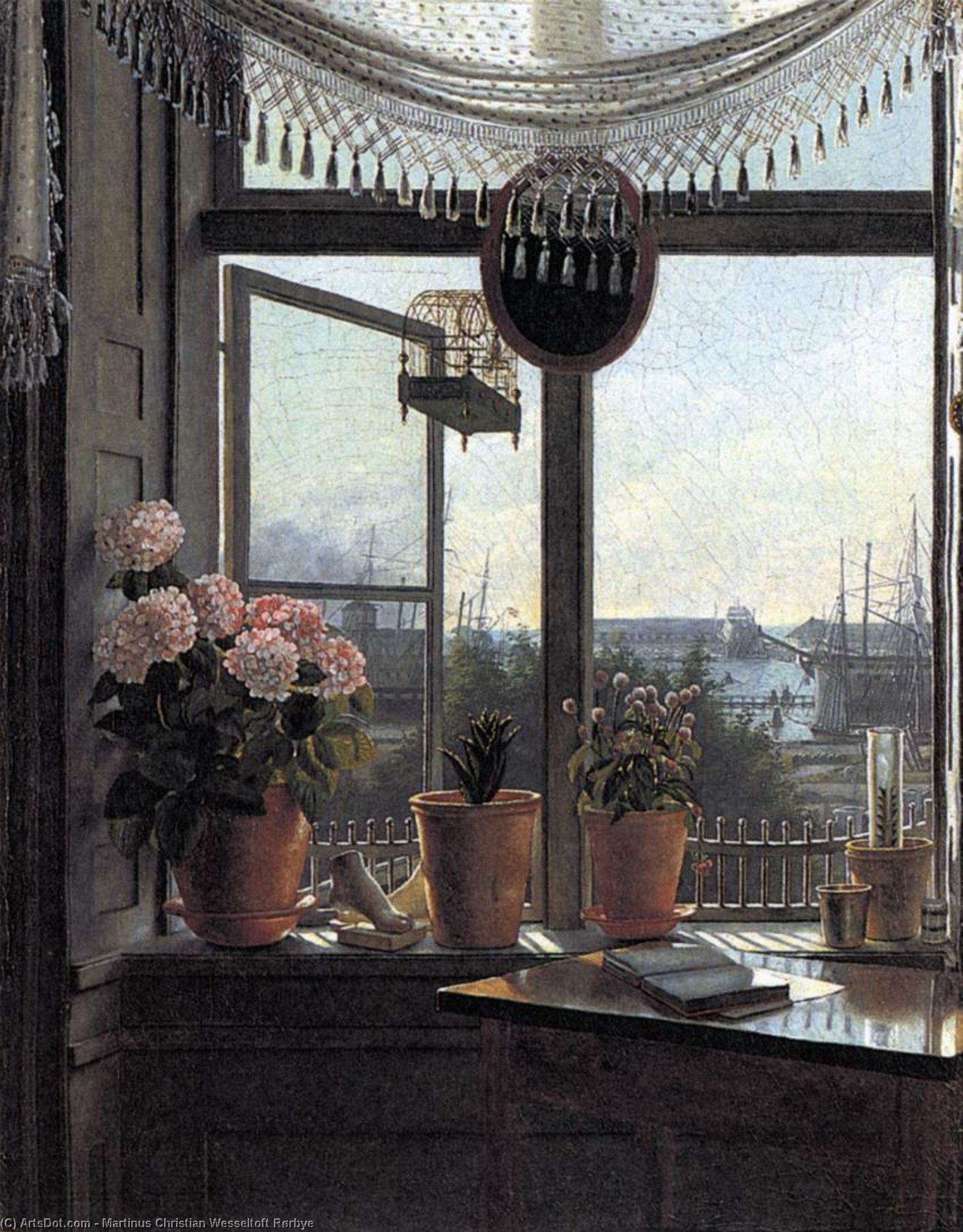
Martinus Christian Wesseltoft Rørbye’s “View from the Artist’s Window,” painted in 1825, isn't merely a landscape; it’s a carefully constructed tableau brimming with quiet contemplation and subtle yearning. Captured within the confines of a Copenhagen window, the scene unfolds as a serene harbor vista – dominated by the bustling Flådestation Holmen naval dockyard – punctuated by the delicate beauty of potted plants and the promise of distant horizons. More than just a depiction of a view, it’s an intimate portrait of a young artist poised on the cusp of his career, grappling with the allure of the known world versus the vast, uncharted territories that beckoned beyond.
The painting immediately draws the eye to the rectangular frame of the window itself, acting as both a barrier and a portal. Rørbye masterfully utilizes light and shadow to create depth, guiding our gaze from the warmly lit interior space – furnished with a table holding vases, books, and a birdcage – outwards towards the cool, expansive waters and ships. The muted palette of greens, blues, browns, and creams evokes a sense of understated elegance, while the subtle variations in tone suggest a slightly overcast day, lending an air of contemplative stillness to the scene.
The Language of Symbolism
Diving deeper into “View from the Artist’s Window,” one discovers layers of symbolic meaning woven throughout the composition. The caged bird perched above the windowsill is perhaps the most potent emblem – a visual representation of artistic confinement and the desire for freedom, mirroring Rørbye's own aspirations as he navigated his burgeoning career. The arrangement of plants, particularly the vibrant hydrangeas and smaller greenery, speaks to themes of growth, vitality, and the cyclical nature of life. The inclusion of a sketchbook and an empty page hints at the creative process itself – a space awaiting inspiration and filled with potential.
Furthermore, the ships in the harbor represent more than just maritime activity; they symbolize journeys, exploration, and the allure of distant lands—a direct reflection of Rørbye’s own adventurous spirit. The ropewalks visible along the docks underscore the industriousness of the port, grounding the scene in a tangible reality while simultaneously hinting at the broader world beyond.
A Masterclass in Technique
Rørbye's skill as an artist is evident in his meticulous attention to detail and his ability to capture the essence of a moment. Executed in oil on canvas, the painting showcases a traditional technique characterized by smooth brushstrokes, layered glazing, and a masterful use of perspective. The linear perspective creates a convincing sense of depth, drawing the viewer into the scene and allowing them to appreciate the vastness of the harbor while simultaneously feeling the intimacy of the room.
The artist’s ability to render textures—the smooth glass of the window, the rough bark of the potted plants, the soft fabric of the curtains—adds a remarkable tactile quality to the work. The diffused natural light creates subtle gradations in tone and shadow, enhancing the sense of realism and contributing to the painting's overall atmosphere of tranquility. The use of muted colors allows the details to shine through, creating a harmonious balance between observation and artistic interpretation.
A Legacy of Danish Golden Age
“View from the Artist’s Window” stands as a quintessential example of Danish art during the Golden Age—a period marked by a renewed interest in landscape painting and a celebration of national identity. Rørbye's work reflects this era's fascination with both the beauty of nature and the complexities of human experience. Today, housed at the Statens Museum for Kunst in Copenhagen, it continues to captivate viewers with its serene beauty, subtle symbolism, and masterful technique. Reproductions offer a wonderful opportunity to bring this timeless masterpiece into your home, allowing you to appreciate Rørbye’s vision and find solace in its quiet contemplation.
Related Artworks
Artist Biography
A Pioneer of Danish Golden Age Painting: Martinus Rørbye
Martinus Christian Wesseltoft Rørbye, born in Drammen, Norway in 1803, stands as a pivotal figure within the radiant constellation of the Danish Golden Age. Though often overshadowed by contemporaries like Eckersberg and Marstrand, Rørbye’s contribution was uniquely defined by his restless spirit and pioneering travels – a characteristic that set him apart and profoundly shaped his artistic vision. He wasn't merely a painter of scenes; he was a chronicler of encounters, a sensitive observer who translated the nuances of diverse cultures and landscapes onto canvas with remarkable skill. His life story is one of dedication to craft interwoven with an insatiable curiosity about the world beyond Denmark’s borders.Early Training and Artistic Foundations
Rørbye's early inclinations didn’t lean towards academic pursuits, yet his artistic talent was evident enough to warrant enrollment at the Royal Danish Academy of Fine Arts in Copenhagen at the age of seventeen, in 1820. There, he fell under the tutelage of two influential masters: Christian August Lorentzen and, more significantly, Christoffer Wilhelm Eckersberg. Eckersberg’s emphasis on meticulous observation of nature and a commitment to realistic detail deeply resonated with Rørbye, forming the bedrock of his artistic methodology. Simultaneously, Lorentzen's masterful use of color broadened Rørbye’s palette and instilled in him an appreciation for atmospheric effects. He quickly distinguished himself at the Academy, earning the small silver medal in 1824 and the large silver medal four years later. While he repeatedly sought the coveted large gold medal, it remained elusive, a testament to his willingness to experiment and deviate from strictly prescribed academic norms. Even during these formative years, hints of his future wanderlust were present; “View from the Artist’s Window,” painted around 1825, subtly foreshadowed his yearning for exploration through its depiction of a caged bird poised between domestic security and the beckoning expanse of the open sea.Journeys and Expanding Horizons
Rørbye was, without question, the most peripatetic of the Danish Golden Age painters. His travels weren’t mere leisurely excursions; they were integral to his artistic development, providing him with a wealth of inspiration and subject matter. He first ventured into Norway in 1830 and again in 1832, journeys that exposed him to landscapes reminiscent of those favored by Johan Christian Dahl and Caspar David Friedrich – artists whose Romantic sensibilities subtly influenced his work. A particularly memorable encounter during these travels was with the celebrated author Hans Christian Andersen; they journeyed together through Jutland, forging a brief but significant artistic companionship. However, it was Rørbye’s 1834 travel scholarship that truly unlocked his potential for international exploration. This allowed him to traverse the Netherlands and France before arriving in Rome, then the vibrant hub of Danish artists centered around the sculptor Bertel Thorvaldsen. From Italy, he ventured further afield, accompanied by architect Michael Gottlieb Bindesbøll, to Greece and even Constantinople – a daring expedition that placed him among the first Scandinavian artists to document the Ottoman Empire. These travels weren’t simply about recording visual impressions; Rørbye meticulously sketched and noted everything from local customs and costumes to architectural details and sweeping vistas, transforming his experiences into a rich tapestry of artistic inspiration.Legacy and Artistic Significance
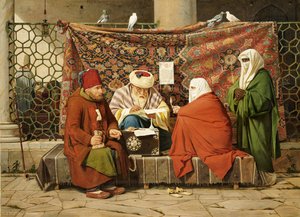
Upon returning to Copenhagen in 1837, Rørbye brought with him not only a portfolio brimming with exotic studies but also a heightened sense of artistic confidence. His orientalist paintings, imbued with the vibrant colors and captivating scenes he’d witnessed firsthand, captivated the Danish public. He was unanimously elected to the Academy in 1838 based on his Turkish folk scene derived from sketches made near Smyrna. Rørbye's influence extended beyond his immediate circle of contemporaries. He anticipated the Skagen painters – Michael Ancher, Anna Ancher, and P.S. Krøyer – by almost half a century when he first began painting in Skagen, at the northernmost tip of Jutland. His dedication to capturing realistic details, combined with his sensitivity to light and atmosphere, established him as a master of both genre painting and landscape art. Though he died prematurely in 1848, leaving behind an unfinished body of work, Martinus Rørbye’s legacy endures as a testament to the power of travel, observation, and artistic innovation during Denmark's Golden Age. He remains a vital link between the classical traditions of Danish painting and the burgeoning Romanticism that would define much of 19th-century art.
Martinus Christian Wesseltoft Rørbye
1802 - 1848 , Norway
Quick Facts
- Artistic Movement Or Style: Golden Age painting
- Artists Or Movements Influenced By This Artist: ['Skagen Painters']
- Artists Who Influenced This Artist:
- C.A. Lorentzen
- C.W. Eckersberg
- Date Of Birth: May 17, 1803
- Date Of Death: 1848
- Full Name: Martinus Christian Rørbye
- Nationality: Danish
- Notable Artworks:
- Christ Healing the Blind
- View from Artist's Window
- Place Of Birth: Drammen, Norway
Related Articles

Beyond the Horizon: 10 Landscape Masterpieces for Your Home Decor
Journey through 10 breathtaking landscape paintings by Monet, Van Gogh & more! Explore iconic artworks, artistic techniques & find inspiration for your home decor. Museum-quality reproductions at ArtsDot.com. Discover all masterpieces on ArtsDot.com
Peder Mørk Mønsted: Capturing the Danish Golden Age Landscape – A Study in Atmospheric Realism
Explore the captivating landscapes of Peder Mørk Mønsted, a master of Danish Golden Age realism. Discover his atmospheric techniques, influences, and enduring legacy in our expert analysis.

Romantic Landscapes: 10 Masterpieces for Your Home | ArtsDot
Journey through 10 Romantic landscape masterpieces by Friedrich, Turner & Cole. Explore emotional art, sublime nature scenes & iconic 19th-century paintings. Find museum-quality reproductions for your home at ArtsDot.com – discover the full collection online!

Dutch Masters: 10 Golden Age Paintings That Still Inspire |
Journey into the Dutch Golden Age! Explore 10 iconic paintings by Rembrandt, Vermeer & Hals. Discover the stories behind these Baroque masterpieces and find museum-quality art reproductions to elevate your home decor on .
Nicolaes Berchem: Dutch Golden Age Pastoralism & the Evolution of Landscape Painting
Explore the captivating world of Nicolaes Berchem, a leading Dutch Golden Age painter. Discover his idyllic landscapes, masterful technique & lasting influence on art history. Learn more at ArtsDot.