 Preview
 Send
Send Share
Share
 Details

 Download
 Similars
 X-Ray
X-Ray Diaporama
The Temperate and the Intemperate
 Northern Renaissance
 1480
1480- Late Medieval
 17.0 x 19.0 cm
 J. Paul Getty Museum
 Read More
Hand Made Oil Reproduction
Hand-painted oil on canvas in your size and frame, made to order by our artists. ( Buy Print Buy Image)




P118B $10

P118H $10

P118W $10

P438Z $10

P508JH $12

P508YH $12

P805H $10

P805Z $10

P919BZ $10

P919G $10

P919XJ $10

P959ZH $10

P968JZ $12

W106C $8

W218G $10

W218JH $8

W218Y $10

W307PJ $10

W316G $10

W316PJ $8

W316Y $10

W398PJ $8

W4111J $10

W500HY $15

W500JH $15

W692G $12

W849H $8

W940BG $15

W953PJ $8




Pick from our preset sizes that match the artwork's original proportions.

You may enter your own dimensions to fit a specific frame or space. If your selected size does not match the original image's proportions, we will either crop the artwork or extend the painting with additional hand-painted elements. A digital mockup will be sent for your approval before production begins.
Please note that the on-screen preview does not reflect the actual cropping or extension. Only the mockup will accurately show the final composition.
While custom sizes are available, we recommend selecting a dimension from the predefined list to preserve the original proportions.
After order, ArtsDot.com team will email client for instructions and provide a mockup preview
Worldwide Delivery () in 3/4 weeks instead of standard 5 weeks. (26 August). No compromise on quality.

Free Worldwide Express Shipping

High-Quality Linen Canvas

Full Shipping Insurance

Customs Tax Refund Guarantee

True Color Matching Guarantee

60-Day Return Policy (Defects Only)

100% Money-Back Guarantee

Bulk Discount Offer
 Glass option is only available in size under 110 CM

The Temperate and the Intemperate
Reproduction Medium
Reproduction Size
-


Total Price
$ 263
Artwork Description
A Banquet of Virtue and Vice
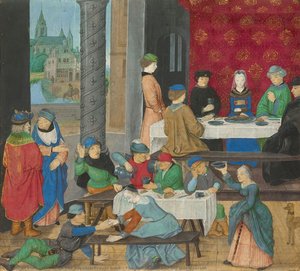
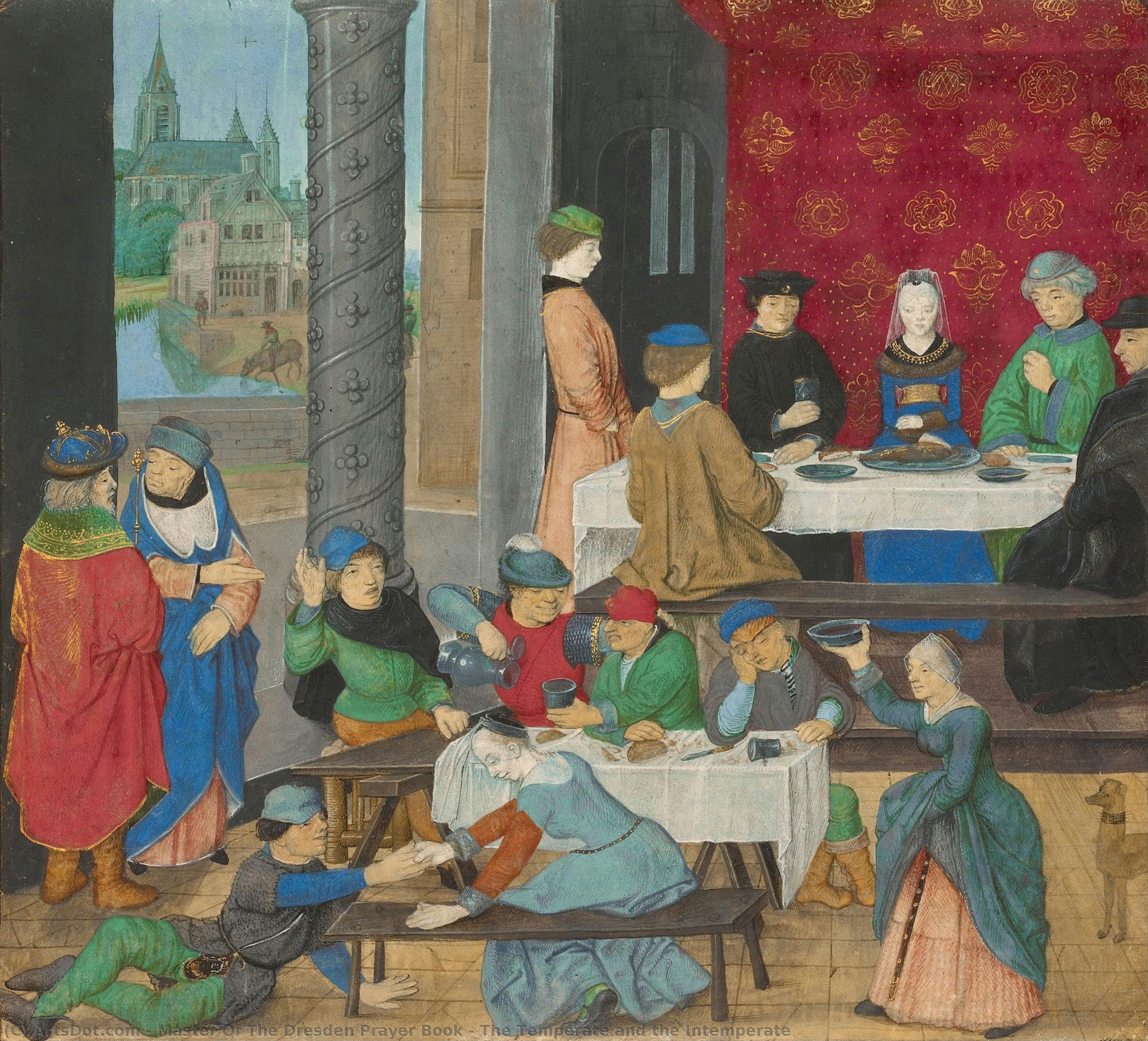
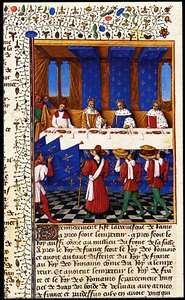
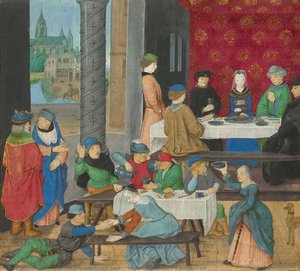
In the intimate scale of this 1480 masterpiece, The Temperate and the Intemperate, we are invited into a world where every gesture and every vessel tells a story of moral consequence. The painting presents a lively, crowded scene set within the stone-walled grandeur of a late medieval hall. At first glance, the eye is drawn to the communal energy of the thirteen figures gathered around a heavy dining table. There is a palpable sense of movement; some guests lean in with whispered secrets, while others stand poised as if caught mid-sentence. The table itself serves as a stage for a silent drama, meticulously set with the humble tools of a feast—cups, bowls, and utensils that catch the soft, ambient light of the era. This is not merely a depiction of a meal, but a window into the social fabric of the Burgundian Netherlands, where the act of dining was deeply intertwined with the display of character.
< nocode >The Artistry of an Anonymous Master
Though the identity of the master of the dresden prayer book remains veiled in the mists of history, his technical prowess shines through this exquisite work. The artist employs a delicate, precise technique characteristic of Flemish illumination, where every detail—from the glint of a silver spoon to the heavy folds of a tunic—is rendered with profound clarity. Despite its small size of 17 x 19 cm, the composition possesses an expansive emotional depth. The use of light and shadow creates a sense of volume, making the figures feel tangible and present within their architectural setting. For the discerning collector or interior designer, this piece offers a rare opportunity to possess a fragment of the late Middle Ages, bringing a sense of historical weight and scholarly elegance to any curated space.
The painting draws its narrative soul from Valerius Maximus’s The Memorable Deeds and Sayings of the Romans, a text that served as a moral compass for centuries. Through this lens, the feast becomes a symbolic battleground between temperance and excess. The arrangement of the guests—some composed and others perhaps more boisterous—serves as a visual metaphor for the struggle to maintain self-control amidst the temptations of earthly delights. To display such a reproduction is to invite a conversation about history, ethics, and the enduring human condition into one's home.
Related Artworks
Artist Biography
A Shadowed Hand: Unveiling the Master of the Dresden Prayer Book
The name evokes a single, breathtaking manuscript – the *Dresden Prayer Book* – yet behind it lies an artist whose life remains shrouded in mystery. The Master of the Dresden Prayer Book was not a celebrated figure during his lifetime, but rather an anonymous Flemish illuminator active between 1460 and 1520. We know him only through his work: over fifty manuscripts are attributed to his hand, each a testament to a remarkable skill and vision flourishing in the heart of the Burgundian Netherlands. His anonymity is not unusual for artists of the period; manuscript illumination was often a collaborative process undertaken within workshops, and individual authorship wasn’t always prioritized or recorded. However, the consistency of style and quality across these attributed works allows us to confidently identify a singular artistic voice – a master craftsman whose influence resonated throughout the late medieval and early Renaissance art world.Flanders in Bloom: Artistic Context and Early Influences
To understand the Master’s artistry, one must consider the vibrant cultural landscape of 15th-century Flanders. Cities like Ghent, Bruges, and Brussels were thriving centers of commerce and artistic production, fueled by a wealthy merchant class eager to commission lavish devotional objects. The Burgundian court, renowned for its patronage of the arts, fostered an environment where realism, intricate detail, and opulent materials were highly valued. Early in his career, the Master likely absorbed these prevailing aesthetics. His work demonstrates a clear understanding of existing illumination traditions, particularly those associated with the Brothers van Eyck and Rogier van der Weyden – though he quickly developed a style distinctly his own. The influence of early Netherlandish painting is palpable in his figures’ delicate modeling, expressive faces, and naturalistic drapery. He wasn't simply copying; rather, he was translating the innovations of panel painting into the miniature format, pushing the boundaries of what could be achieved with brush and pigment on parchment.A Signature Style: Intimacy, Detail, and Religious Devotion
What sets the Master apart is his unique approach to illumination. His compositions are characterized by a remarkable intimacy – figures often occupy shallow spaces, brought close to the viewer as if inviting personal contemplation. This closeness is amplified by an extraordinary attention to detail. Every fold of fabric, every strand of hair, every jewel and ornament is rendered with meticulous precision. He possessed an exceptional talent for depicting textures and patterns, creating surfaces that seem almost tactile. But his artistry wasn’t merely about technical virtuosity; it was deeply rooted in religious devotion. The manuscripts he illuminated were intended to facilitate personal prayer, and his images reflect a profound understanding of theological themes. His figures are not idealized saints but rather relatable human beings experiencing faith, doubt, and spiritual longing. The use of rich, saturated colors – particularly blues and golds – further enhances the emotional impact of his work. The *Dresden Prayer Book* itself exemplifies these qualities: its vibrant scenes from the life of Christ and the Virgin Mary are imbued with a sense of both grandeur and tenderness.Beyond Dresden: Tracing the Master’s Oeuvre
While the *Dresden Prayer Book* remains his most famous creation, the Master's influence extends far beyond Saxony. Manuscripts attributed to him can be found in collections across Europe and North America, offering glimpses into a prolific career spanning several decades. These works reveal a gradual development of his style over time. Early manuscripts tend to be more conservative, adhering closely to established conventions. Later works demonstrate a greater degree of experimentation – bolder compositions, more dynamic figures, and an increased emphasis on narrative detail. Scholars continue to debate the precise chronology of his oeuvre, but there is a general consensus that he worked in multiple workshops throughout Flanders, collaborating with other artists and assistants. Identifying these collaborations is crucial for understanding the full scope of his artistic network and influence.A Lasting Legacy: The Enduring Appeal of Medieval Illumination
The Master of the Dresden Prayer Book’s historical significance lies in his ability to synthesize existing traditions with a uniquely personal vision. He represents a pivotal moment in the history of manuscript illumination – a transition from the stylized forms of the medieval period to the more naturalistic aesthetics of the Renaissance. His work not only reflects the religious sensibilities of his time but also offers valuable insights into the social and cultural context of 15th-century Flanders. Though his name remains unknown, his artistry continues to captivate audiences today. The intricate beauty and profound spirituality of his manuscripts serve as a powerful reminder of the enduring power of art to inspire devotion, evoke emotion, and transcend time.- His influence on subsequent generations of illuminators is undeniable.
- The meticulous detail in his work provides valuable insights into medieval life and costume.
- He exemplifies the artistic flourishing of the Burgundian Netherlands.
Quick Facts
- Artistic Movement Or Style: Renaissance Art
- Date Of Birth: c. 1460
- Date Of Death: c. 1520
- Full Name: Master of the Dresden Prayer Book
- Nationality: Flemish
- Notable Artworks: ['Dresden Prayer Book']
- Place Of Birth: Flanders, Belgium
Related Articles
Late Medieval Masterpieces: 10 Artworks That Defined an Era | ArtsDot
Journey through 10 defining Late Medieval masterpieces – from Giotto's frescoes to Jan van Eyck’s realism. Explore the stories, techniques & vibrant colors of Gothic art. Find museum-quality reproductions and elevate your home decor with ArtsDot.com! Discover all masterpieces on ArtsDot.com
High Medieval Art: 10 Masterpieces That Shaped an Era | ArtsDot
Journey through High Medieval Art! Explore 10 iconic masterpieces – from Giotto's frescoes to stunning Gothic cathedrals. Discover the stories behind these timeless paintings, sculptures & illuminated manuscripts. Find museum-quality art reproductions at ArtsDot.com.
Illuminating Faith & Power: A Journey Through Medieval Art (c. 500 – c. 1500)
Explore the rich history of Medieval Art (c. 500 – c. 1500) with ArtsDot. Discover Byzantine mosaics, Gothic cathedrals & Renaissance masterpieces. Expert insights & museum-quality reproductions.
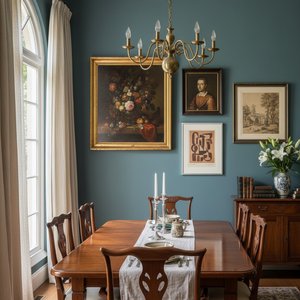
Cultivating Ambiance: Selecting Art Reproductions for the Dining Room – A Historical & Aesthetic Guide
Elevate your dining room with expertly curated art reproductions! Explore historical context, aesthetic considerations & modern applications for a captivating space. Discover the perfect artwork to inspire conversation and enhance every meal.
Aesthetic Gastronomy: The Role of Curated Art Collections in Shaping Perceptions of Michelin-Starred Dining Experiences
Discover how curated art collections elevate Michelin-starred dining experiences. Expert insights on sensory branding, emotional intelligence & ROI for luxury restaurants and hotels. Transform your space with ArtsDot.