 Preview
 Send
Send Share
Share
 Details

 Download
 Similars
 X-Ray
X-Ray Diaporama
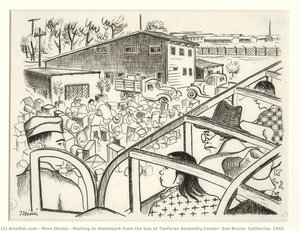
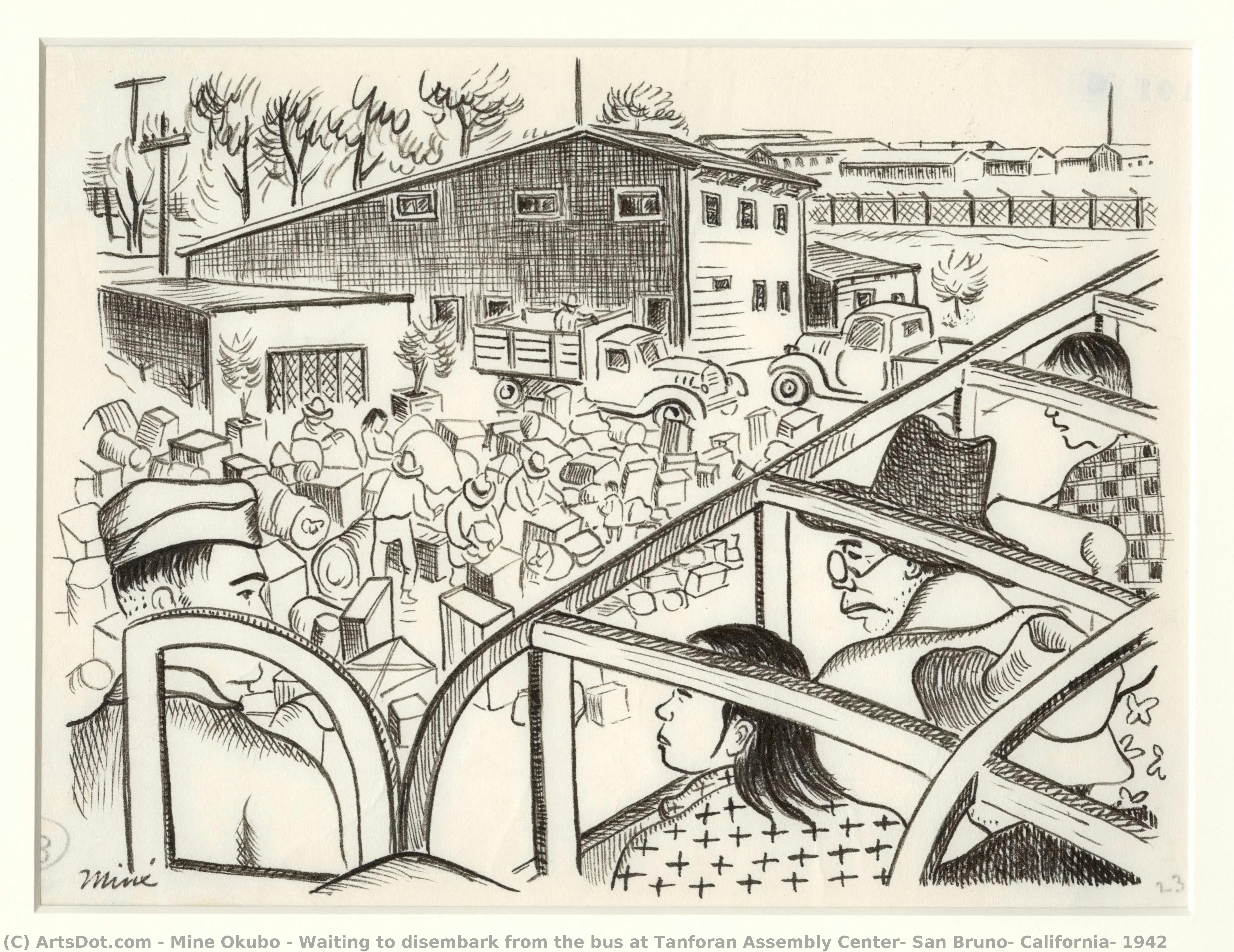
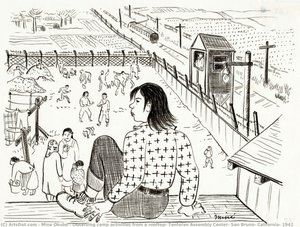
Waiting to disembark from the bus at Tanforan Assembly Center, San Bruno, California, 1942


 Read More
Hand Made Oil Reproduction
Hand-painted oil on canvas in your size and frame, made to order by our artists. ( Buy Print Buy Image)




P118B $10

P118H $10

P118W $10

P438Z $10

P508JH $12

P508YH $12

P805H $10

P805Z $10

P919BZ $10

P919G $10

P919XJ $10

P959ZH $10

P968JZ $12

W106C $8

W218G $10

W218JH $8

W218Y $10

W307PJ $10

W316G $10

W316PJ $8

W316Y $10

W398PJ $8

W4111J $10

W500HY $15

W500JH $15

W692G $12

W849H $8

W940BG $15

W953PJ $8




Pick from our preset sizes that match the artwork's original proportions.

You may enter your own dimensions to fit a specific frame or space. If your selected size does not match the original image's proportions, we will either crop the artwork or extend the painting with additional hand-painted elements. A digital mockup will be sent for your approval before production begins.
Please note that the on-screen preview does not reflect the actual cropping or extension. Only the mockup will accurately show the final composition.
While custom sizes are available, we recommend selecting a dimension from the predefined list to preserve the original proportions.
After order, ArtsDot.com team will email client for instructions and provide a mockup preview
Worldwide Delivery () in 3/4 weeks instead of standard 5 weeks. (22 August). No compromise on quality.

Free Worldwide Express Shipping

High-Quality Linen Canvas

Full Shipping Insurance

Customs Tax Refund Guarantee

True Color Matching Guarantee

60-Day Return Policy (Defects Only)

100% Money-Back Guarantee

Bulk Discount Offer
 Glass option is only available in size under 110 CM

Waiting to disembark from the bus at Tanforan Assembly Center, San Bruno, California, 1942
Reproduction Medium
Reproduction Size
-


Total Price
$ 263
Artwork Description
A Moment Frozen in Time: Miné Okubo’s “Waiting to Disembark from the Bus at Tanforan Assembly Center, San Bruno, California, 1942”
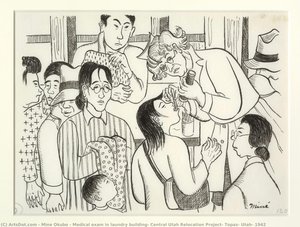
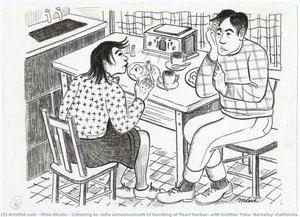
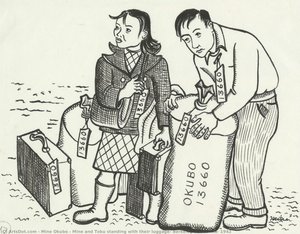
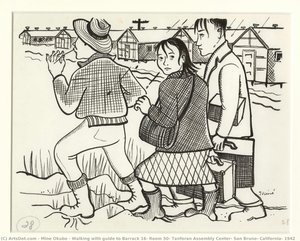
Miné Okubo's stark and profoundly moving illustration, "Waiting to Disembark from the Bus at Tanforan Assembly Center, San Bruno, California, 1942," isn’t merely a depiction of a wartime scene; it’s a visceral testament to resilience, displacement, and the quiet dignity of those caught in the machinery of American history. Created during her forced incarceration at the Tanforan and Topaz camps – experiences that irrevocably shaped her life and artistic vision – this piece transcends its documentary roots to become a universal symbol of uncertainty and the yearning for home. The image captures a pivotal, yet often overlooked, moment: the anxious anticipation of a group of Japanese Americans awaiting transport after months of confinement within the assembly center’s vast, echoing halls.
The illustration's power lies in its masterful use of monochrome – a deliberate choice that amplifies the scene’s emotional weight. Okubo employs a meticulous technique of hatching and cross-hatching, building up layers of tone to create an astonishingly rich texture. The shadows are deep and pervasive, suggesting not only the physical darkness of the assembly center but also the psychological gloom experienced by those held within. The figures themselves are rendered with a remarkable sensitivity; their faces etched with worry, exhaustion, and a palpable sense of vulnerability. Notice how she subtly captures the nuances of expression – the furrowed brows, averted gazes, and hesitant postures—transforming a simple scene into a powerful portrait of collective anxiety.
The Crucible of Camp Life: Context and Historical Significance
To fully appreciate “Waiting to Disembark,” one must understand the harrowing context in which it was created. Following the attack on Pearl Harbor in December 1941, fueled by wartime hysteria and deeply ingrained anti-Japanese sentiment, over 120,000 Japanese Americans – including citizens of the United States – were forcibly removed from their homes and incarcerated in assembly centers like Tanforan and later Topaz. These camps, often hastily constructed and woefully inadequate, became symbols of injustice and a profound betrayal of American ideals. Okubo’s work serves as a crucial historical record, offering an intimate glimpse into the daily realities of this dark chapter – a reality that has been frequently glossed over in official narratives.
The Tanforan Assembly Center itself was a repurposed racetrack, transformed into a temporary holding facility. The image's background subtly reveals this transformation—the vast expanse of the track and the imposing building hint at the scale of the operation and the sheer number of people confined within its walls. It’s important to remember that Okubo wasn’t simply sketching; she was meticulously documenting, creating a visual archive of her experience and those around her – an act of quiet resistance against the dehumanizing conditions imposed upon them.
Symbolism and Emotional Resonance
Beyond its historical significance, “Waiting to Disembark” is rich in symbolic resonance. The bus itself represents not just transportation but also a journey—a forced journey away from home, towards an uncertain future. The figures huddled together, clutching suitcases and belongings, embody the shared experience of displacement and loss. Their gazes are directed outwards, towards the unknown, reflecting both hope and apprehension. The muted palette reinforces this sense of melancholy, while the careful rendering of details—the worn luggage, the anxious expressions—grounds the scene in a tangible reality.
The composition is deliberately restrained, focusing on the immediate human drama unfolding before the viewer. There’s no grand narrative or heroic gesture; instead, Okubo presents a quiet tableau of everyday life under extraordinary circumstances. This simplicity amplifies the emotional impact, allowing the viewer to connect with the subjects on a deeply personal level.
A Legacy of Witness: Miné Okubo and Her Enduring Art
Miné Okubo’s “Waiting to Disembark from the Bus at Tanforan Assembly Center, San Bruno, California, 1942” is more than just an illustration; it's a powerful act of remembrance. Her subsequent book, *Citizen 13660*, which included this drawing and many others, became one of the first graphic memoirs documenting the Japanese American experience during World War II – a groundbreaking work that continues to resonate today. Okubo’s art serves as a vital reminder of the injustices of the past and a testament to the enduring power of human resilience. Reproductions of this poignant image offer not only an aesthetic pleasure but also a profound opportunity for reflection on themes of identity, displacement, and the importance of bearing witness.
Related Artworks
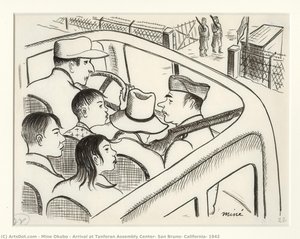
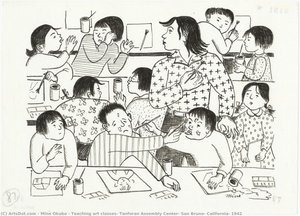
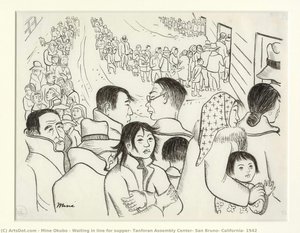
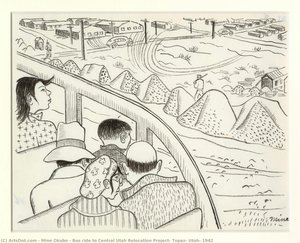
Artist Biography
A Life Etched in Resilience: The Art of Miné Okubo
Miné Okubo, born in Riverside, California, in 1912, was an artist whose life became inextricably linked to a pivotal and painful chapter in American history. Her story is not simply one of artistic talent, but of profound courage, unwavering observation, and the power of art as witness. From her early encouragement within a family that valued creativity – her mother a skilled calligrapher, her father a scholar – Okubo embarked on a path toward formal training, studying at the University of California, Berkeley, and later venturing to Europe in 1938 to broaden her artistic horizons. This period of study was abruptly curtailed by the looming shadow of World War II, forcing her return to America just as global tensions reached a boiling point. Little could she have known that this homecoming would lead not to continued artistic exploration, but to forced incarceration and an experience that would define both her life and her art.Bearing Witness: Art Within the Walls
The attack on Pearl Harbor irrevocably altered the course of Okubo’s life, as it did for countless other Japanese Americans. In 1942, she and her brother Benji were uprooted from their home and unjustly confined to the Tanforan Assembly Center, a converted racetrack that served as a temporary holding facility before transfer to the more permanent Topaz War Relocation Center in Utah. It was within these barbed-wire confines, amidst the dust and despair, that Okubo embarked on her most significant artistic undertaking. Driven by an almost compulsive need to document the reality around her, she began creating a remarkable visual record of camp life – over 2,000 drawings and sketches meticulously rendered in pen and ink, watercolor, and charcoal. These weren’t grand historical paintings or idealized portraits; they were raw, honest depictions of daily existence: crowded living quarters, bureaucratic processes, the faces etched with worry and resignation, moments of quiet dignity amidst profound hardship. She captured the mundane details – laundry hanging on lines, children playing in the dust, meals served in mess halls – transforming them into powerful statements about resilience and the erosion of civil liberties. Okubo’s art wasn't merely a personal response; it was an act of defiance, a refusal to be silenced or erased.Citizen 13660: A Testament to Dehumanization and Hope
Upon her release from Topaz in 1944, Okubo channeled her experiences into a groundbreaking work of art and literature: Citizen 13660. Published in 1946, the book comprised 198 of her drawings accompanied by poignant text. The title itself is deeply symbolic, referencing the number assigned to her within the internment system – a stark reminder of the dehumanizing process she and so many others endured. Citizen 13660 wasn’t simply a chronicle of suffering; it was a nuanced portrayal of human spirit in the face of adversity. Okubo didn't shy away from depicting the indignities and injustices, but she also captured moments of community, humor, and quiet strength. The drawings are characterized by their directness, emotional depth, and masterful use of line and shadow. The book quickly became a seminal work documenting the Japanese American internment experience, offering an unflinching look at a dark chapter in American history that many preferred to ignore.A Continuing Legacy: Art as Social Commentary
Following the war, Okubo relocated to New York City and continued her artistic career, working as a freelance illustrator for magazines and books, and undertaking mural projects. While she never fully abandoned the themes of social justice and human dignity that had defined her wartime work, her style evolved over time. She explored different mediums and techniques, but always maintained a commitment to realism and honest observation. Okubo’s artistic influences were diverse, drawing inspiration from the Social Realist movement – which emphasized depicting social issues and everyday life with unflinching accuracy – and artists like Käthe Kollwitz, renowned for her powerful depictions of human suffering. Throughout her career, she received numerous awards and recognitions, including grants from the National Endowment for the Arts, acknowledging the significance of her contributions to American art and culture. Miné Okubo passed away in 2001, leaving behind a legacy that continues to resonate today. Her work serves as a potent reminder of the fragility of civil liberties, the importance of vigilance against prejudice and discrimination, and the enduring power of art to bear witness, challenge injustice, and inspire hope. Her drawings are not just historical documents; they are deeply human stories etched in ink and watercolor, demanding that we remember, learn from, and never repeat the mistakes of the past.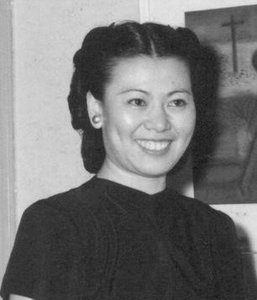
Miné Okubo
1912 - 2001 , United States of America
Quick Facts
- Artistic Movement Or Style: Social Realism
- Artists Or Movements Influenced By This Artist: ['Civil Rights Movement']
- Artists Who Influenced This Artist: ['Käthe Kollwitz']
- Date Of Birth: June 27, 1912
- Date Of Death: February 10, 2001
- Full Name: Miné Okubo
- Nationality: American
- Notable Artworks:
- Citizen 13660
- Interior of Mine and Toku
- Working at the Topaz Times
- Place Of Birth: Riverside, USA
Related Articles
Serenity on Canvas: A Guide to the Timeless Beauty of Japanese Landscape Painting
Discover the serene beauty of Japanese landscape painting. From Hokusai's iconic woodblock prints to meditative sumi-e ink washes, explore a visual journey through the 'floating world' and learn how to bring this timeless Zen aesthetic into your modern home decor.

Hokusai's Masterpieces: 25 Iconic Prints & Paintings for Art Lovers | ArtsDot
Journey through Katsushika Hokusai’s 25 most iconic artworks, including *The Great Wave*. Explore the ukiyo-e master's history, style & timeless Japanese woodblock prints. Find museum-quality reproductions for your home at ArtsDot.com.
Floating World: The Captivating Art and Legacy of Japanese Ukiyo-e
Explore the profound beauty of Japanese Ukiyo-e. Discover the history, masters like Hokusai, and the enduring legacy of the 'Floating World' through an expert art-historical lens.
Léonard Foujita: A Poetic Synthesis of Japanese Sensibility & European Modernism
Discover the captivating world of Léonard Foujita, a master bridging Japanese aesthetics & European Modernism. Explore his signature style, diverse works, and enduring legacy – essential reading for discerning art collectors.
Utagawa Kuniyoshi: A Master of Japanese Ukiyo-e – Narrative Innovation & the Fusion of Tradition with Popular Culture
Explore the captivating world of Utagawa Kuniyoshi, a master of Japanese ukiyo-e woodblock prints. Discover his innovative warrior scenes, vibrant landscapes & lasting legacy in 19th-century art history.
![[Untitled]](/media/artworks/images-thumb/99/e8/99e8a9067d016b065f6cdee3ab5f27d0.jpg)