 Preview
 Send
Send Share
Share
 Details

 Download
 Similars
 X-Ray
X-Ray Diaporama
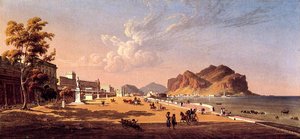
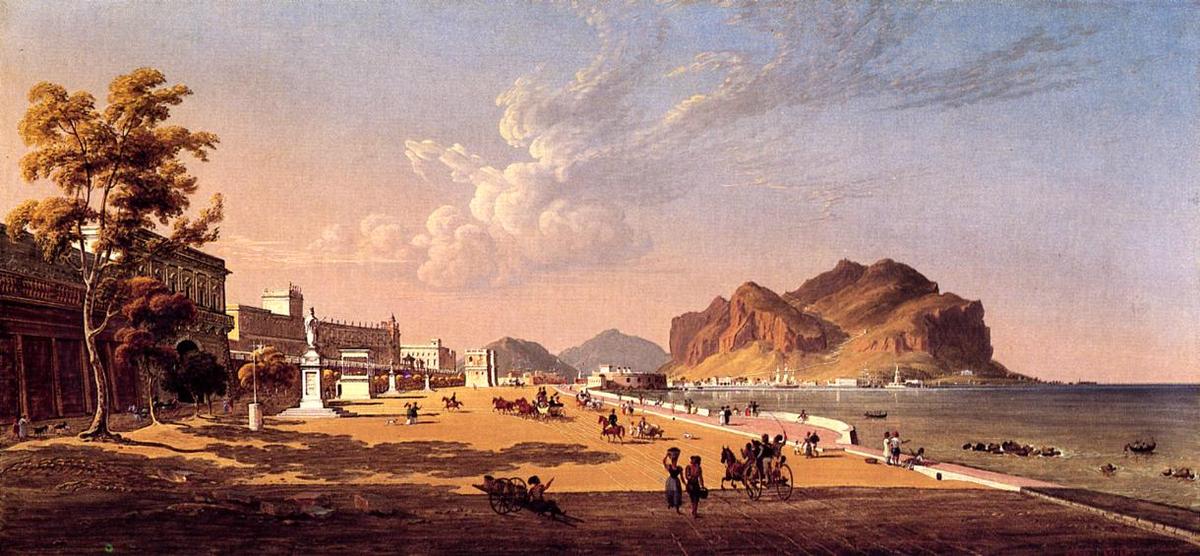
View of Palermo


 Read More
Hand Made Oil Reproduction
Hand-painted oil on canvas in your size and frame, made to order by our artists. ( Buy Print Buy Image)




P118B $10

P118H $10

P118W $10

P438Z $10

P508JH $12

P508YH $12

P805H $10

P805Z $10

P919BZ $10

P919G $10

P919XJ $10

P959ZH $10

P968JZ $12

W106C $8

W218G $10

W218JH $8

W218Y $10

W307PJ $10

W316G $10

W316PJ $8

W316Y $10

W398PJ $8

W4111J $10

W500HY $15

W500JH $15

W692G $12

W849H $8

W940BG $15

W953PJ $8




Pick from our preset sizes that match the artwork's original proportions.

You may enter your own dimensions to fit a specific frame or space. If your selected size does not match the original image's proportions, we will either crop the artwork or extend the painting with additional hand-painted elements. A digital mockup will be sent for your approval before production begins.
Please note that the on-screen preview does not reflect the actual cropping or extension. Only the mockup will accurately show the final composition.
While custom sizes are available, we recommend selecting a dimension from the predefined list to preserve the original proportions.
After order, ArtsDot.com team will email client for instructions and provide a mockup preview
Worldwide Delivery () in 3/4 weeks instead of standard 5 weeks. (17 August). No compromise on quality.

Free Worldwide Express Shipping

High-Quality Linen Canvas

Full Shipping Insurance

Customs Tax Refund Guarantee

True Color Matching Guarantee

60-Day Return Policy (Defects Only)

100% Money-Back Guarantee

Bulk Discount Offer
 Glass option is only available in size under 110 CM

View of Palermo
Reproduction Medium
Reproduction Size
-


Total Price
$ 263
Artwork Description
Robert W. Salmon’s “View of Palermo” – A Romantic Echo of Imperial Grandeur
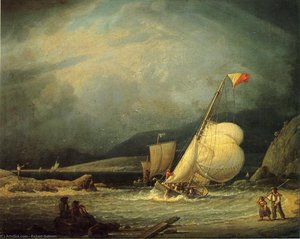
Robert W. Salmon’s “View of Palermo,” painted in 1845, stands as a quintessential example of Romantic landscape painting infused with Neoclassical elegance and Luminism—a technique championed by artists like Turner that sought to capture the fleeting effects of light on nature. More than just a depiction of a coastal panorama, it embodies an ambitious vision of imperial power tempered by serene beauty, transporting viewers back to a pivotal moment in Sicilian history.
The artwork captures a sprawling promenade lined with figures – nobles and soldiers alike – enjoying the breezy Mediterranean air overlooking Cassaro Street. Salmon skillfully employs horizontal lines dominating the composition, emphasizing the vastness of the beach and sea, mirroring the grandeur of Roman imperial architecture. Dominating the right side is a dramatic rocky island rising from the water, serving as a powerful focal point that draws the eye upwards into the hazy distance.
- Composition & Perspective: Salmon’s linear perspective guides the viewer's gaze towards distant buildings and mountains, gradually diminishing in detail and atmospheric haze—a hallmark of Luminism. This masterful illusion of depth creates a palpable sense of space and contributes significantly to the painting’s immersive quality.
- Color Palette & Brushwork: The color palette is muted yet rich, primarily utilizing soft blues, greens, browns, and ochres. Loose brushstrokes—characteristic of Romantic style—add texture and dynamism to the canvas, conveying a feeling of movement and capturing the ephemeral qualities of twilight.
- Symbolism & Context: Painted during the reign of Queen Victoria, “View of Palermo” reflects the Victorian fascination with idealized landscapes and celebrates the splendor of nature as viewed through an aristocratic lens. The island’s rugged terrain symbolizes resilience and strength, juxtaposed against the tranquil sea—a visual metaphor for peace and stability.
- Technique: Salmon utilized oil paints on canvas, employing a glazing technique to achieve luminous colors and subtle tonal variations. This meticulous layering of paint allowed him to capture the atmospheric conditions of late afternoon or early evening with remarkable accuracy.
The foreground promenade invites contemplation, populated by figures dressed in formal attire—a testament to Palermo’s aristocratic heritage. Architectural details like grand buildings and columns along Cassaro Street reinforce the painting's Neoclassical influence, grounding its Romantic spirit within a framework of classical ideals. The sky is filled with billowing clouds, intensifying the dramatic mood and enhancing the overall visual impact.
Ultimately, “View of Palermo” succeeds in evoking a profound emotional response—a feeling of awe at the beauty of nature combined with an awareness of imperial authority. It’s a painting that lingers in the memory long after viewing, reminding us of a bygone era and its enduring artistic legacy.
Related Artworks
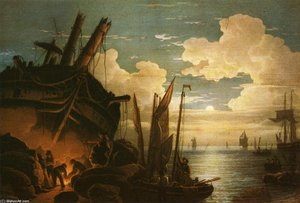
Artist Biography
Early Life and Artistic Training
- Origins: Salmon was born Robert Salomon to Francis Salomon, a jeweler. Whitehaven's bustling port provided an early influence on his artistic development.
- Early Influences: His training is not extensively documented but it’s believed he studied Dutch marine painters of the 17th century, Italian vedute artists, and Claude Lorrain.
- Early Works: His earliest known works, “Two Armed Merchantmen Leaving Whitehaven Harbor” (1800) and “The ‘Estridge’ off Dover,” demonstrate his early skill in capturing maritime scenes.
- Royal Academy Debut: Salmon first exhibited at the Royal Academy in 1802, marking a significant step in his career.
Career Development and Style
- Move to Liverpool (1806): Salmon settled in Liverpool and changed his name to Salmon. This period saw him produce numerous marine paintings now housed in the National Maritime Museum in London.
- Ship Portraits: His ship portraits reveal a deep familiarity with sailing ships and their mechanics, often depicting the same vessel from multiple angles on a single canvas.
- Popularity & Collectors: Salmon's work gained popularity among prominent Bostonians like Samuel Cabot, Robert Bennett Forbes, and John Newmarch Cushing, indicating his growing recognition in America.
- Luminism Pioneer: He is considered a key figure in the development of American Luminism, influencing artists like William Bradford and Fitz Henry Lane. His emphasis on light and atmosphere created serene and tranquil scenes.
Notable Works and Artistic Significance
- Key Paintings: Some of Salmon's most recognized works include "The Brig 'Ariel'," "Sailing Ship 'Trelawney'," and “View of Liverpool from Cheshire.” These paintings exemplify his skill in capturing the beauty and complexity of sailing vessels.
- Boston Harbor Series: He produced a significant body of work depicting Boston Harbor, showcasing maritime life and historical Boston. “Boston Harbor from Castle Island (Ship Charlotte)” is a notable example.
- Influence on American Art: Salmon's style profoundly influenced subsequent generations of American seascape painters, contributing to the development of Luminism as an important artistic movement.
Legacy and Recognition
- Museum Holdings: Salmon’s works are held in prestigious institutions including the U.S. Naval Academy, Museum of Fine Arts, Boston, and the National Maritime Museum, Greenwich.
- Lasting Impact: His paintings continue to inspire artists today, serving as a testament to his skill and artistry.
- Father of American Luminism: Salmon’s legacy is firmly established as a pioneer of American Luminism, leaving an indelible mark on the art world.
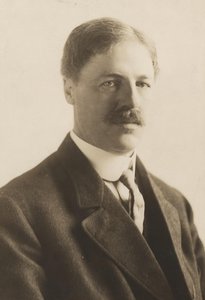
Robert W. Salmon
1775 - 1845 , United Kingdom
Quick Facts
- Artistic Movement Or Style: American Luminism
- Artists Or Movements Influenced By This Artist:
- William Bradford
- Fitz Henry Lane
- Artists Who Influenced This Artist:
- Dutch marine painters
- Italian vedute artists
- Claude Lorrain
- Date Of Birth: 1775
- Date Of Death: 1845
- Full Name: Robert W. Salmon
- Nationality: British
- Notable Artworks:
- Sailing Ship 'Trelawney'
- Boston Harbor from Castle Island
- A Frigate of the Baltic Fleet
- Place Of Birth: Whitehaven, United Kingdom
Related Articles

Romantic Landscapes: 10 Masterpieces for Your Home | ArtsDot
Journey through 10 Romantic landscape masterpieces by Friedrich, Turner & Cole. Explore emotional art, sublime nature scenes & iconic 19th-century paintings. Find museum-quality reproductions for your home at ArtsDot.com – discover the full collection online!
Robert W. Salmon: Navigating the Currents of Maritime Painting & American Realism
Explore the captivating maritime paintings of Robert W. Salmon, a pioneer of American Luminism. Discover his Boston Harbor scenes, legacy, and collecting guide at ArtsDot.

Beyond the Horizon: 10 Landscape Masterpieces for Your Home Decor
Journey through 10 breathtaking landscape paintings by Monet, Van Gogh & more! Explore iconic artworks, artistic techniques & find inspiration for your home decor. Museum-quality reproductions at ArtsDot.com. Discover all masterpieces on ArtsDot.com

Robert Spencer: Luminism, Narrative & the American Landscape Tradition
Explore the captivating world of Luminism & the Hudson River School with our expert analysis. Discover the history, artists, and enduring beauty of 19th-century American landscape painting. Find museum-quality reproductions at ArtsDot.
Hubert Robert: Picturing Ruins, Preserving Memory – A Study of Romantic Antiquarianism & Artistic Innovation
Explore the captivating world of Hubert Robert, master of Romantic landscape painting & 'capriccio' ruins. Discover his historical context, artistic innovations, and collecting insights with ArtsDot.