 Preview
 Send
Send Share
Share
 Details

 Download
 Similars
 X-Ray
X-Ray Diaporama
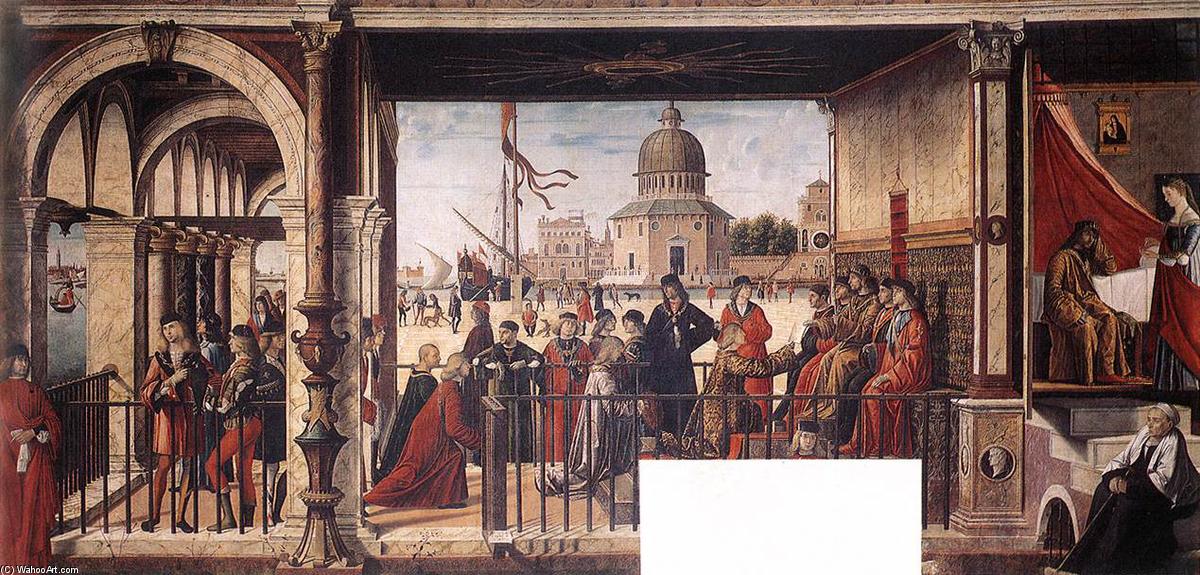
Arrival of the English Ambassadors
 Tempera On Panel
- WallArt
- Renaissance Narrative Painting
 1495
1495- Renaissance
 275.0 x 589.0 cm
 Gallerie dell'Accademia
 Read More
Hand Made Oil Reproduction
Hand-painted oil on canvas in your size and frame, made to order by our artists. ( Buy Print Buy Image)




P118B $10

P118H $10

P118W $10

P438Z $10

P508JH $12

P508YH $12

P805H $10

P805Z $10

P919BZ $10

P919G $10

P919XJ $10

P959ZH $10

P968JZ $12

W106C $8

W218G $10

W218JH $8

W218Y $10

W307PJ $10

W316G $10

W316PJ $8

W316Y $10

W398PJ $8

W4111J $10

W500HY $15

W500JH $15

W692G $12

W849H $8

W940BG $15

W953PJ $8




Pick from our preset sizes that match the artwork's original proportions.

You may enter your own dimensions to fit a specific frame or space. If your selected size does not match the original image's proportions, we will either crop the artwork or extend the painting with additional hand-painted elements. A digital mockup will be sent for your approval before production begins.
Please note that the on-screen preview does not reflect the actual cropping or extension. Only the mockup will accurately show the final composition.
While custom sizes are available, we recommend selecting a dimension from the predefined list to preserve the original proportions.
After order, ArtsDot.com team will email client for instructions and provide a mockup preview
Worldwide Delivery () in 3/4 weeks instead of standard 5 weeks. (2 September). No compromise on quality.

Free Worldwide Express Shipping

High-Quality Linen Canvas

Full Shipping Insurance

Customs Tax Refund Guarantee

True Color Matching Guarantee

60-Day Return Policy (Defects Only)

100% Money-Back Guarantee

Bulk Discount Offer
 Glass option is only available in size under 110 CM

Arrival of the English Ambassadors
Reproduction Medium
Reproduction Size
-


Total Price
$ 263
A Grand Stage of Venetian Diplomacy
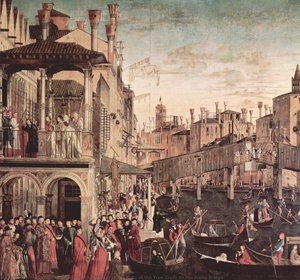
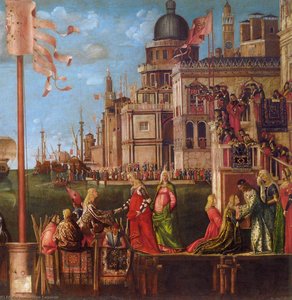
In the heart of late fifteenth-century Venice, where the salt air of the lagoon meets the opulence of a maritime empire, Vittore Carpaccio captured a moment of profound political theater. His masterpiece, Arrival of the English Ambassadors, completed in 1495, is far more than a mere historical record; it is a vibrant, breathing tableau of international intrigue. As the viewer’s eye enters the grand palazzo courtyard, they are immediately swept into a choreographed dance of diplomacy. The scene depicts the formal reception of envoys from England by Venetian dignitaries, a moment where every gesture, every fold of heavy silk, and every glance exchanged between nobles carries the weight of statecraft. Carpaccio does not merely paint a meeting; he constructs a stage where the tension of burgeoning international relations is palpable, inviting us to witness the very pulse of Renaissance power.
The composition is a triumph of architectural precision and narrative depth. Through the sweeping arches and classical columns of the Venetian palace, Carpaccio guides our gaze toward a breathtaking vista of the city itself. In the distance, the iconic domes and towers of Venice rise above the water, while a solitary ship glides across the lagoon, serving as a poignant reminder of the commerce and connectivity that fueled the Republic's greatness. This interplay between the intimate, crowded courtyard and the expansive, sunlit cityscape creates a sense of immense scale, making the viewer feel like an unobserved guest at one of history's most significant diplomatic encounters.
The Mastery of Color and Tradition
While many of his contemporaries were beginning to experiment with the radical shifts of the High Renaissance, Carpaccio remained a steadfast guardian of a more conservative, luminous aesthetic. His technique, utilizing tempera on wood panels, allows for a jewel-like brilliance that remains striking centuries later. By meticulously layering pigments, he achieved a depth of color and a subtle gradation of tone that breathes life into the heavy drapery and ornate costumes of the figures. The palette is dominated by rich, regal tones—deep reds, shimmering golds, and profound blues—that reflect the immense wealth and status of the participants.
Influenced by the polished surfaces of Antonello da Messina and the luminous light of Giovanni Bellini, Carpaccio’s style possesses a unique, almost tactile quality. Every detail, from the intricate patterns on a diplomat's doublet to the weathered texture of the stone masonry, is rendered with a painstaking precision that borders on the devotional. For the collector or the interior designer, this level of detail offers an unparalleled sensory experience. A high-quality reproduction of this work brings not just a piece of art into a room, but a window into a meticulously crafted world, where the light of the Venetian sun seems to dance across the very surface of the canvas.
An Enduring Legacy for the Discerning Eye
Beyond its technical brilliance, Arrival of the English Ambassadors resonates with an emotional gravity that transcends time. It captures the anxiety and the splendor of an era defined by exploration and the delicate balance of power. There is a certain courtly drama in the way the figures are positioned—some engaged in hushed conversation, others observing the proceedings with watchful eyes—that evokes a sense of mystery and importance. It is a painting that rewards repeated viewing, revealing new layers of storytelling with every encounter.
For those seeking to infuse a space with historical significance and artistic sophistication, this work serves as an extraordinary centerpiece. Whether placed in a grand library, a formal dining hall, or a contemporary gallery setting, the painting commands attention through its sheer narrative complexity and aesthetic richness. It is an invitation to contemplate the enduring human desire for connection, the beauty of ritual, and the timeless elegance of the Venetian spirit.
Related Artworks
![Double Portrait Of Jean De Dinteville And Georges De Selve (aka The Ambassadors) [detail] — Hans Holbein The Younger, Northern Renaissance](/media/artworks/images-thumb/bb/ab/bbab7ce77b7dd15d23d21114a63b51a4.jpg)




Artist Biography
early life and training
vittore carpaccio, a prominent italian painter, was born in venice around 1465. he studied under the tutelage of gentile bellini, a renowned artist of the venetian school. this apprenticeship laid the foundation for carpaccio's future success.artistic style and influences
carpaccio's style was characterized by its conservative nature, showing minimal influence from the humanist trends that transformed italian renaissance painting during his lifetime. his work was influenced by antonello da messina's style and early netherlandish art. this unique blend of styles resulted in a distinctive approach to venetian painting.notable works
- the legend of saint ursula, a cycle of nine paintings, is carpaccio's most famous work. this series, now housed in the gallerie dell'accademia, showcases his mastery of narrative painting.
- glory of st. ursula altarpiece (1491) demonstrates carpaccio's skill in capturing light and color, reminiscent of giovanni bellini's style.
- miracle of the relic of the cross at the ponte di rialto (1494) highlights carpaccio's ability to balance composition and narrative.
career highlights and legacy
- carpaccio's principal works were executed between 1490 and 1519, ranking him among the early masters of the venetian renaissance.
- his orientalist style, as seen in st. george baptizing the selenites, reflects a new fascination with the levant.
- carpaccio's work has been somewhat overlooked in comparison to his contemporaries, such as giovanni bellini or giorgione.
references and further reading
discover more about vittore carpaccio and the venetian school on ArtsDot.
Vittore Carpaccio
1465 - 1526 , Italy
Quick Facts
- Artistic Movement Or Style: Early Venetian Renaissance
- Artists Or Movements Influenced By This Artist: ['Early Netherlandish Painting']
- Artists Who Influenced This Artist:
- Antonello da Messina
- Gentile Bellini
- Date Of Birth: Venice, Italy (c. 1465)
- Date Of Death: 1526
- Full Name: Vittore Carpaccio
- Nationality: Italian
- Notable Artworks:
- The Legend of Saint Ursula
- Glory of St. Ursula Altarpiece
- Miracle of the Relic of the Cross at the Ponte di Rialto
- Place Of Birth: Venice
Related Articles
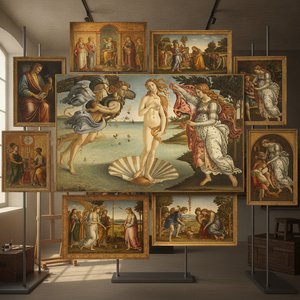
10 Legendary Tempera Masterpieces That Changed Art History Forever
Journey through history with 10 legendary tempera masterpieces that redefined art. From Renaissance icons to timeless techniques, explore the stories behind these museum-quality works and find perfect art reproductions for your decor. Discover all masterpieces on ArtsDot.com.
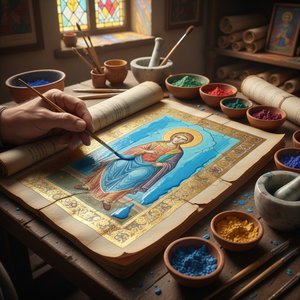
Illuminating History: A Comprehensive Exploration of Tempera Painting Techniques & Artistic Legacy
Explore the rich history & techniques of tempera painting! Discover Renaissance masters like Botticelli & Fra Angelico, conservation insights, and the enduring legacy of this captivating art form.

Illuminating Surfaces: A Comprehensive Exploration of Tempera on Panel Painting Techniques & Historical Significance
Explore the rich history & techniques of tempera painting! Discover Renaissance masters like Botticelli & Fra Angelico, conservation insights, and the enduring legacy of this captivating art form. Learn more now!
Jacopo Tintoretto's Masterpieces: 25 Paintings That Define Venetian Drama | ArtsDot
Explore 25 breathtaking masterpieces by Jacopo Tintoretto, the Venetian master of drama and light. Discover the stories behind iconic Renaissance paintings & find museum-quality art reproductions to elevate your home decor on ArtsDot.com.
Illuminating Eternity: A Comprehensive Exploration of Byzantine Art's Legacy
Explore the rich history & stunning artistry of the Byzantine Empire! Discover iconic mosaics, profound symbolism, and lasting influence on Western art. A comprehensive guide for history lovers.