 Preview
 Send
Send Share
Share
 Details

 Download
 Similars
 X-Ray
X-Ray Diaporama
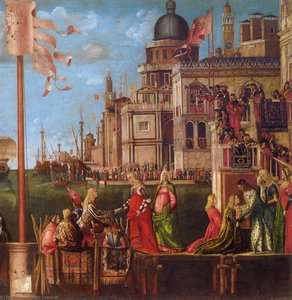
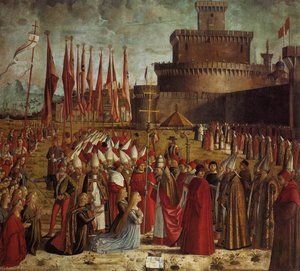
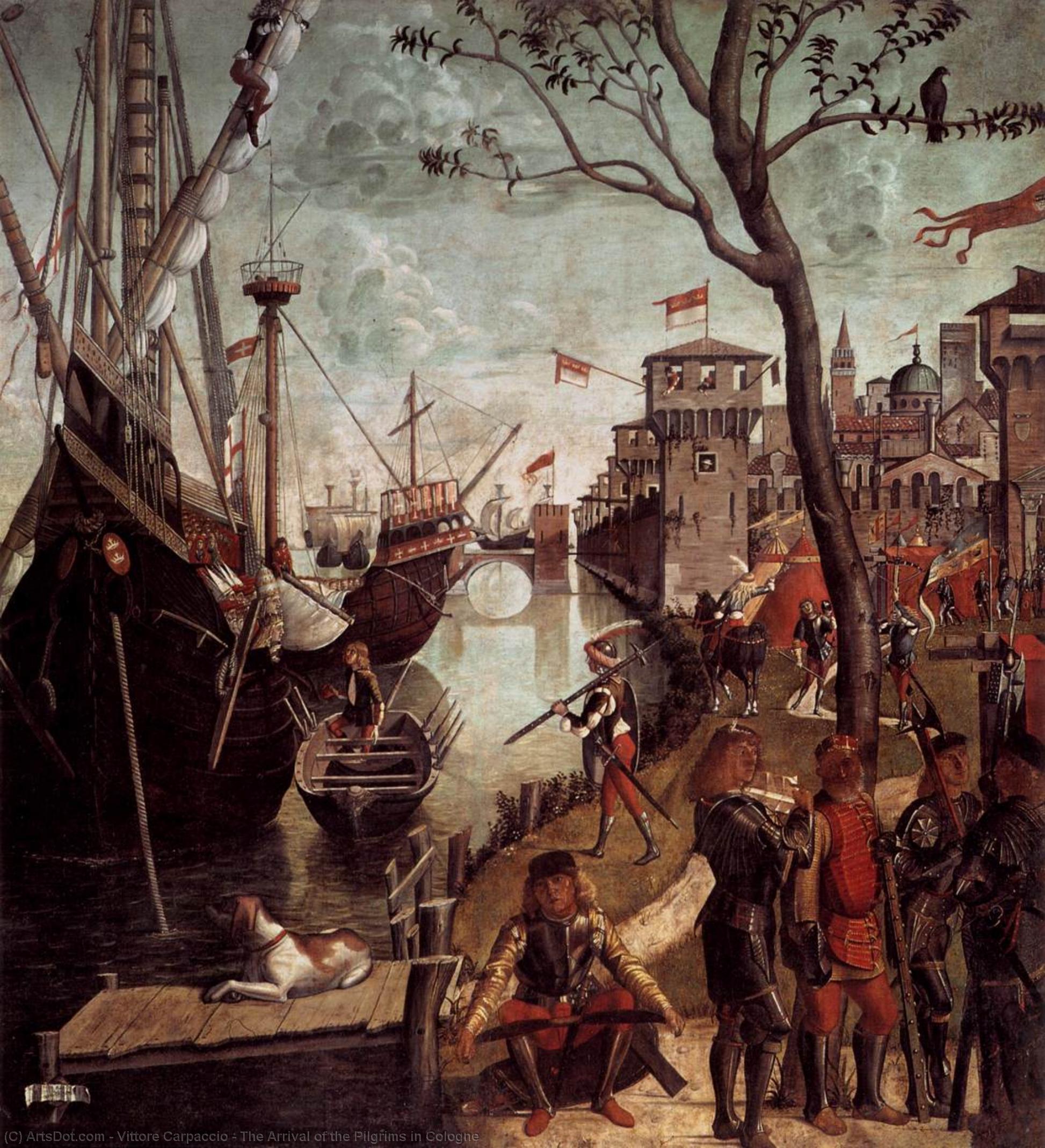
The Arrival of the Pilgrims in Cologne
 Acrylic On Canvas
- WallArt
- Venetian Renaissance
 1490
1490 280.0 x 255.0 cm
 Gallerie dell'Accademia
 Read More
Hand Made Oil Reproduction
Hand-painted oil on canvas in your size and frame, made to order by our artists. ( Buy Print Buy Image)




P118B $10

P118H $10

P118W $10

P438Z $10

P508JH $12

P508YH $12

P805H $10

P805Z $10

P919BZ $10

P919G $10

P919XJ $10

P959ZH $10

P968JZ $12

W106C $8

W218G $10

W218JH $8

W218Y $10

W307PJ $10

W316G $10

W316PJ $8

W316Y $10

W398PJ $8

W4111J $10

W500HY $15

W500JH $15

W692G $12

W849H $8

W940BG $15

W953PJ $8




Pick from our preset sizes that match the artwork's original proportions.

You may enter your own dimensions to fit a specific frame or space. If your selected size does not match the original image's proportions, we will either crop the artwork or extend the painting with additional hand-painted elements. A digital mockup will be sent for your approval before production begins.
Please note that the on-screen preview does not reflect the actual cropping or extension. Only the mockup will accurately show the final composition.
While custom sizes are available, we recommend selecting a dimension from the predefined list to preserve the original proportions.
After order, ArtsDot.com team will email client for instructions and provide a mockup preview
Worldwide Delivery () in 3/4 weeks instead of standard 5 weeks. (16 August). No compromise on quality.

Free Worldwide Express Shipping

High-Quality Linen Canvas

Full Shipping Insurance

Customs Tax Refund Guarantee

True Color Matching Guarantee

60-Day Return Policy (Defects Only)

100% Money-Back Guarantee

Bulk Discount Offer
 Glass option is only available in size under 110 CM

The Arrival of the Pilgrims in Cologne
Reproduction Medium
Reproduction Size
-


Total Price
$ 263
Artwork Description
A Chronicle of Faith and Journey: Exploring Carpaccio’s “Arrival of the Pilgrims in Cologne”
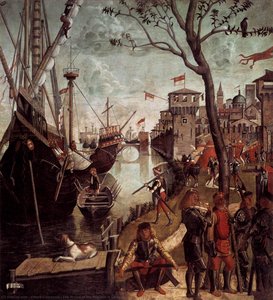
Vittore Carpaccio's "The Arrival of the Pilgrims in Cologne," painted around 1490, isn’t merely a depiction of a historical event; it’s a meticulously crafted narrative brimming with symbolism and reflecting the complex spiritual landscape of late Renaissance Venice. This monumental work, now housed within the Gallerie dell’Accademia, transports us to a pivotal moment – the arrival of pilgrims in Cologne, seeking the relics of Saint Ursula. More than just a scene of travel, it's a carefully orchestrated tableau of faith, diplomacy, and impending tragedy, rendered with Carpaccio’s signature blend of meticulous detail and dramatic storytelling.
The painting immediately captivates with its vibrant palette and dynamic composition. Carpaccio eschews the idealized beauty favored by some of his contemporaries, opting instead for a grounded realism that emphasizes texture, light, and shadow. The scene unfolds within an open pavilion, bathed in the diffused glow of a misty morning – a detail evocative of Venice itself, subtly grounding the fantastical elements within a recognizable setting. The figures are not presented as heroic saints but as ordinary people engaged in extraordinary circumstances, their faces etched with a mixture of anticipation, solemnity, and perhaps even apprehension. The use of perspective is masterful, drawing the eye through the crowded scene towards the central action: the exchange between the Breton envoys and the representatives of Cologne.
The Layers of Narrative: Symbolism and Historical Context
Carpaccio’s work draws heavily from Jacobus de Voragine's *Golden Legend*, a collection of hagiographies that profoundly influenced Venetian art. The story of Saint Ursula, a virgin princess who died alongside her eleven thousand companions in the 5th century, was particularly popular during this period. The painting isn’t simply recounting the arrival; it’s illustrating the complex political and religious negotiations surrounding the pilgrimage – a marriage alliance between Brittany and the pagan kingdom of Cologne. The envoys, clad in richly colored robes, represent the diplomatic mission, while the figures on the left depict the Breton court, highlighting the importance of this union for both kingdoms.
Beyond the immediate narrative, the painting is rich with symbolic details. The presence of the didascalos – a figure resembling the Renaissance humanist Ermolao Barbaro – suggests the role of interpretation and explanation within the context of religious storytelling. The ships in the distance, the city walls of Cologne, and even the arrangement of figures all contribute to a layered visual language that invites contemplation. The scene’s setting itself—a blend of Venetian architecture and imagined landscapes—reflects Venice's position as a crossroads of cultures and commerce during the Renaissance.
Carpaccio’s Technique: A Masterclass in Detail and Drama
What distinguishes Carpaccio’s work is his extraordinary attention to detail. Every garment, every facial expression, every architectural element is rendered with painstaking precision. He employs a technique known as *disegno*, prioritizing the preparatory drawing before applying paint, resulting in remarkably accurate depictions of form and space. The figures are not merely sketched; they are sculpted with an almost photographic realism. This meticulous approach contrasts sharply with the looser brushwork often found in contemporary Venetian painting, highlighting Carpaccio’s unique artistic vision.
Furthermore, Carpaccio masterfully manipulates light and shadow to create a sense of drama and depth. The diffused morning light casts long shadows across the pavilion, emphasizing the figures' forms and creating a palpable atmosphere of anticipation. The use of color is equally deliberate, with rich reds and blues dominating the scene, drawing attention to key elements and adding visual interest. This combination of meticulous detail and dramatic lighting elevates “The Arrival of the Pilgrims in Cologne” beyond a simple historical depiction—it becomes a powerful meditation on faith, diplomacy, and the human condition.
A Legacy of Narrative: Reproductions and Artistic Inspiration
Today, "The Arrival of the Pilgrims in Cologne" stands as a testament to Carpaccio’s artistic genius. Reproductions offer an accessible way to experience this monumental work, allowing viewers to appreciate its intricate details and profound symbolism. Whether adorning a grand salon or a smaller study, a high-quality reproduction can evoke the same sense of wonder and contemplation that captivated audiences in 15th-century Venice. Carpaccio’s legacy continues to inspire artists and designers alike, reminding us of the power of narrative painting to transport us across time and space.
Related Artworks


Artist Biography
early life and training
vittore carpaccio, a prominent italian painter, was born in venice around 1465. he studied under the tutelage of gentile bellini, a renowned artist of the venetian school. this apprenticeship laid the foundation for carpaccio's future success.artistic style and influences
carpaccio's style was characterized by its conservative nature, showing minimal influence from the humanist trends that transformed italian renaissance painting during his lifetime. his work was influenced by antonello da messina's style and early netherlandish art. this unique blend of styles resulted in a distinctive approach to venetian painting.notable works
- the legend of saint ursula, a cycle of nine paintings, is carpaccio's most famous work. this series, now housed in the gallerie dell'accademia, showcases his mastery of narrative painting.
- glory of st. ursula altarpiece (1491) demonstrates carpaccio's skill in capturing light and color, reminiscent of giovanni bellini's style.
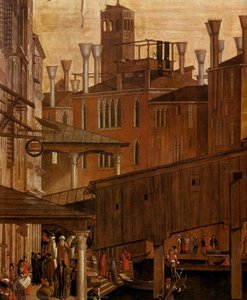
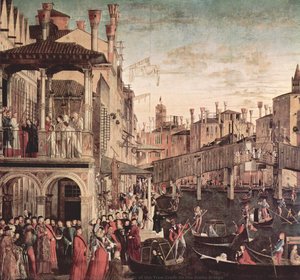
- miracle of the relic of the cross at the ponte di rialto (1494) highlights carpaccio's ability to balance composition and narrative.
career highlights and legacy
- carpaccio's principal works were executed between 1490 and 1519, ranking him among the early masters of the venetian renaissance.
- his orientalist style, as seen in st. george baptizing the selenites, reflects a new fascination with the levant.
- carpaccio's work has been somewhat overlooked in comparison to his contemporaries, such as giovanni bellini or giorgione.
references and further reading
discover more about vittore carpaccio and the venetian school on ArtsDot.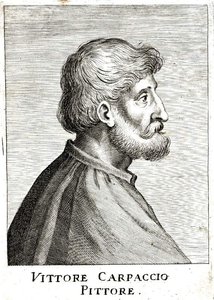
Vittore Carpaccio
1465 - 1526 , Italy
Quick Facts
- Artistic Movement Or Style: Early Venetian Renaissance
- Artists Or Movements Influenced By This Artist: ['Early Netherlandish Painting']
- Artists Who Influenced This Artist:
- Antonello da Messina
- Gentile Bellini
- Date Of Birth: Venice, Italy (c. 1465)
- Date Of Death: 1526
- Full Name: Vittore Carpaccio
- Nationality: Italian
- Notable Artworks:
- The Legend of Saint Ursula
- Glory of St. Ursula Altarpiece
- Miracle of the Relic of the Cross at the Ponte di Rialto
- Place Of Birth: Venice
Related Articles
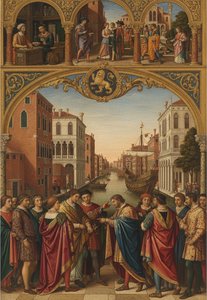
Vittore Carpaccio: Venetian Renaissance Narrative & the Poetics of Detail
Explore the captivating world of Vittore Carpaccio, a master storyteller of the Venetian Renaissance. Discover his intricate details, narrative cycles like 'The Legend of St. Ursula,' and unique artistic style.
High Medieval Art: 10 Masterpieces That Shaped an Era | ArtsDot
Journey through High Medieval Art! Explore 10 iconic masterpieces – from Giotto's frescoes to stunning Gothic cathedrals. Discover the stories behind these timeless paintings, sculptures & illuminated manuscripts. Find museum-quality art reproductions at ArtsDot.com.
Late Medieval Masterpieces: 10 Artworks That Defined an Era | ArtsDot
Journey through 10 defining Late Medieval masterpieces – from Giotto's frescoes to Jan van Eyck’s realism. Explore the stories, techniques & vibrant colors of Gothic art. Find museum-quality reproductions and elevate your home decor with ArtsDot.com! Discover all masterpieces on ArtsDot.com
Early Medieval Art: 10 Masterpieces That Shaped a New World | ArtsDot
Journey through 10 stunning Early Medieval masterpieces – from the Book of Kells to Carolingian mosaics. Explore art history, symbolism & find museum-quality reproductions for your home at ArtsDot.com. Discover all masterpieces online!
Illuminating Faith & Power: A Journey Through Medieval Art (c. 500 – c. 1500)
Explore the rich history of Medieval Art (c. 500 – c. 1500) with ArtsDot. Discover Byzantine mosaics, Gothic cathedrals & Renaissance masterpieces. Expert insights & museum-quality reproductions.