 Preview
 Send
Send Share
Share
 Details

 Download
 Similars
 X-Ray
X-Ray Diaporama
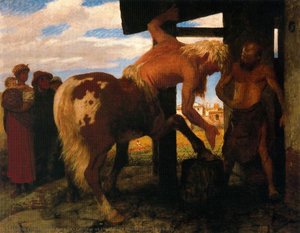
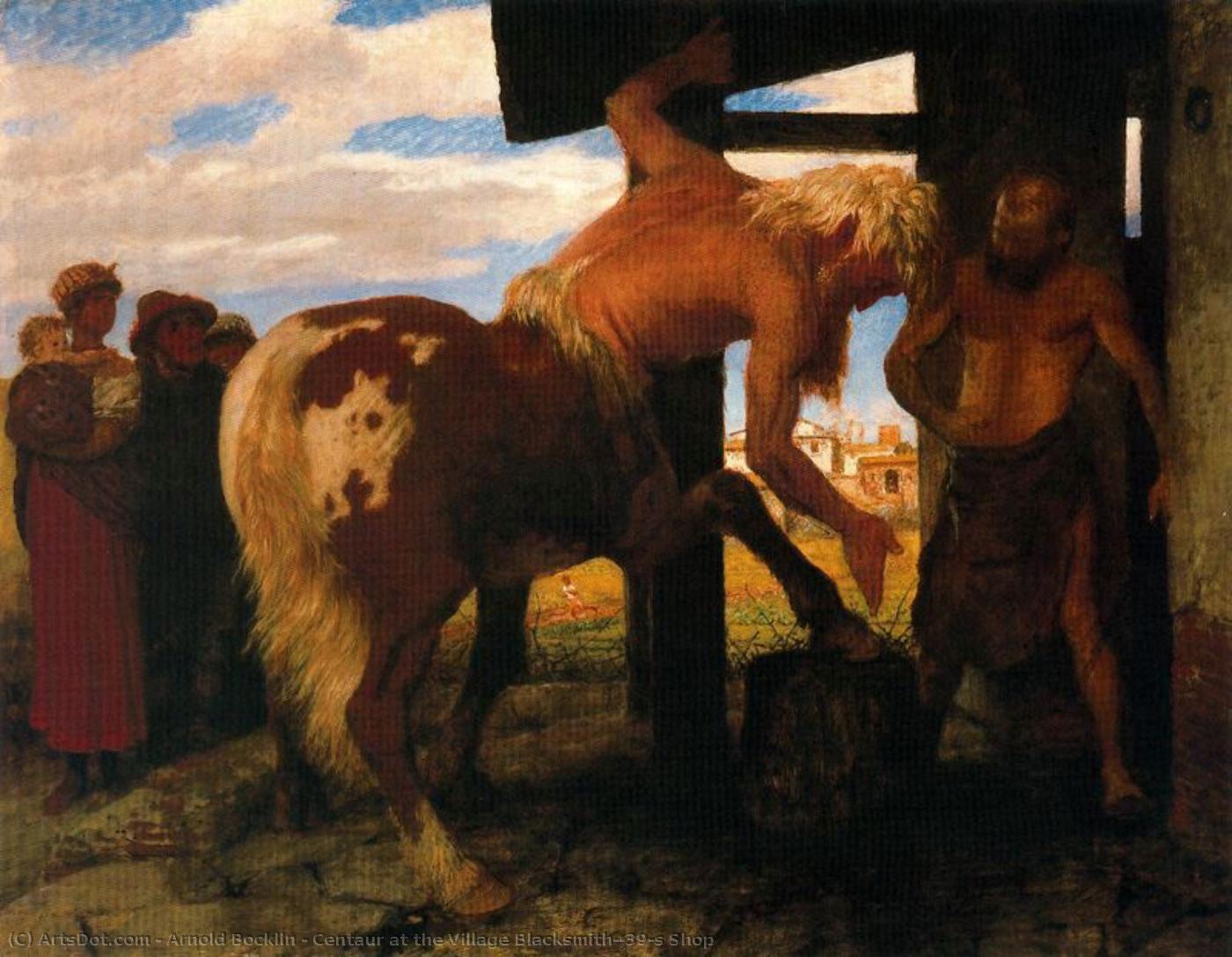
Centaur at the Village Blacksmith's Shop
 Acrylic On Canvas
- WallArt
- Symbolist Painting
 1888
1888 100.0 x 80.0 cm
 Museum of Fine Arts
 Read More
Hand Made Oil Reproduction
Hand-painted oil on canvas in your size and frame, made to order by our artists. ( Buy Print Buy Image)




P118B $10

P118H $10

P118W $10

P438Z $10

P508JH $12

P508YH $12

P805H $10

P805Z $10

P919BZ $10

P919G $10

P919XJ $10

P959ZH $10

P968JZ $12

W106C $8

W218G $10

W218JH $8

W218Y $10

W307PJ $10

W316G $10

W316PJ $8

W316Y $10

W398PJ $8

W4111J $10

W500HY $15

W500JH $15

W692G $12

W849H $8

W940BG $15

W953PJ $8




Pick from our preset sizes that match the artwork's original proportions.

You may enter your own dimensions to fit a specific frame or space. If your selected size does not match the original image's proportions, we will either crop the artwork or extend the painting with additional hand-painted elements. A digital mockup will be sent for your approval before production begins.
Please note that the on-screen preview does not reflect the actual cropping or extension. Only the mockup will accurately show the final composition.
While custom sizes are available, we recommend selecting a dimension from the predefined list to preserve the original proportions.
After order, ArtsDot.com team will email client for instructions and provide a mockup preview
Worldwide Delivery () in 3/4 weeks instead of standard 5 weeks. (17 August). No compromise on quality.

Free Worldwide Express Shipping

High-Quality Linen Canvas

Full Shipping Insurance

Customs Tax Refund Guarantee

True Color Matching Guarantee

60-Day Return Policy (Defects Only)

100% Money-Back Guarantee

Bulk Discount Offer
 Glass option is only available in size under 110 CM

Centaur at the Village Blacksmith's Shop
Reproduction Medium
Reproduction Size
-


Total Price
$ 263
Artwork Description
A Moment Frozen in Mythic Time: Exploring Arnold Böcklin’s “Centaur at the Village Blacksmith's Shop”
Arnold Böcklin’s “Centaur at the Village Blacksmith’s Shop,” completed in 1888, stands as a cornerstone of Symbolist painting—a genre dedicated to conveying emotion and psychological states rather than merely representing reality. More than just a depiction of an everyday scene infused with fantastical elements, this artwork delves into profound themes of mortality, innocence lost, and the enduring power of primal instincts against the backdrop of classical antiquity. Its haunting beauty continues to captivate audiences today, prompting contemplation on the complexities of human experience.The Scene: Rural Tranquility Disrupted
The painting portrays a solitary centaur—half man, half horse—engaged in the seemingly mundane task of shoeing a horse before a modest village blacksmith’s forge. This juxtaposition is deliberately unsettling. Böcklin eschews grand narratives or dramatic action; instead, he presents a tableau of quiet labor rendered in muted tones – predominantly browns and greys – creating an atmosphere of palpable stillness. The blacksmith's shop itself is depicted with meticulous detail, emphasizing its solidity and permanence, representing the established order of civilization. Yet, this tranquility is immediately undermined by the presence of the centaur, whose gaze directs towards the viewer, conveying a sense of melancholy and hinting at a hidden narrative beneath the surface.Symbolism Rooted in Antiquity
Böcklin’s artistic vision draws heavily from classical mythology, specifically referencing depictions of centaurs as symbols of untamed nature versus civilized intellect. The centaur embodies primal instincts—strength, instinctual knowledge—contrasted with human reason and artistry. This duality is powerfully conveyed through Böcklin's masterful use of chiaroscuro – the dramatic interplay between light and shadow – which sculpts the figures and enhances their emotional impact. The horse represents fertility and vitality, while the blacksmith symbolizes craftsmanship and tradition. These elements intertwine to suggest a confrontation between opposing forces—the natural world versus human endeavor—a theme prevalent throughout Böcklin’s oeuvre.Technique: Delicate Watercolor on Paper
Executed in watercolor on paper, “Centaur at the Village Blacksmith's Shop” exemplifies Böcklin’s signature technique. Watercolor lends itself beautifully to capturing subtle gradations of tone and texture, allowing for an ethereal quality that contributes significantly to the painting’s mood. Böcklin painstakingly layered washes of pigment, achieving remarkable luminosity and blending colors seamlessly—a testament to his meticulous attention to detail. The artist's deliberate restraint in color reinforces the painting’s contemplative spirit, prioritizing atmosphere over precise representation. This technique underscores Böcklin’s commitment to conveying emotion through visual form rather than literal depiction.Emotional Resonance: A Meditation on Loss and Acceptance
Ultimately, “Centaur at the Village Blacksmith’s Shop” transcends its formal elements to evoke a profound emotional response in the viewer. The painting speaks to themes of vulnerability, solitude, and the inevitability of decay—concepts central to Symbolist philosophy. Böcklin's depiction of the centaur’s sorrowful expression invites reflection on mortality and the acceptance of life’s transient nature. It is not merely a visual spectacle but rather an invitation to contemplate existential questions. The painting lingers in the mind long after viewing, prompting viewers to consider the enduring power of mythic imagery to illuminate the human condition—a testament to Böcklin's artistic genius and his ability to capture the essence of emotion within a carefully constructed composition.Related Artworks
Artist Biography
early life and training
arnold böcklin, a swiss symbolist painter, was born on october 16, 1827, in basel, switzerland. his father, christian frederick böcklin, descended from an old family of schaffhausen and engaged in the silk trade. arnold's mother, ursula lippe, was a native of the same city. he studied at the düsseldorf academy under schirmer, becoming a friend of anselm feuerbach. böcklin is associated with the düsseldorf school of painting.artistic career and symbolism
böcklin's artistic journey took him to various cities, including paris, where he worked at the louvre, and rome, where he was influenced by its sights. his work often featured allegorical and mythological figures in settings involving classical architecture, exploring themes of death and mortality.- great park, one of his earliest works, showcased ancient mythology.
- nymph and satyr (1858) and sappho (1859) were notable works from this period.
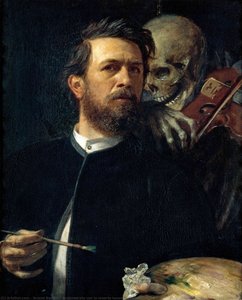
- böcklin's portrait of myself, with death playing a violin (1872) exemplified his unique style.
legacy and influence
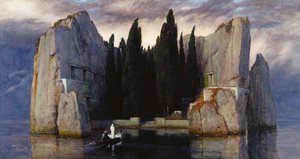
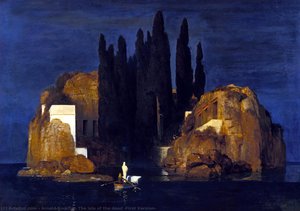
böcklin is best known for his five versions of the isle of the dead (1880-1886), which evoked the english cemetery in florence, where his daughter was buried. his work influenced younger artists like hans thoma and inspired several late-romantic composers.- clement greenberg described böcklin's work as "one of the most consummate expressions" of its time.
- böcklin's style overlapped with the pre-raphaelites, emphasizing the world of dreams and mysticism.
museums and collections
böcklin's work can be found in various museums, including:- öffentliche kunstsammlung (basel, switzerland)
- kunstmuseum basel (switzerland)
- museum kunsthaus zürich (zürich, switzerland)
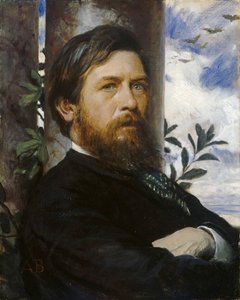
Arnold Böcklin
1827 - 1901 , Switzerland
Quick Facts
- Artistic Movement Or Style: Symbolism
- Artists Or Movements Influenced By This Artist:
- Hans Thoma
- Pre-Raphaelites
- Artists Who Influenced This Artist:
- Schirmer
- Feuerbach
- Date Of Birth: October 16, 1827
- Date Of Death: January 16, 1901
- Full Name: Arnold Böcklin
- Nationality: Swiss
- Notable Artworks:
- Isle of the Dead
- Nymph and Satyr
- Sappho
- Portrait of Myself
- Place Of Birth: Basel, Switzerland
Related Articles

John Constable's Masterpieces: Explore 25 Iconic Landscapes for Your Home
Journey through John Constable's 25 most celebrated landscapes. Explore Romanticism, Dedham Vale & his masterful use of light in iconic paintings like 'Hay Wain'. Find museum-quality art reproductions and elevate your home decor on ArtsDot.com.

Beyond the Horizon: 10 Landscape Masterpieces for Your Home Decor
Journey through 10 breathtaking landscape paintings by Monet, Van Gogh & more! Explore iconic artworks, artistic techniques & find inspiration for your home decor. Museum-quality reproductions at ArtsDot.com. Discover all masterpieces on ArtsDot.com

Cultivating Visions: A Historical Journey Through Rural Landscapes in Art
Explore the rich history of rural landscape painting with ArtsDot. Discover Impressionist masterpieces, key artists & movements. Find your perfect serene artwork and bring nature's beauty home.

Romantic Landscapes: 10 Masterpieces for Your Home | ArtsDot
Journey through 10 Romantic landscape masterpieces by Friedrich, Turner & Cole. Explore emotional art, sublime nature scenes & iconic 19th-century paintings. Find museum-quality reproductions for your home at ArtsDot.com – discover the full collection online!

Evocations of Place: A Historical Journey Through Landscape Art
Explore the rich history of landscape art with ArtsDot. Discover renowned artists, movements like Impressionism & Romanticism, and expert guidance for collecting timeless pieces. Find your perfect serene escape today!