 Preview
 Send
Send Share
Share
 Details

 Download
 Similars
 X-Ray
X-Ray Diaporama
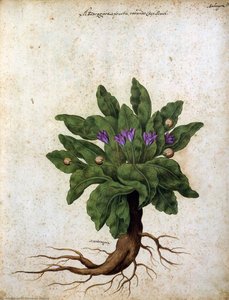
Mandrake
 Watercolor
- WallArt
- Baroque
 1650
1650- Early Modern
 495.0 x 380.0 cm
 Dumbarton Oaks
 Read More
Hand Made Oil Reproduction
Hand-painted oil on canvas in your size and frame, made to order by our artists. ( Buy Print Buy Image)




P118B $10

P118H $10

P118W $10

P438Z $10

P508JH $12

P508YH $12

P805H $10

P805Z $10

P919BZ $10

P919G $10

P919XJ $10

P959ZH $10

P968JZ $12

W106C $8

W218G $10

W218JH $8

W218Y $10

W307PJ $10

W316G $10

W316PJ $8

W316Y $10

W398PJ $8

W4111J $10

W500HY $15

W500JH $15

W692G $12

W849H $8

W940BG $15

W953PJ $8




Pick from our preset sizes that match the artwork's original proportions.

You may enter your own dimensions to fit a specific frame or space. If your selected size does not match the original image's proportions, we will either crop the artwork or extend the painting with additional hand-painted elements. A digital mockup will be sent for your approval before production begins.
Please note that the on-screen preview does not reflect the actual cropping or extension. Only the mockup will accurately show the final composition.
While custom sizes are available, we recommend selecting a dimension from the predefined list to preserve the original proportions.
After order, ArtsDot.com team will email client for instructions and provide a mockup preview
Worldwide Delivery () in 3/4 weeks instead of standard 5 weeks. (17 August). No compromise on quality.

Free Worldwide Express Shipping

High-Quality Linen Canvas

Full Shipping Insurance

Customs Tax Refund Guarantee

True Color Matching Guarantee

60-Day Return Policy (Defects Only)

100% Money-Back Guarantee

Bulk Discount Offer
 Glass option is only available in size under 110 CM

Mandrake
Reproduction Medium
Reproduction Size
-


Total Price
$ 263
Artwork Description
The Enigmatic Beauty of Mandrake
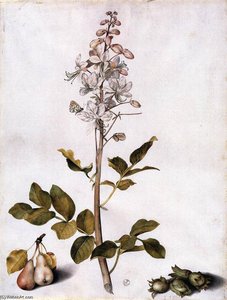
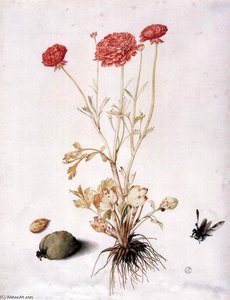
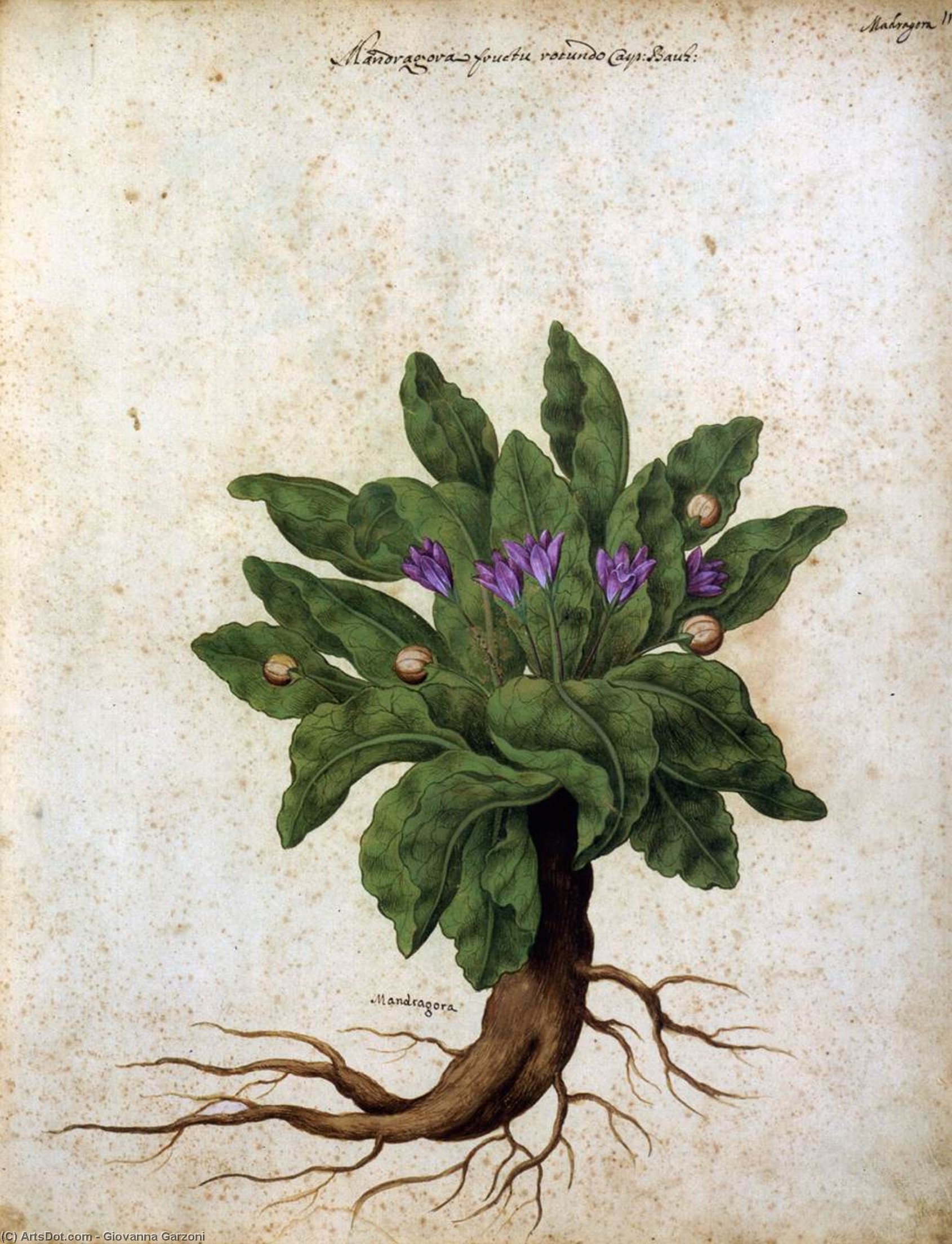
To gaze upon Giovanna Garzoni's depiction of the Mandrake is to step directly into the meticulous heart of Baroque scientific inquiry blended seamlessly with breathtaking artistry. This watercolor, dating from 1650, transcends the mere classification of a botanical specimen; it is a vibrant meditation on nature’s potent mysteries. The artist has captured the Mandragora in profile, presenting its roots descending like an ancient tapestry and its serrated green leaves unfurling with perfect, almost palpable realism. The delicate clusters of purple buds atop the plant promise a bloom yet to come, lending the entire composition a sense of suspended anticipation.
Mastery in Watercolor Technique
Garzoni’s command of watercolor is nothing short of miraculous. In this piece, she achieves an astonishing depth of texture, allowing one to almost feel the rough, bark-like quality of the root system against the smooth vitality of the foliage. The background, a serene and pale beige, acts not as emptiness, but as a carefully chosen breath, ensuring that every vibrant green vein and every subtle purple hue of the flowers commands the viewer's full attention. This technical brilliance speaks to an artist who was both a devoted student of science and a master interpreter of light and shadow.
A Tapestry of Symbolism and Lore
Beyond its scientific precision, the Mandrake has always held potent symbolic weight throughout history. In art, it whispers tales of folklore, magic, and hidden power. Garzoni’s inclusion of this subject invites contemplation on the boundary between the observable natural world and the realm of myth. Owning a reproduction of this work is to invite that conversation into your space—a sophisticated nod to antiquity's fascination with potent flora.
A Touch of Baroque Elegance for Modern Spaces
For the discerning collector or interior designer, this artwork offers unparalleled depth. Its combination of scientific rigor and painterly grace makes it a remarkable focal point. Whether displayed in a library setting that celebrates natural history or within an elegant drawing-room, its presence elevates the atmosphere with intellectual weight and undeniable beauty. It is a piece that rewards close looking, revealing new nuances of color and form with every passing glance.
Related Artworks
Artist Biography
The Silent Botanist of Baroque Italy
In the vibrant, often tumultuous landscape of seventeenth-century Italy, a singular voice emerged through the delicate application of watercolor and tempera. Giovanna Garzoni (1600–1670) did not command the grand, sweeping canvases of the Baroque era's most famous masters; instead, she captured the profound beauty of the minute. Born in Ascoli Piculated into a lineage of Venetian nobility and intellectual prestige, Garzoni possessed an innate curiosity that bridged the gap between fine art and scientific inquiry. While her contemporaries often focused on the dramatic tension of religious martyrdom or mythological upheaval, Garzoni turned her gaze toward the quiet, breathing world of flora, fauna, and the humble textures of everyday objects.
Her early life was steeped in an environment where art and scholarship were inextricably linked. As the daughter of a humanist scholar, her upbringing provided the intellectual foundation necessary for her later scientific precision. The influence of her uncle, the painter Pietro Gaia, likely offered her first glimpses into the technical rigors of the Venetian tradition. This early exposure to the mastery of light and form allowed her to develop a style that was both aesthetically enchanting and remarkably accurate. As she matured, Garzoni’s work began to transcend mere decoration, evolving into a sophisticated study of nature that anticipated the botanical illustrations of later centuries.
A Mastery of Precision and Medium
Garzoni’s true genius lay in her ability to manipulate delicate mediums like watercolor and tempera on surfaces such as vellum and paper. Her technique was characterized by an almost microscopic attention to detail, where the translucent skin of a citrus fruit or the intricate veins of a leaf were rendered with breathtaking clarity. This precision was not merely an artistic choice but a reflection of her engagement with the burgeoning scientific spirit of the age. She approached her subjects—citrons, shells, birds, and vegetables—with the eye of a naturalist, documenting the physical world with a fidelity that made her work invaluable to both collectors and scholars.
Her repertoire was remarkably diverse for a woman of her era. While she is most celebrated for her botanical still lifes, her talent extended into several other realms:
- Religious and Mythological Works: In her earlier career, Garzoni engaged with the grander themes of her time, demonstrating a command over narrative and allegory.
- Portraiture: She possessed the ability to capture the character and essence of her subjects, moving beyond simple likeness to convey depth.
- Experimental Surfaces: Her artistry was not confined to paper; she explored the possibilities of painting on cloth and stone, showcasing a versatile mastery over varied textures.
Legacy and Historical Significance
The historical significance of Giovanna Garzoni extends far beyond the borders of her beautiful illustrations. She stands as a pioneer for women in the arts, breaking through the gendered boundaries of the seventeenth century to claim a space within the scientific and still-life genres—fields that required a level of objective observation often deemed "unfeminine" at the time. Her travels across Italy, often accompanied by her brother, allowed her to gather a vast array of specimens, making her work a living record of the natural world as it was perceived during the Baroque period.
Today, Garzoni’s legacy is preserved in some of the world's most prestigious institutions, such as The J. Paul Getty Museum. Her ability to marry the ephemeral beauty of nature with the permanence of scientific record ensures her place in the canon of art history. She remains a testament to the power of the observant eye, reminding us that there is an entire universe of drama and complexity to be found in the smallest petal, the simplest shell, and the most quiet corner of the natural world.
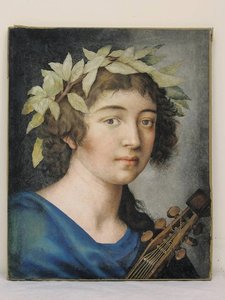
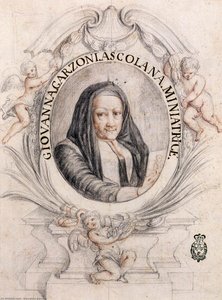
Giovanna Garzoni
1600 - 1670 , Italy
Quick Facts
- Artistic Movement Or Style: Baroque
- Artists Or Movements Influenced By This Artist: ['Ligozzi']
- Artists Who Influenced This Artist: ['Jacopo Ligozzi']
- Date Of Birth: 1600
- Date Of Death: 1670
- Full Name: Giovanna Garzoni
- Nationality: Italian
- Notable Artworks:
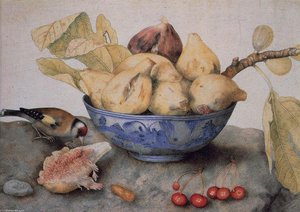
- China Bowl with Figs, a Bird, and Cherries
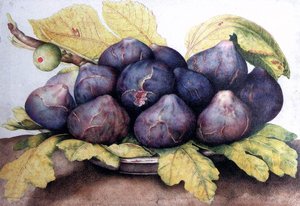
- Figs
- Bowl with Plums
- Place Of Birth: Ascoli Piceno, Italy
Related Articles

Watercolor Wonders: 10 Masterpieces That Redefined Art History | ArtsDot
Journey through 10 legendary watercolor masterpieces by Sargent, Turner & Homer! Explore iconic landscapes, portraits & floral art that redefined history. Find museum-quality reproductions and curated decor ideas at ArtsDot.com.

Ephemeral Visions: Exploring the Artistic Legacy & Contemporary Practice of Watercolor Painting
Explore the captivating world of watercolor painting! Discover its rich history, essential techniques, influential artists & collecting tips. A comprehensive guide for art enthusiasts from ArtsDot.

Ephemeral Visions: Exploring the Artistic Legacy & Nuances of Watercolor Painting
Explore the captivating world of watercolor painting! Discover its rich history, essential techniques, influential artists & collecting tips from art experts. A comprehensive guide for enthusiasts.

Ephemeral Visions: Exploring the History & Emotional Resonance of Watercolor Painting
Explore the captivating history of watercolor painting, from ancient techniques to modern masters like Kandinsky & Blake. Discover essential artists, collecting tips & the emotional power of this luminous medium. Expert insights for art enthusiasts.

Giclée Prints: Archival Quality & Aesthetic Nuances for the Discerning Collector
Explore the world of giclée prints with ArtsDot. Learn about archival quality, aesthetic nuances & investment potential. Expert guidance for discerning art collectors seeking museum-quality reproductions and lasting value.