 Preview
 Send
Send Share
Share
 Details

 Download
 Similars
 X-Ray
X-Ray Diaporama
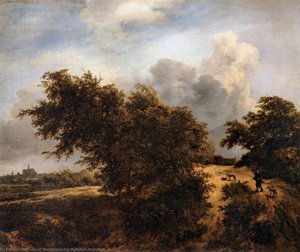
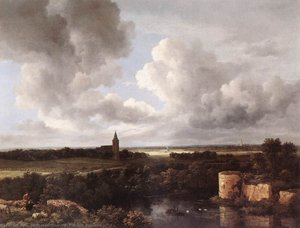
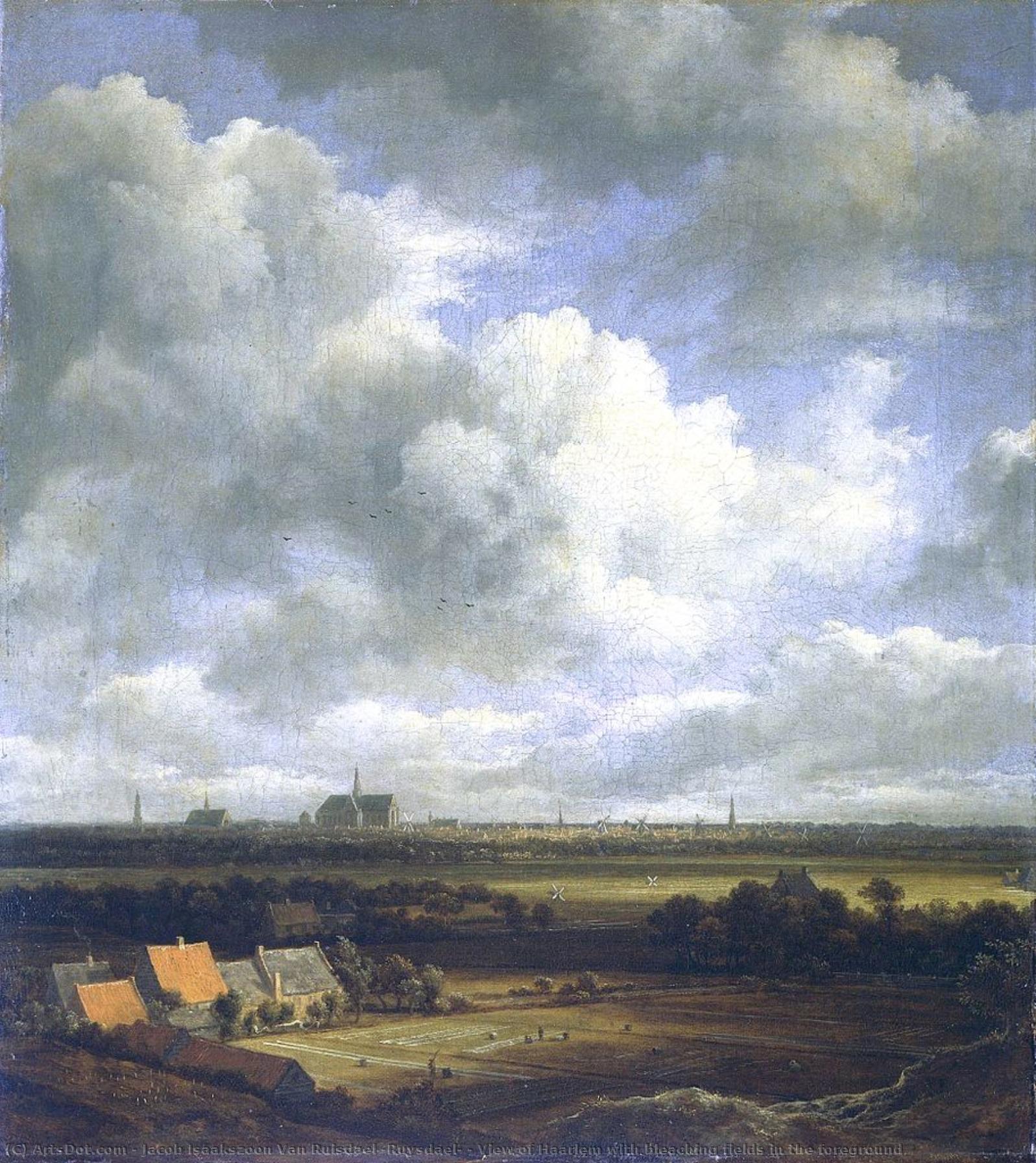
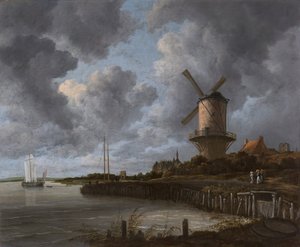
View of Haarlem with bleaching fields in the foreground
 Dutch Golden Age Landscape
 1670
1670- Early Modern
 43.0 x 38.0 cm
 Rijksmuseum
 Read More
Hand Made Oil Reproduction
Hand-painted oil on canvas in your size and frame, made to order by our artists. ( Buy Print Buy Image)




P118B $10

P118H $10

P118W $10

P438Z $10

P508JH $12

P508YH $12

P805H $10

P805Z $10

P919BZ $10

P919G $10

P919XJ $10

P959ZH $10

P968JZ $12

W106C $8

W218G $10

W218JH $8

W218Y $10

W307PJ $10

W316G $10

W316PJ $8

W316Y $10

W398PJ $8

W4111J $10

W500HY $15

W500JH $15

W692G $12

W849H $8

W940BG $15

W953PJ $8




Pick from our preset sizes that match the artwork's original proportions.

You may enter your own dimensions to fit a specific frame or space. If your selected size does not match the original image's proportions, we will either crop the artwork or extend the painting with additional hand-painted elements. A digital mockup will be sent for your approval before production begins.
Please note that the on-screen preview does not reflect the actual cropping or extension. Only the mockup will accurately show the final composition.
While custom sizes are available, we recommend selecting a dimension from the predefined list to preserve the original proportions.
After order, ArtsDot.com team will email client for instructions and provide a mockup preview
Worldwide Delivery () in 3/4 weeks instead of standard 5 weeks. (17 August). No compromise on quality.

Free Worldwide Express Shipping

High-Quality Linen Canvas

Full Shipping Insurance

Customs Tax Refund Guarantee

True Color Matching Guarantee

60-Day Return Policy (Defects Only)

100% Money-Back Guarantee

Bulk Discount Offer
 Glass option is only available in size under 110 CM

View of Haarlem with bleaching fields in the foreground
Reproduction Medium
Reproduction Size
-


Total Price
$ 263
Artwork Description
A Dutch Master’s Serene Vision: ‘View of Haarlem with Bleaching Fields’
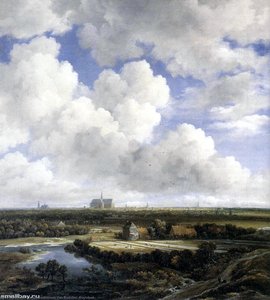
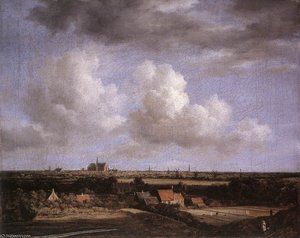
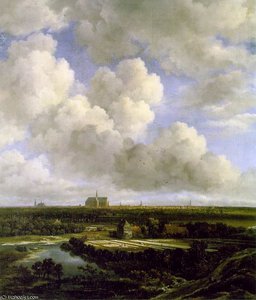
Jacob Isaackszoon van Ruisdael's “View of Haarlem with Bleaching Fields” isn’t merely a landscape painting; it’s a carefully constructed meditation on the heart of 17th-century Dutch life. Completed around 1670-1675, this iconic work transcends its subject matter – a humble view of a provincial town – to become a profound statement about prosperity, identity, and the relationship between humanity and nature. The painting immediately draws the eye with its expansive composition, dominated by a vast, cloud-strewn sky that occupies nearly two-thirds of the canvas. This deliberate emphasis on the heavens wasn’t arbitrary; it reflects the Dutch Golden Age's fascination with the sublime, imbuing even a commonplace scene with an aura of grandeur and spiritual significance. Below this dramatic expanse lies a meticulously rendered landscape – a low-lying vista punctuated by the familiar elements of Haarlem: its church, identifiable by its towering presence, and the surrounding fields, most notably those dedicated to the vital industry of linen bleaching.- The Bleaching Fields: The foreground is dominated by these fields, rendered in muted browns and greens, a testament to Ruisdael’s mastery of capturing texture. Figures are subtly depicted working diligently, their forms blending seamlessly into the landscape – they aren't portraits but rather representations of the community’s collective labor.
- A Town Defined: The church, a prominent landmark, anchors the scene and provides a sense of orientation. Its silhouette against the sky establishes a visual hierarchy, guiding the viewer’s eye through the composition.
- The Atmospheric Perspective: Notice how distant buildings and trees fade into a hazy blue, creating an effective illusion of depth and distance – a hallmark of aerial perspective that was revolutionary for its time.
Technique and Materials: A Symphony of Light and Layered Color
Ruisdael’s skill as a painter is evident in every brushstroke. He employed a technique known as *glazing*, applying thin, translucent layers of oil paint to build up color and luminosity gradually. This method allowed him to achieve subtle tonal variations and create an incredibly rich surface quality – the clouds seem to billow with light, while the fields possess a tactile realism. The artist’s use of impasto—thickly applied paint—is restrained but strategically employed in areas like the rooftops of the houses and the edges of the fields, adding visual interest and texture without overwhelming the overall composition. The painting's palette is deliberately muted, reflecting the earthy tones of the Dutch countryside – browns, greens, greys, and blues – creating a sense of tranquility and harmony.Historical Context: Prosperity and National Identity
“View of Haarlem with Bleaching Fields” isn’t simply a depiction of a landscape; it's deeply intertwined with the economic and social history of the Netherlands in the 17th century. Linen bleaching was a hugely important industry for Haarlem, providing employment for countless families and generating substantial wealth for the city. Ruisdael’s decision to prominently feature these fields speaks volumes about Dutch national pride – it's a celebration of a vital economic sector and a symbol of the nation’s prosperity. The painting can be interpreted as an allegory for the flourishing of the Dutch Republic, showcasing its industriousness and connection to the land. The work was created shortly after the end of the Eighty Years’ War, a period of immense national achievement, further cementing the painting's patriotic significance.Symbolism and Emotional Resonance: A Quiet Triumph
Beyond its historical context, “View of Haarlem with Bleaching Fields” possesses a quiet emotional resonance. The vastness of the sky evokes a sense of awe and humility, while the orderly arrangement of the landscape suggests a harmonious relationship between humanity and nature. The subtle details – the figures working in the fields, the church dominating the horizon – invite contemplation about the rhythms of daily life and the enduring values of community and labor. The painting’s muted colors and atmospheric perspective create a sense of serenity and timelessness, inviting viewers to lose themselves in its tranquil beauty. It's a testament to Ruisdael's ability to capture not just a scene, but also the spirit of an era—a serene triumph over time and circumstance.Related Artworks
Artist Biography
early life and career
jacob isaackszoon van ruisdael, a prominent dutch painter, draughtsman, and etcher, was born in 1628 in the netherlands. he is widely regarded as the pre-eminent landscape painter of the dutch golden age, a period marked by great wealth and cultural achievement.
artistic style and contributions
van ruisdael's work is characterized by its versatility and prolific nature, depicting a wide variety of landscape subjects. from 1646, he painted remarkable dutch countryside scenes, which later took on a more heroic character after his trip to germany in 1650. his late work, produced while living and working in amsterdam, featured city panoramas and seascapes, often with the sky occupying two-thirds of the canvas.
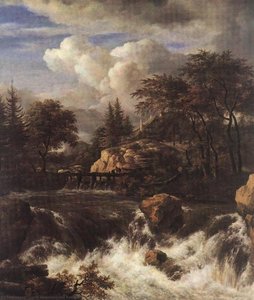
- waterfall in a rocky and mountainous landscape, showcasing his mastery of light and composition.
- view of haarlem with bleaching grounds, exemplifying his ability to capture the essence of the dutch landscape.
- view of the dam and the damrak in amsterdam, highlighting his skill in cityscape painting.
museums and collections
van ruisdael's work is spread across private and institutional collections worldwide, with notable holdings at:
- the national gallery in london
- the rijksmuseum in amsterdam
- the hermitage museum in st. petersburg
influence and legacy
van ruisdael's influence on landscape painting traditions is profound, shaping the english romantics, the barbizon school in france, and the hudson river school in the us. he also inspired generations of dutch landscape artists. notable works:
- view of haarlem with bleaching grounds
- waterfall in a rocky and mountainous landscape
- view of the dam and the damrak in amsterdam
artist's profile on ArtsDot: jacob isaackszoon van ruisdael
jacob isaackszoon van ruisdael
1628 - 1682 , Netherlands
Quick Facts
- Artistic Movement Or Style: Dutch Golden Age, Baroque
- Artists Or Movements Influenced By This Artist:
- English Romantics
- Barbizon School
- Artists Who Influenced This Artist: ['Hendrick Vroom']
- Date Of Birth: 1628/1629, Haarlem
- Date Of Death: 1682, Amsterdam
- Full Name: Jacob Isaackszoon van Ruisdael
- Nationality: Dutch
- Notable Artworks:
- View of Haarlem
- Waterfall landscape
- Amsterdam cityscape
- Place Of Birth: Haarlem, Netherlands
Related Articles

Dutch Masters: 10 Golden Age Paintings That Still Inspire |
Journey into the Dutch Golden Age! Explore 10 iconic paintings by Rembrandt, Vermeer & Hals. Discover the stories behind these Baroque masterpieces and find museum-quality art reproductions to elevate your home decor on .
Jacob van Ruisdael: Master of Dutch Landscape & the Evocation of National Identity
Explore the life & work of Jacob van Ruisdael, the preeminent Dutch landscape painter. Discover his technical brilliance, symbolic depth, and lasting influence on art history. Learn about collecting Ruisdael's masterpieces.

Illuminating Innovation: Exploring the Dutch Golden Age of Painting
Explore the Dutch Golden Age of painting with ArtsDot. Discover Rembrandt, Vermeer & other Masters. Learn about key characteristics, iconic artworks, and lasting influence. Expert insights for collectors & enthusiasts.
Nicolaes Berchem: Dutch Golden Age Pastoralism & the Evolution of Landscape Painting
Explore the captivating world of Nicolaes Berchem, a leading Dutch Golden Age painter. Discover his idyllic landscapes, masterful technique & lasting influence on art history. Learn more at ArtsDot.
Abraham Hulk Senior: Pioneering Maritime Topography of the Dutch Golden Age
Explore the captivating seascapes of Abraham Hulk Senior, a leading Anglo-Dutch marine painter of the 19th century. Discover his signature style, family legacy & collectable artworks at ArtsDot.