 Preview
 Send
Send Share
Share
 Details

 Download
 Similars
 X-Ray
X-Ray Diaporama
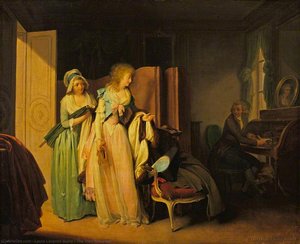
L'oiseau privé, dit le couple et l'oiseau envolé


 Read More
Giclée / Art Print
Museum-quality giclée or canvas print with fast production and flexible finish options. ( Buy Hand Made Painting Buy Image)




P118B $10

P118H $10

P118W $10

P438Z $10

P508JH $12

P508YH $12

P805H $10

P805Z $10

P919BZ $10

P919G $10

P919XJ $10

P959ZH $10

P968JZ $12

W106C $8

W218G $10

W218JH $8

W218Y $10

W307PJ $10

W316G $10

W316PJ $8

W316Y $10

W398PJ $8

W4111J $10

W500HY $15

W500JH $15

W692G $12

W849H $8

W940BG $15

W953PJ $8




Pick from our preset sizes that match the artwork's original proportions.

You may enter your own dimensions to fit a specific frame or space. If your selected size does not match the original image's proportions, we will either crop the artwork or extend the image with a mirrored or solid-fill edge. A digital mockup will be sent for your approval before production begins.
Please note that the on-screen preview does not reflect the actual cropping or extension. Only the mockup will accurately show the final composition.
While custom sizes are available, we recommend selecting a dimension from the predefined list to preserve the original proportions.
Worldwide Delivery () in 2 weeks instead of standard 4/5 weeks. (2 September)

Free Worldwide Express Shipping

High-Quality Linen Canvas

Full Shipping Insurance

Customs Tax Refund Guarantee

True Color Matching Guarantee

60-Day Return Policy (Defects Only)

100% Money-Back Guarantee

Bulk Discount Offer
 Glass option is only available in size under 110 CM

L'oiseau privé, dit le couple et l'oiseau envolé
Giclée / Art Print
Reproduction Size
-


Total Price
$ 63
A Glimpse into Parisian Serenity
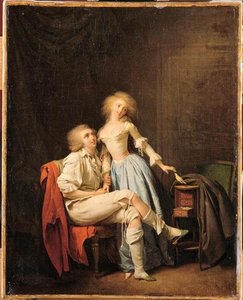
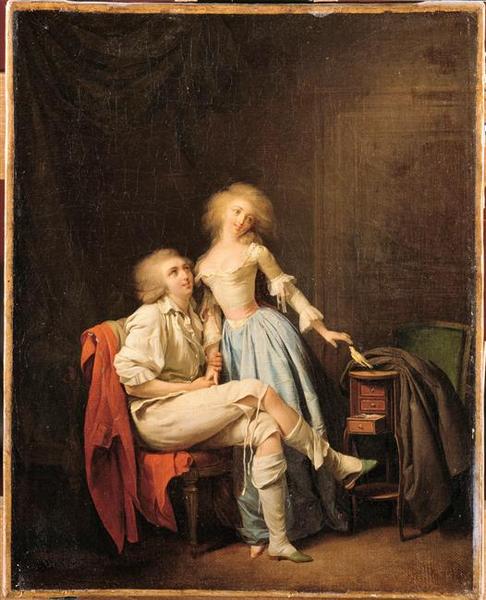
In the twilight of the eighteenth century, as the winds of revolution began to stir the foundations of France, Louis Léopold Boilly captured a moment of profound, quiet intimacy. L'oiseau privé, dit le couple et l'oiseau envolé, painted in 1789, serves as more than a mere domestic scene; it is a window into the refined soul of Parisian society. The artwork presents a tender tableau of a couple seated at a table, their attention captivated by a birdcage that holds a single, delicate inhabitant. Through Boilly’s masterful hand, we are invited into a world where elegance and stillness act as a sanctuary against the encroaching uncertainties of a changing era. For the discerning collector or interior designer, this piece offers an unparalleled sense of tranquility and timeless grace, making it a centerpiece capable of anchoring a room with historical depth and emotional warmth.
The composition is a masterclass in balance and classical structure. Boilly employs a subtle triangular arrangement, positioning the figures at the apex to naturally draw the viewer’s gaze toward the central interaction. This geometric precision is softened by the organic flow of draped fabrics and the gentle contours of the subjects, creating a harmony between rigid form and fluid movement. As the eye wanders through the scene, the use of linear perspective provides a convincing sense of depth, leading us past the foregrounded furniture into the soft, receding shadows of the background. This careful layering ensures that the painting feels less like a flat image and more like an inviting space one could almost step into.
The Artistry of Light and Texture
Technically, Boilly’s work is a triumph of traditional oil painting, characterized by a luminous quality that seems to radiate from within the canvas. He utilized meticulous layers of glaze to achieve a breathtaking realism, particularly in the way light interacts with different surfaces. One can almost feel the contrast between the cool, smooth texture of fine silk drapery and the warm, tactile softness of human skin. The lighting is intentionally diffused, eschewing harsh shadows in favor of a gentle, even glow that bathes the couple in a romantic, ethereal light. This soft illumination enhances the nuanced color palette—a sophisticated arrangement of muted whites, beiges, blues, and deep reds that avoids ostentation to embrace an understated, aristocratic elegance.
Beyond its aesthetic beauty, the painting is rich with symbolic resonance. The birdcage, a central motif, serves as a potent metaphor for the complexities of human existence; it can represent the safety of domesticity or the melancholy of confinement. This duality invites deep contemplation, mirroring the tension felt in 1789 Paris between the desire for stability and the inevitability of change. For those looking to adorn a space with art that provokes thought, this reproduction offers a perfect blend of decorative splendor and intellectual intrigue. It is an exquisite choice for any curated collection, bringing with it the spirit of a lost age of refinement and the enduring beauty of the human connection.
Related Artworks
Artist Biography
Louis Léopold Boilly: A Life in Portraiture and Parisian Society
- Born: July 5, 1761, La Bassée, France
- Died: January 4, 1845, Paris, France
Early Life and Artistic Development
- Boilly's artistic journey began early; he produced works as young as twelve. Largely self-taught, his initial training included trompe-l’oeil painting under Dominique Doncre.
- His talent was recognized by the Augustinians of Douai in 1774, leading to an invitation from the Bishop of Arras. This period saw him create over three hundred small portrait paintings.
- Early works often featured amorous and moralizing subjects, demonstrating a developing skill in capturing likenesses and details.
Artistic Style and Key Works
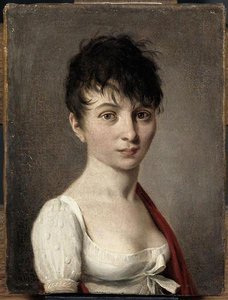
- Style: Boilly's style is characterized by meticulous detail, careful coloring, and a focus on depicting everyday life within the French middle class. He skillfully blended portraiture with genre scenes.
- Evolution: After 1794, his compositions became more crowded, reflecting the bustling social scene of Paris. His portraits gained widespread acclaim, with over 5,000 painted throughout his career.
- Notable Works:
- The Suitor's Gift – An early work showcasing amorous themes and meticulous detail.
- Triumph of Marat – A patriotic piece created to avoid condemnation during the Reign of Terror.
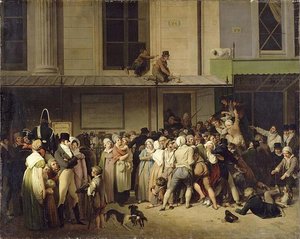
- The Arrival of a Mail-Coach in the Courtyard of the Messageries – A vibrant depiction of Parisian life and transportation.
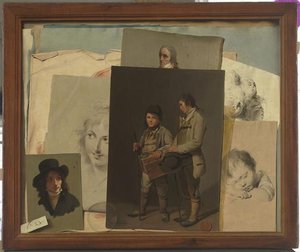
- Optical Illusions: Boilly was fascinated by optics, as demonstrated in works like *Un Trompe-l'œil*, which introduced the term to describe his technique of creating realistic imagery that mimics three-dimensional objects.
Recognition and Legacy
- Salon Success: Boilly received a medal from the Paris Salon in 1804, solidifying his reputation as a skilled artist.
- Honors: He was decorated as a Chevalier of the Légion d'Honneur in 1833, recognizing his contributions to French art.
- Family Influence: His son, Alphonse Boilly, became a professional engraver and apprenticed in New York with Asher Brown Durand.
- Historical Significance: Boilly’s work provides invaluable insights into the social customs, fashion, and daily life of the French middle class during a period of significant political upheaval. He is remembered as one of France's most celebrated portraitists and genre painters.
Museum Holdings
- Musée des Beaux Arts, Lille: Holds Triumph of Marat among other works.
- Louvre Museum: Features selections from Boilly’s extensive oeuvre.
- National Gallery of Art (Washington D.C.): Possesses several paintings including *Self-Portrait*, *Les Amateurs de Tableaux* and *The Public in the Salon of the Louvre, Viewing the Painting of the "Sacre"*.
- Getty Museum: Holds a collection of Boilly's works.
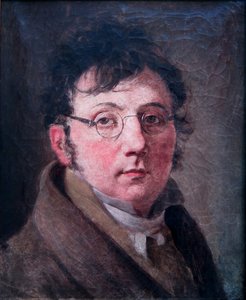
Louis Léopold Boilly
1761 - 1845 , France
Quick Facts
- Artistic Movement Or Style: Genre painting, Portraiture
- Artists Who Influenced This Artist:
- Gabriel Metsu
- Willem van Mieris
- Gerard ter Borch
- Date Of Birth: July 5, 1761
- Date Of Death: January 4, 1845
- Full Name: Louis Léopold Boilly
- Nationality: French
- Notable Artworks:
- The Suitor's Gift
- Triumph of Marat
- Arrival of a Mail-Coach
- Place Of Birth: La Bassée, France
Related Articles
Anne-Louis Girodet: Bridging Neoclassicism & Romanticism with Emotional Truth
Explore the captivating world of Anne-Louis Girodet, a pivotal figure bridging Neoclassicism & Romanticism. Discover his masterpieces and unique artistic vision with ArtsDot.
The Revival of Antiquity: Exploring Ideals of Beauty & Power in Neoclassical Portraiture
Explore the captivating world of Neoclassical portraiture! Discover the power & ideals behind masterpieces by David, Girodet & more. Expert analysis, custom reproductions & art appraisal at ArtsDot.
Charles-André van Loo: A Study in Rococo Portraiture & the French Court's Artistic Dynamics
Explore the elegant world of Charles-André van Loo, a master of Rococo portraiture at the French court. Discover his life, techniques, and enduring influence on 18th-century art. Hand-painted reproductions available.
The Enduring Legacy of Formal Portraiture: Power, Identity & Artistic Exploration
Explore the rich history of formal portraiture & its enduring power to capture identity and shape perception. Discover investment-worthy artworks, expert appraisals, and custom reproduction services at ArtsDot.
Charles Le Brun: Master of French Baroque Classicism & His Enduring Legacy
Explore the life & art of Charles Le Brun, master of French Baroque Classicism. Discover his royal commissions, influence on Versailles, and enduring legacy through detailed analysis & stunning artworks.