 Send
Send Share
Share
 Details

 Download
 Similars
 Diaporama
Shop on Rue Pierre Charron, Paris
 Black and White Photography
- Photo
- Art Deco
 1937
1937- Modern
 17.0 x 23.0 cm
 Palazzo Fortuny
 Read More
Hand Made Oil Reproduction
Hand-painted oil on canvas in your size and frame, made to order by our artists. ( Buy Print Buy Image)




































Pick from our preset sizes that match the artwork's original proportions.

You may enter your own dimensions to fit a specific frame or space. If your selected size does not match the original image's proportions, we will either crop the artwork or extend the painting with additional hand-painted elements. A digital mockup will be sent for your approval before production begins.
Please note that the on-screen preview does not reflect the actual cropping or extension. Only the mockup will accurately show the final composition.
While custom sizes are available, we recommend selecting a dimension from the predefined list to preserve the original proportions.
After order, ArtsDot.com team will email client for instructions and provide a mockup preview
Worldwide Delivery () in 3/4 weeks instead of standard 5 weeks. (24 August). No compromise on quality.

Free Worldwide Express Shipping

High-Quality Linen Canvas

Full Shipping Insurance

Customs Tax Refund Guarantee

True Color Matching Guarantee

60-Day Return Policy (Defects Only)

100% Money-Back Guarantee

Bulk Discount Offer
 Glass option is only available in size under 110 CM

Shop on Rue Pierre Charron, Paris
Reproduction Medium
Reproduction Size
-


Total Price
$ 263
Artwork Description
A Window into Elegance: The Legacy of Mariano Fortuny
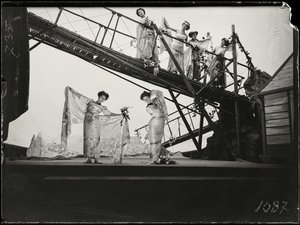
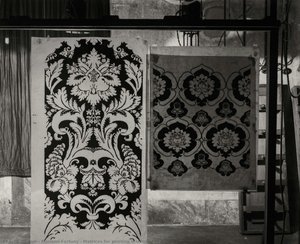
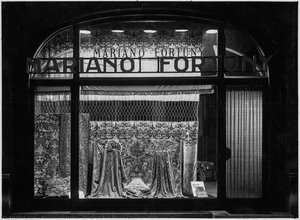
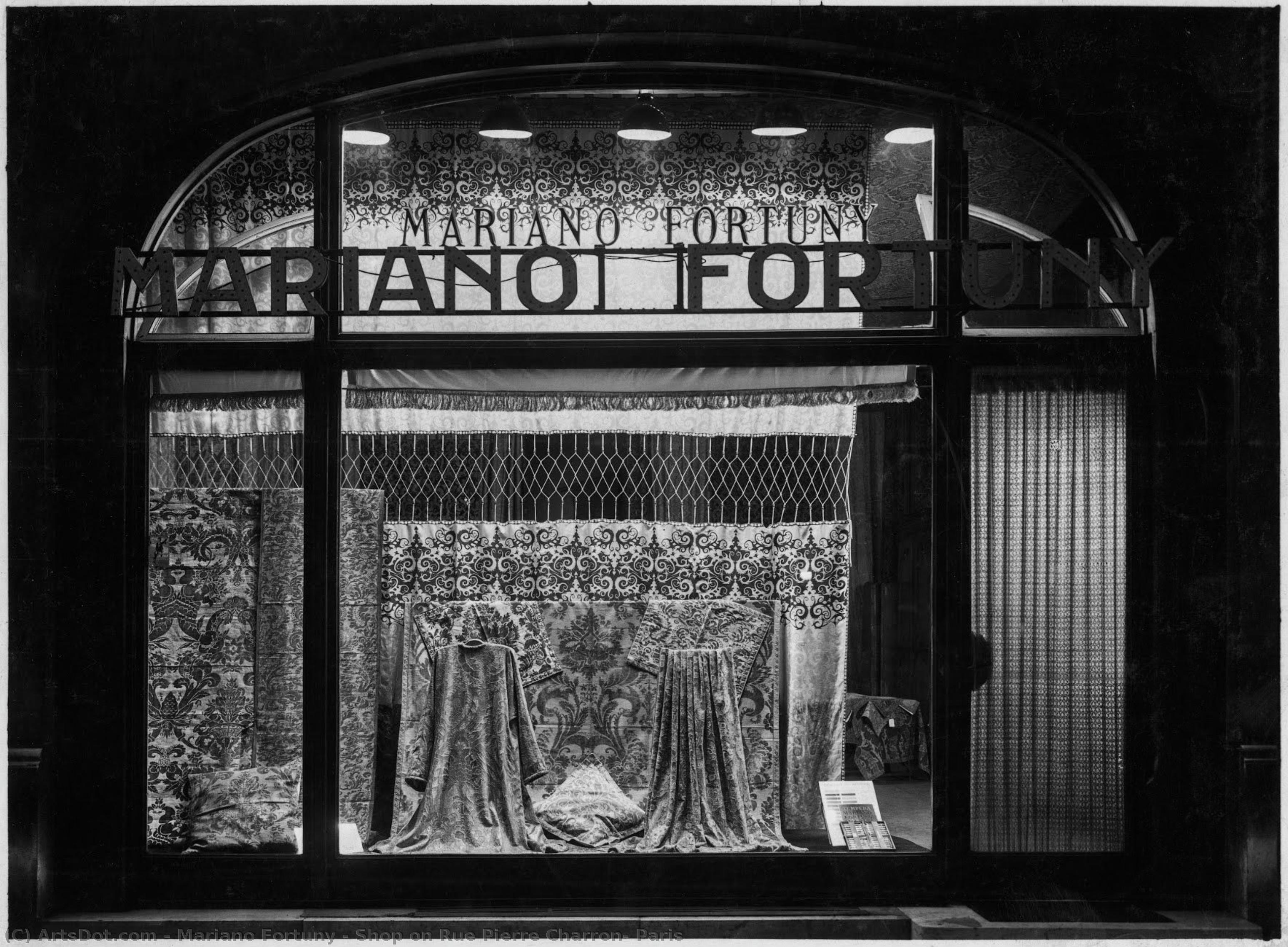
In the heart of Paris, captured through the timeless lens of monochrome photography, lies a portal to a bygone era of unparalleled sophistication. Shop on Rue Pierre Charron, Paris is more than a mere documentation of a storefront; it is an evocative window into the soul of 20th-century design. This 1937 photograph presents the storefront of the legendary Mariano Fortuny, a polymath whose influence stretched far beyond the seams of haute couture. As we gaze upon this grayscale composition, we are not just looking at a shop window, but witnessing the intersection of textile artistry, architectural grace, and the quiet drama of Parisian street life.
The photograph utilizes a masterful command of light and shadow to breathe life into the static display. Through the delicate interplay of deep blacks and luminous whites, the textures of the scene become almost tactile. One can sense the rough, industrial grit of the wire mesh fence contrasted against the ethereal, fluid drapes of Fortuny’s celebrated fabrics. The composition is anchored by a grand architectural arch that frames the display, lending a sense of classical permanence to the fleeting moment captured on film. This structural elegance guides the eye toward the mannequins, whose stylized forms emerge from the shadows like silent sentinels of fashion, draped in the very textures that revolutionized the world of theatrical and wearable art.
The Intersection of Artistry and Innovation
To understand this image is to understand the genius of Mariano Fortuny himself. Born in Spain but deeply rooted in the artistic pulse of Paris, Fortuny was a creator who refused to be confined by a single medium. He was an inventor, a painter, and a master of light. The subject matter here—the storefront itself—serves as a testament to his ability to merge the commercial with the sublime. The presence of the wire mesh creates a poignant symbolic barrier; it suggests an air of exclusivity and mystery, inviting the viewer to peer into a world of curated beauty that remains just out of reach, protected yet tantalizingly visible.
For the discerning collector or interior designer, this piece offers a profound sense of historical depth. The documentary style of the photograph provides an authentic glimpse into the 1930s, making it an ideal centerpiece for spaces that celebrate vintage aesthetics, Art Deco influences, or the history of fashion. It evokes a nostalgic longing for the "Belle Époque" spirit that persisted even in the turbulent years of the mid-century. When hung in a curated collection, this reproduction serves as a conversation piece, bridging the gap between the industrial reality of the street and the dreamlike luxury of Fortuny’s creative vision.
Whether you are drawn to the rhythmic horizontal lines of the signage or the soft, atmospheric perspective that lends depth to the background, this work resonates with an emotional gravity. It captures a moment of stillness in a bustling metropolis, offering a meditative look at how light, fabric, and architecture converge to create an icon of style. Owning a reproduction of this piece is an invitation to surround oneself with the enduring elegance of Parisian history.
Related Artworks
Artist Biography
early life and inspiration
mariano fortuny, a spanish fashion designer, was born on may 11, 1871, in granada, spain. his father, mariano fortuny y marsal, was a genre painter who passed away when mariano was just three years old. this event led to the family's move to paris, france, where mariano's mother introduced him to various textiles and fabrics that would later influence his creativity.artistic talents and inventions
mariano fortuny showcased his artistic talents from a young age, demonstrating skills in painting, photography, sculpting, architecture, etching, and theatrical stage lighting. his inventions, including over twenty patented between 1901 and 1934, revolutionized the world of theater design.- he developed the fortuny cyclorama dome, a quarter dome-shaped structure of plaster or cloth, which used indirect lighting to create a seamless transition between scenes.
- his treatise "eclairage scenique" (1904) described his discovery of reflecting light off different surfaces, changing its color, intensity, and properties.
notable contributions and collaborations
mariano fortuny's work gained widespread recognition in the 1920s. he collaborated with notable figures, including:- richard wagner, a german composer, whose operas inspired mariano to paint scenes.
- the famous opera house, la scala of milan, where he installed his dome, adapting it for the larger theater and inventing a suction fan to maintain its taut structure.
legacy and later life
mariano fortuny passed away on may 3, 1949, in venice, italy. his work inspired french novelist marcel proust, and his life was depicted in pere gimferrer's novel "fortuny." mariano's legacy continues to influence the world of theatrical design.- explore more about mariano fortuny's inventions and designs at ArtsDot's collection.
- discover the impact of his work on theatrical lighting in the museum destroyed by fire (united states), a story of an unfortunate event that shaped american art history, available at ArtsDot's blog.
selected paintings by mariano fortuny and other artists
- mariano fortuny: teagown (museum of fine arts, boston, united states), available at ArtsDot's collection.
- marc chagall: study to 'song of songs iv' (naive art / primitivism), available at ArtsDot's collection.
- pablo picasso: clarinet (analytical cubism, oil on canvas), available at ArtsDot's collection.
- vincent van gogh: tree roots (50 x 100 cm, post-impressionism, oil on canvas), available at ArtsDot's collection.
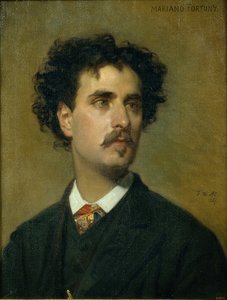
Mariano Fortuny
1871 - 1949 , Spain
Quick Facts
- Artistic Movement Or Style: Orientalism art
- Artists Or Movements Influenced By This Artist: ['Marcel Proust']
- Artists Who Influenced This Artist: ['Richard Wagner']
- Date Of Birth: May 11, 1871
- Date Of Death: May 3, 1949
- Full Name: Mariano Fortuny y Marsal
- Nationality: Spanish
- Notable Artworks:
- Teagown
- Portrait of Henriette Fortuny
- Place Of Birth: Granada, Spain
Related Articles
Mariano Fortuny: A Fusion of Art, Fashion & Design – Exploring a Venetian Innovator's Legacy
Explore the captivating world of Mariano Fortuny – artist, designer & innovator. Discover his revolutionary textiles, iconic Delphos gown, and lasting influence on art, fashion & interiors. A collector's guide to a Venetian master.
Draped Narratives: Fashion as Symbol & Subject in Historical Art
Explore the fascinating history of fashion as a symbol of power & status in art! Discover masterpieces from Gainsborough to Tissot and learn how clothing shaped societal narratives. Find museum-quality reproductions at ArtsDot.
Gianfranco Ferré: Deconstructing Haute Couture – A Legacy of Architectural Form
Explore the revolutionary world of Gianfranco Ferré, 'the architect of fashion.' Discover his architectural approach to haute couture, iconic Dior designs, and lasting influence on luxury style. A deep dive for collectors & enthusiasts.
Woven Wonders: A Beginner's Guide to Elevating Your New Home with Timeless Textile Art
Discover how to transform your new home with the warmth of textile art. Our expert guide for newlyweds explores handwoven tapestries, tactile fibers, and timeless ways to curate a soulful, sophisticated interior through beautiful woven wonders.
Cristóbal Balenciaga: Deconstructing Haute Couture's Architectural Legacy
Explore the revolutionary world of Cristóbal Balenciaga, the 'couturier's couturier'. Discover his architectural designs, lasting influence on haute couture, and guide to collecting rare pieces. A connoisseur’s resource.