 Preview
 Send
Send Share
Share
 Details

 Download
 Similars
 X-Ray
X-Ray Diaporama
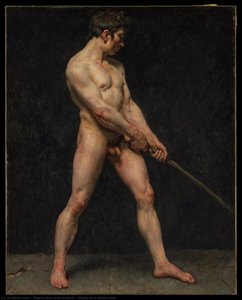
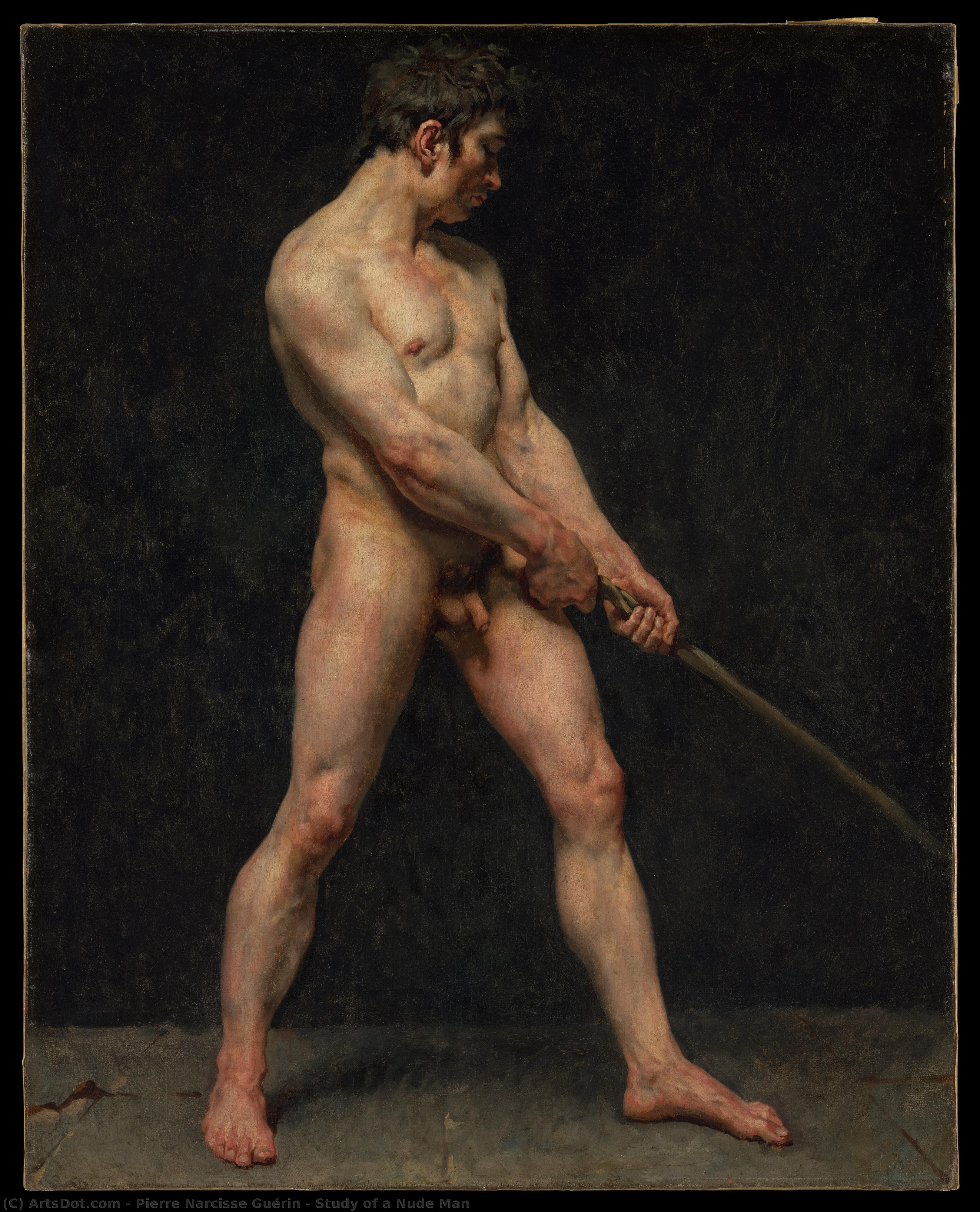
Study of a Nude Man
 Acrylic On Canvas
- WallArt
- Neoclassical
 1810
1810 81.0 x 64.0 cm
 Metropolitan Museum of Art
 Read More
Hand Made Oil Reproduction
Hand-painted oil on canvas in your size and frame, made to order by our artists. ( Buy Print Buy Image)




P118B $10

P118H $10

P118W $10

P438Z $10

P508JH $12

P508YH $12

P805H $10

P805Z $10

P919BZ $10

P919G $10

P919XJ $10

P959ZH $10

P968JZ $12

W106C $8

W218G $10

W218JH $8

W218Y $10

W307PJ $10

W316G $10

W316PJ $8

W316Y $10

W398PJ $8

W4111J $10

W500HY $15

W500JH $15

W692G $12

W849H $8

W940BG $15

W953PJ $8




Pick from our preset sizes that match the artwork's original proportions.

You may enter your own dimensions to fit a specific frame or space. If your selected size does not match the original image's proportions, we will either crop the artwork or extend the painting with additional hand-painted elements. A digital mockup will be sent for your approval before production begins.
Please note that the on-screen preview does not reflect the actual cropping or extension. Only the mockup will accurately show the final composition.
While custom sizes are available, we recommend selecting a dimension from the predefined list to preserve the original proportions.
After order, ArtsDot.com team will email client for instructions and provide a mockup preview
Worldwide Delivery () in 3/4 weeks instead of standard 5 weeks. (16 August). No compromise on quality.

Free Worldwide Express Shipping

High-Quality Linen Canvas

Full Shipping Insurance

Customs Tax Refund Guarantee

True Color Matching Guarantee

60-Day Return Policy (Defects Only)

100% Money-Back Guarantee

Bulk Discount Offer
 Glass option is only available in size under 110 CM

Study of a Nude Man
Reproduction Medium
Reproduction Size
-


Total Price
$ 263
Artwork Description
A Study in Quiet Strength: Pierre Narcisse Guérin’s Nude Man
The year is 1810. Paris pulses with the echoes of revolution and the nascent energy of Romanticism, yet within the meticulously ordered studios of artists like Pierre Narcisse Guérin, a different kind of transformation was underway – one rooted in classical tradition but subtly anticipating the emotional intensity to come. Guérin’s “Study of a Nude Man,” a remarkably intimate depiction of a young male figure holding a simple rope or staff, isn't merely a portrait; it’s a distillation of artistic principles and a poignant reflection on the evolving relationship between art, observation, and the human form. The painting possesses an understated power, achieved through a masterful control of light, shadow, and anatomical detail that speaks volumes about Guérin’s training under the influential Jacques Louis David and his own dedication to capturing the essence of the live model.
The subject himself is presented with remarkable composure – not overtly sensual, but imbued with a quiet dignity. He's posed in a half-length format, allowing us ample opportunity to appreciate the musculature of his torso, sculpted with an almost academic precision. The rope or staff he holds isn’t just a prop; it suggests a potential narrative, hinting at a life of labor or perhaps even a symbolic connection to nature – a fisherman hauling his net, as the description notes, but also a figure poised for action, ready to engage with the world. The subtle tension in his stance and the direct gaze he casts towards the viewer invite us into this private moment, fostering a sense of intimacy despite the formal setting.
The Legacy of Guérin and His Artistic Circle
Guérin’s work is inextricably linked to the artistic circles of 18th-century Paris. He was part of a group of artists who benefited from the patronage of influential figures like Jean-Baptiste Greuze, whose own genre scenes explored themes of morality and social commentary. Crucially, Guérin apprenticed under Pierre-Narcisse Guérin himself, a student of Jacques Louis David – a lineage that underscores the painting’s grounding in Neoclassical ideals. This connection to David is significant; David championed a return to classical forms and principles after the perceived excesses of the Rococo period, emphasizing clarity, order, and restraint. Guérin absorbed these lessons, translating them into his own distinctive style.
However, Guérin wasn’t simply a follower of David. He possessed a sensitivity and an ability to imbue his subjects with emotion that distinguished him from his mentor. The “Study of a Nude Man” exemplifies this – it's not a cold, detached depiction of the human body; rather, it conveys a sense of vulnerability and introspection. The painting’s creation involved a collaborative process, as Guérin learned directly from observing live models alongside David and other masters, absorbing their techniques and developing his own approach to capturing the nuances of human expression.
Technique and Composition: A Masterclass in Light and Shadow
The technical execution of “Study of a Nude Man” is remarkably refined. Guérin employs a chiaroscuro technique – a dramatic contrast between light and shadow – that dramatically emphasizes the contours of the figure’s body, highlighting his strength and form. The lighting is carefully considered, creating a sense of depth and volume while simultaneously concealing any unnecessary detail. The brushwork is smooth and controlled, contributing to the painting's overall sense of composure and elegance.
Compositionally, the image is balanced and harmonious. The figure occupies the central space, drawing our attention immediately. The background is deliberately muted, allowing the subject to command the viewer’s gaze. The use of a half-length format further enhances the intimacy of the scene, creating a sense of connection between the artist and his model. It's a testament to Guérin's understanding of how to create a visually compelling image through careful attention to detail and compositional balance.
Symbolism and Emotional Resonance
Beyond its technical merits, “Study of a Nude Man” carries a subtle symbolic weight. The figure’s pose – holding the rope or staff – suggests a connection to labor, perhaps even a hint of melancholy. The painting's creation during the early 19th century, a period marked by social and political upheaval, adds another layer of meaning. It can be interpreted as an exploration of human resilience in the face of adversity, a quiet affirmation of strength amidst uncertainty.
Ultimately, “Study of a Nude Man” is more than just a portrait; it’s a meditation on beauty, vulnerability, and the enduring power of art to capture the essence of the human experience. Its understated elegance and profound emotional resonance continue to captivate viewers today, cementing Guérin's place as a pivotal figure in the transition from Neoclassicism to Romanticism.
Related Artworks
Artist Biography
The Bridge Between Eras: The Life and Legacy of Pierre Narcisse Guérin
In the grand tapestry of French art history, few figures embody the delicate transition from the disciplined rigor of Neoclassicism to the turbulent passion of Romanticism as gracefully as Pierre Narcisse Guérin. Born in Paris in 1774, Guérin emerged during a period of profound societal transformation, where the echoes of the French Revolution still reverberated through the halls of the Academy. A student of the esteemed Jean-Baptiste Regnault, Guérin’s early career was marked by immediate distinction; in 1796, he secured one of the prestigious grands prix, a victory that signaled his arrival as a formidable talent capable of reviving the competitive spirit of the French art world after years of revolutionary hiatus.
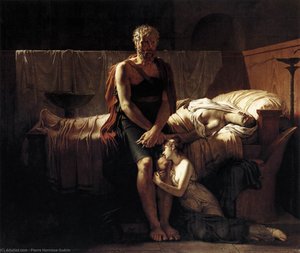
Guérin’s ascent to fame was not merely a matter of technical proficiency but of emotional resonance. When he unveiled The Return of Marcus Sextus at the Salon of 1799, the impact was nothing short of electric. The painting, which depicted a Roman veteran returning to a home devastated by death and political upheaval, served as a poignant allegory for the contemporary French experience. Through this work, Guérin demonstrated an uncanny ability to weave historical narrative with the raw, personal grief of his subjects, effectively using the classical past to mirror the chaotic present. This mastery of drama would become his hallmark, earning him public acclaim and leading to further studies in Rome under Joseph-Benoît Suvée.
A Journey Through Light and Myth
The trajectory of Guérin’s life was shaped by both artistic ambition and physical frailty. His time in Rome, while intellectually enriching, was cut short by ill health, prompting a relocation to Naples. It was here that his palette began to expand, embracing the atmospheric grandeur of landscapes as seen in his commemorative work for the tomb of Amyntas. This period of wandering allowed him to infuse his Neoclassical foundations with a new sense of light and shadow, a precursor to the more expressive styles that would soon dominate Europe.
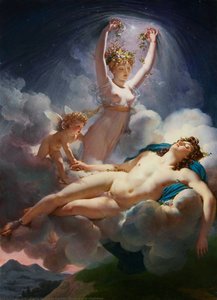
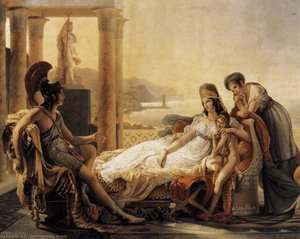
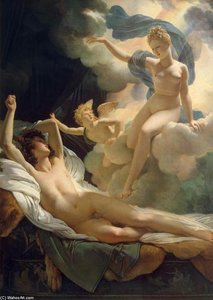
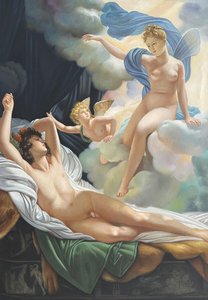
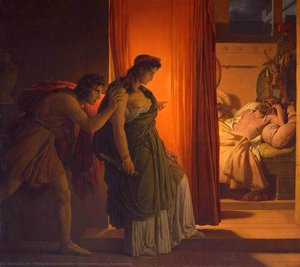
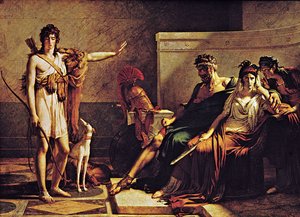
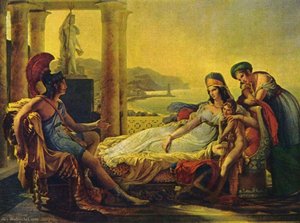
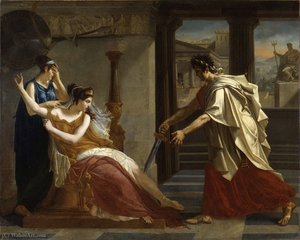
As he returned to Paris, Guérin’s repertoire grew to include some of the most captivating mythological and historical scenes of the early 19th century. His works often featured a luminous chiaroscuro that breathed life into divine figures, such as in the ethereal Morpheus and Iris. Whether depicting the tragic fate of Dido and Aeneas or the intense, heroic energy of Andromache and Pyrrhus, Guérin possessed a unique gift for imbuing mythological subjects with human vulnerability. His ability to balance the idealized beauty of the classical tradition with an emerging sense of psychological depth made him a favorite of the imperial court during the Napoleonic era.
The Master’s Influence and Artistic Significance
Beyond his individual canvases, Guérin’s historical significance lies in his role as a pivotal mentor and stylistic bridge. He stood at the crossroads of generations, providing a foundation upon which the giants of Romanticism could build. His influence can be traced through the works of legendary painters such as:
- Eugène Delacroix, who drew upon Guérin’s dramatic compositions and emotional intensity to pioneer the Romantic movement.
- Théodore Géricault, whose powerful depictions of human struggle echoed the narrative weight found in Guérin’s history paintings.
- Henry Scheffer, a talented pupil who carried forward the refined Neoclassical elegance taught by his master.
Ultimately, Pierre Narcisse Guérin was more than just a painter of beautiful scenes; he was an artist who understood the pulse of his era. Through his portraits, mythological allegories, and historical epics, he captured the tension between order and chaos, stability and change. His legacy remains etched in the halls of institutions like the Louvre and the Hermitage, serving as a testament to a man who could command the discipline of the old world while whispering the secrets of the new.
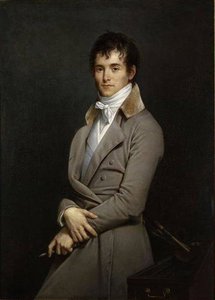
pierre narcisse guérin
1774 - 1833 , France
Quick Facts
- Artistic Movement Or Style: Neoclassical
- Artists Or Movements Influenced By This Artist:
- Delacroix
- Géricault
- Artists Who Influenced This Artist: ['Jean-Baptiste Regnault']
- Date Of Birth: Paris, France (1774)
- Date Of Death: 1833
- Full Name: Pierre Narcisse Guérin
- Nationality: French
- Notable Artworks:
- The Return of Marcus Sextus
- Morpheus and Iris
- Aurora and Cephalus
- Place Of Birth: Paris
Related Articles
Leonardo da Vinci's Masterpieces: Explore 25 Iconic Artworks for Your Home | ArtsDot
Journey through Leonardo da Vinci's genius with our curated selection of 25 iconic artworks. Explore the stories behind Mona Lisa, The Last Supper & more Renaissance masterpieces. Find museum-quality art reproductions for your home at ArtsDot.com.
The Enduring Allure of the Nude: A Historical & Artistic Exploration of the Human Form
Explore the captivating history of nude art! Discover iconic paintings & artists from classical to modern eras. Uncover symbolism, techniques & find museum-quality reproductions at ArtsDot.
The Eloquent Form: A Historical & Aesthetic Exploration of the Nude in Art
Explore the captivating history of the nude in art! From ancient Greece to modern masters, discover its evolving symbolism, techniques & enduring beauty. Expert insights for collectors and enthusiasts.
Acrylic on Paper: 10 Masterpieces That Redefined Modern Art | ArtsDot
Explore 10 legendary 'Acrylic on Paper' masterpieces by artists like Helen Frankenthaler & Gerhard Richter. Discover abstract expressionism, color field painting & the evolution of modern art. Find museum-quality reproductions for your home at ArtsDot.com.
Ferdinand Delacroix: Romanticism's Revolutionary Brush – A Study of Passion, Politics, and Painterly Innovation
Explore the revolutionary art of Eugène Delacroix, leader of French Romanticism. Discover his masterful use of color, political engagement, and lasting influence on modern painting. Learn about key works & history.