 Preview
 Send
Send Share
Share
 Details

 Download
 Similars
 X-Ray
X-Ray Diaporama
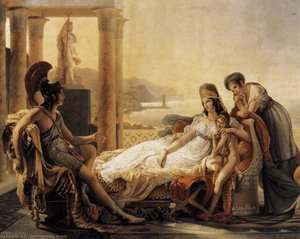
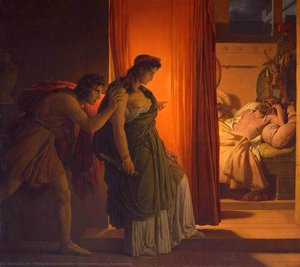
Dido and Aeneas
 Oil On Canvas
- WallArt
- Romanticism
 1815
1815 292.0 x 390.0 cm
 The Louvre
 Read More
Hand Made Oil Reproduction
Hand-painted oil on canvas in your size and frame, made to order by our artists. ( Buy Print Buy Image)




P118B $10

P118H $10

P118W $10

P438Z $10

P508JH $12

P508YH $12

P805H $10

P805Z $10

P919BZ $10

P919G $10

P919XJ $10

P959ZH $10

P968JZ $12

W106C $8

W218G $10

W218JH $8

W218Y $10

W307PJ $10

W316G $10

W316PJ $8

W316Y $10

W398PJ $8

W4111J $10

W500HY $15

W500JH $15

W692G $12

W849H $8

W940BG $15

W953PJ $8




Pick from our preset sizes that match the artwork's original proportions.

You may enter your own dimensions to fit a specific frame or space. If your selected size does not match the original image's proportions, we will either crop the artwork or extend the painting with additional hand-painted elements. A digital mockup will be sent for your approval before production begins.
Please note that the on-screen preview does not reflect the actual cropping or extension. Only the mockup will accurately show the final composition.
While custom sizes are available, we recommend selecting a dimension from the predefined list to preserve the original proportions.
After order, ArtsDot.com team will email client for instructions and provide a mockup preview
Worldwide Delivery () in 3/4 weeks instead of standard 5 weeks. (17 August). No compromise on quality.

Free Worldwide Express Shipping

High-Quality Linen Canvas

Full Shipping Insurance

Customs Tax Refund Guarantee

True Color Matching Guarantee

60-Day Return Policy (Defects Only)

100% Money-Back Guarantee

Bulk Discount Offer
 Glass option is only available in size under 110 CM

Dido and Aeneas
Reproduction Medium
Reproduction Size
-


Total Price
$ 263
Artwork Description
A Vision of Roman Tragedy: Guérin’s Dido and Aeneas
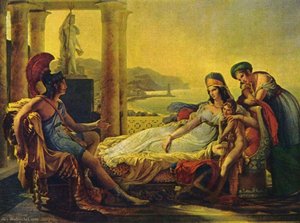
Pierre Narcisse Guérin's “Dido and Aeneas” is not merely a depiction of a myth; it’s a profound exploration of loss, longing, and the bittersweet nature of destiny. Painted in 1815, this canvas transports us to a twilight world – a carefully constructed tableau of Roman tragedy rendered with the delicate brushstrokes characteristic of the Romantic era's embrace of emotional intensity. The scene unfolds within a classically inspired setting: an outdoor space subtly suggesting both grandeur and melancholy, punctuated by simple chairs that invite contemplation alongside the central figures.
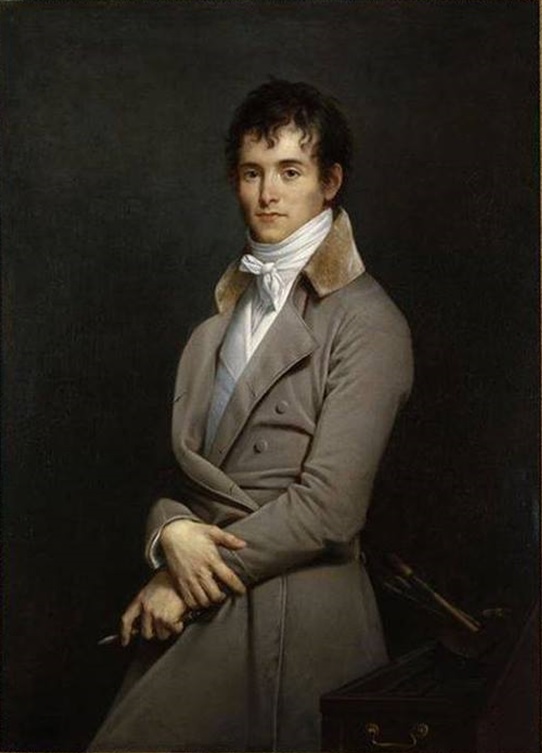
The composition immediately draws the eye to Dido, seated on a bed draped in rich fabrics, her posture conveying both regal authority and profound sorrow. Her child nestles close, mirroring her grief – a poignant symbol of inherited pain and the cyclical nature of suffering. Beside her stands another woman, likely a servant or confidante, offering a gesture of quiet support. Two men occupy the periphery: one, a shadowy figure on the left, hints at the past, while the other, positioned to the right, embodies the future – Aeneas, already captivated by Dido’s beauty and burdened by his impending departure.
The Romantic Echoes of Neoclassicism
Guérin's work represents a fascinating confluence of artistic movements. Rooted in the formal principles of Neoclassicism—evident in the balanced composition, precise rendering of figures, and classical architectural elements—it simultaneously embraces the heightened emotionalism and dramatic intensity championed by Romanticism. This synthesis is particularly striking in the painting’s use of light and shadow; a diffused glow illuminates Dido's face, accentuating her vulnerability, while darker tones suggest the weight of her sorrow and the looming uncertainty of her fate. The artist skillfully employs chiaroscuro to create a sense of theatrical drama, reminiscent of Baroque paintings but imbued with a distinctly Romantic sensibility.
The historical context is crucial to understanding Guérin’s vision. Painted in 1815, just after the Napoleonic Wars and amidst the burgeoning spirit of Romanticism, the work reflects a broader cultural preoccupation with themes of loss, exile, and the search for identity. The story of Dido and Aeneas—a tale of betrayal, love, and abandonment—resonated deeply with audiences grappling with the upheavals of their time.
Symbolism Woven into the Narrative
Beyond its narrative content, “Dido and Aeneas” is rich in symbolic meaning. Dido’s pyre, a recurring motif in Roman mythology, represents not just death but also transformation – a fiery rebirth from ashes. Her decision to commit suicide underscores her unwavering devotion and the devastating consequences of unrequited love. Aeneas's impending departure symbolizes the inevitable separation between passion and duty, highlighting the tragic paradox at the heart of the story. The presence of the child serves as a poignant reminder of the future sacrificed in the name of love and ambition.
The setting itself contributes to the painting’s symbolic weight. The outdoor space, with its simple furnishings, suggests a world stripped bare of artifice, where raw emotion reigns supreme. The chairs invite viewers to contemplate the characters' plight and reflect on their own experiences of loss and longing.
A Legacy in Reproduction
Guérin’s “Dido and Aeneas” continues to captivate audiences today, offering a timeless meditation on love, loss, and the enduring power of myth. Reproductions of this masterpiece provide an accessible way to experience its beauty and emotional depth, allowing it to enrich interior spaces with its evocative atmosphere. When selecting a reproduction, consider the quality of materials and printing techniques to ensure that you capture the painting’s nuanced details and vibrant colors – a testament to Guérin's artistic skill and his ability to translate complex emotions onto canvas.
Related Artworks

Artist Biography
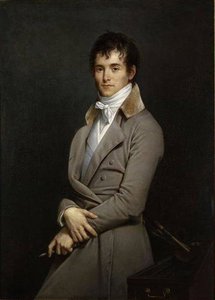
The Bridge Between Eras: The Life and Legacy of Pierre Narcisse Guérin
In the grand tapestry of French art history, few figures embody the delicate transition from the disciplined rigor of Neoclassicism to the turbulent passion of Romanticism as gracefully as Pierre Narcisse Guérin. Born in Paris in 1774, Guérin emerged during a period of profound societal transformation, where the echoes of the French Revolution still reverberated through the halls of the Academy. A student of the esteemed Jean-Baptiste Regnault, Guérin’s early career was marked by immediate distinction; in 1796, he secured one of the prestigious grands prix, a victory that signaled his arrival as a formidable talent capable of reviving the competitive spirit of the French art world after years of revolutionary hiatus.
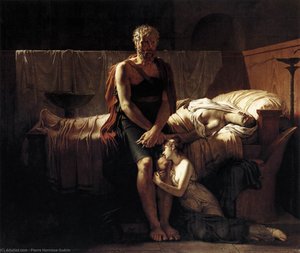
Guérin’s ascent to fame was not merely a matter of technical proficiency but of emotional resonance. When he unveiled The Return of Marcus Sextus at the Salon of 1799, the impact was nothing short of electric. The painting, which depicted a Roman veteran returning to a home devastated by death and political upheaval, served as a poignant allegory for the contemporary French experience. Through this work, Guérin demonstrated an uncanny ability to weave historical narrative with the raw, personal grief of his subjects, effectively using the classical past to mirror the chaotic present. This mastery of drama would become his hallmark, earning him public acclaim and leading to further studies in Rome under Joseph-Benoît Suvée.
A Journey Through Light and Myth
The trajectory of Guérin’s life was shaped by both artistic ambition and physical frailty. His time in Rome, while intellectually enriching, was cut short by ill health, prompting a relocation to Naples. It was here that his palette began to expand, embracing the atmospheric grandeur of landscapes as seen in his commemorative work for the tomb of Amyntas. This period of wandering allowed him to infuse his Neoclassical foundations with a new sense of light and shadow, a precursor to the more expressive styles that would soon dominate Europe.
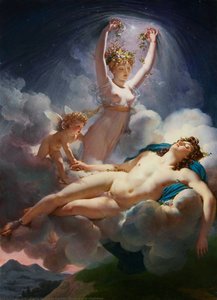
As he returned to Paris, Guérin’s repertoire grew to include some of the most captivating mythological and historical scenes of the early 19th century. His works often featured a luminous chiaroscuro that breathed life into divine figures, such as in the ethereal Morpheus and Iris. Whether depicting the tragic fate of Dido and Aeneas or the intense, heroic energy of Andromache and Pyrrhus, Guérin possessed a unique gift for imbuing mythological subjects with human vulnerability. His ability to balance the idealized beauty of the classical tradition with an emerging sense of psychological depth made him a favorite of the imperial court during the Napoleonic era.
The Master’s Influence and Artistic Significance
Beyond his individual canvases, Guérin’s historical significance lies in his role as a pivotal mentor and stylistic bridge. He stood at the crossroads of generations, providing a foundation upon which the giants of Romanticism could build. His influence can be traced through the works of legendary painters such as:
- Eugène Delacroix, who drew upon Guérin’s dramatic compositions and emotional intensity to pioneer the Romantic movement.
- Théodore Géricault, whose powerful depictions of human struggle echoed the narrative weight found in Guérin’s history paintings.
- Henry Scheffer, a talented pupil who carried forward the refined Neoclassical elegance taught by his master.
Ultimately, Pierre Narcisse Guérin was more than just a painter of beautiful scenes; he was an artist who understood the pulse of his era. Through his portraits, mythological allegories, and historical epics, he captured the tension between order and chaos, stability and change. His legacy remains etched in the halls of institutions like the Louvre and the Hermitage, serving as a testament to a man who could command the discipline of the old world while whispering the secrets of the new.
pierre narcisse guérin
1774 - 1833 , France
Quick Facts
- Artistic Movement Or Style: Neoclassical
- Artists Or Movements Influenced By This Artist:
- Delacroix
- Géricault
- Artists Who Influenced This Artist: ['Jean-Baptiste Regnault']
- Date Of Birth: Paris, France (1774)
- Date Of Death: 1833
- Full Name: Pierre Narcisse Guérin
- Nationality: French
- Notable Artworks:
- The Return of Marcus Sextus
- Morpheus and Iris
- Aurora and Cephalus
- Place Of Birth: Paris
Related Articles
Echoes of Olympus: Mythological Narratives in Western Art Through the Ages
Explore the captivating history of mythological narratives in Western art! From ancient Greece to modern masterpieces, discover iconic artworks & symbolism. Expert analysis and high-quality reproductions at ArtsDot.
The Enduring Legacy of Classicism: Principles, Evolution & Influence in Western Art
Explore the enduring legacy of Classicism in Western art! Discover its historical context, key principles, iconic masterpieces & lasting influence. Learn about Renaissance and Neoclassical movements with ArtsDot.
Neo-Classicism's Greatest Hits: 10 Masterpieces for Your Home |
Journey through Neo-Classicism's finest! Explore 10 iconic masterpieces by David, Ingres & Canova. Discover art history, techniques & timeless beauty – perfect for inspiring your home decor. Find museum-quality reproductions at
Timeless Resonance: Exploring Classic Vibe in Art – A Historical & Aesthetic Analysis
Explore the rich history & enduring aesthetic of Classicism art! Discover key movements, iconic artists like Raphael & David, and its lasting influence on Western art. Deepen your appreciation today.
The Enduring Legacy of Classical Style: Form, Narrative & Influence in Art
Explore the enduring legacy of classical art – from ancient Greece & Rome to Neoclassicism. Discover key artists, philosophical roots & build a timeless collection with ArtsDot's expert guidance.