 Preview
 Send
Send Share
Share
 Details

 Download
 Similars
 X-Ray
X-Ray Diaporama
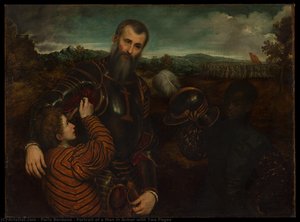
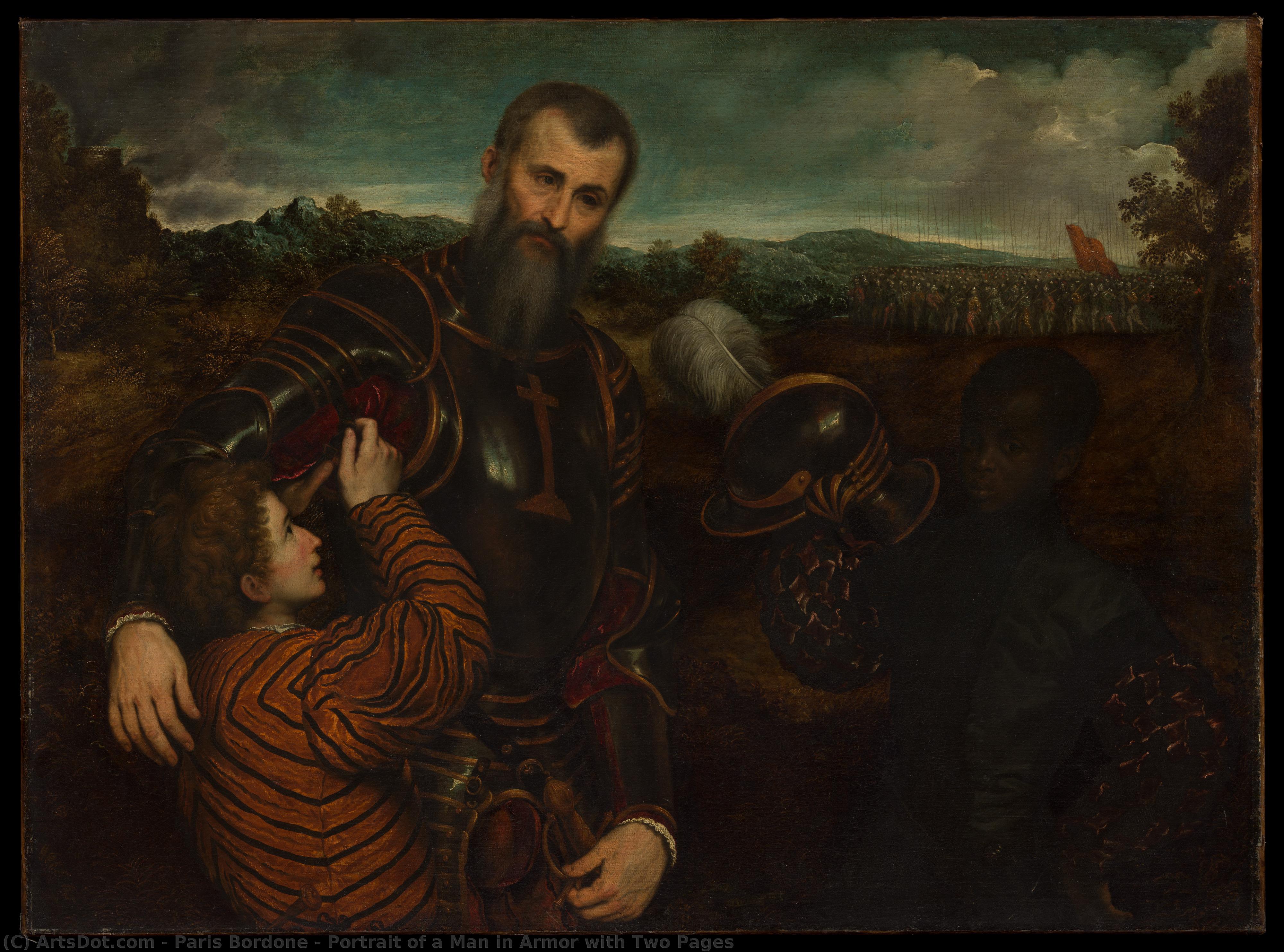
Portrait of a Man in Armor with Two Pages
 Oil On Canvas
- WallArt
- Mannerist Complexity
 Early Modern
 117.0 x 158.0 cm
 Metropolitan Museum of Art
 Read More
Hand Made Oil Reproduction
Hand-painted oil on canvas in your size and frame, made to order by our artists. ( Buy Print Buy Image)




P118B $10

P118H $10

P118W $10

P438Z $10

P508JH $12

P508YH $12

P805H $10

P805Z $10

P919BZ $10

P919G $10

P919XJ $10

P959ZH $10

P968JZ $12

W106C $8

W218G $10

W218JH $8

W218Y $10

W307PJ $10

W316G $10

W316PJ $8

W316Y $10

W398PJ $8

W4111J $10

W500HY $15

W500JH $15

W692G $12

W849H $8

W940BG $15

W953PJ $8




Pick from our preset sizes that match the artwork's original proportions.

You may enter your own dimensions to fit a specific frame or space. If your selected size does not match the original image's proportions, we will either crop the artwork or extend the painting with additional hand-painted elements. A digital mockup will be sent for your approval before production begins.
Please note that the on-screen preview does not reflect the actual cropping or extension. Only the mockup will accurately show the final composition.
While custom sizes are available, we recommend selecting a dimension from the predefined list to preserve the original proportions.
After order, ArtsDot.com team will email client for instructions and provide a mockup preview
Worldwide Delivery () in 3/4 weeks instead of standard 5 weeks. (25 August). No compromise on quality.

Free Worldwide Express Shipping

High-Quality Linen Canvas

Full Shipping Insurance

Customs Tax Refund Guarantee

True Color Matching Guarantee

60-Day Return Policy (Defects Only)

100% Money-Back Guarantee

Bulk Discount Offer
 Glass option is only available in size under 110 CM

Portrait of a Man in Armor with Two Pages
Reproduction Medium
Reproduction Size
-


Total Price
$ 263
Artwork Description
The Grandeur of Venetian Might: A Study in Armor and Allegiance
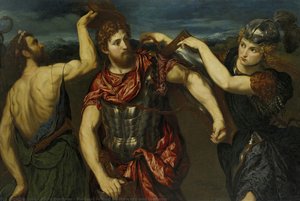
To gaze upon this magnificent portrait is to step directly into the opulent, charged atmosphere of the late Renaissance courts. It presents us with an arresting vision: a high-ranking officer, clad in formidable field armor that speaks volumes of military prowess and aristocratic standing. The very composition hums with latent energy; it feels less like a static painting and more like a moment suspended just before a grand procession or the commencement of a vital campaign. The subject himself, though unidentified by modern scholarship, embodies the martial dignity characteristic of Venetian nobility during this period.
The meticulous detail captured in the armor itself is breathtaking. It is not merely protective gear; it is a statement of identity and allegiance. Notice the cross emblazoned upon his breastplate—a subtle yet potent symbol suggesting deep ties to prestigious military orders, perhaps even the revered Knights Hospitaller. This confluence of personal portraiture with institutional symbolism elevates the piece beyond mere likeness; it becomes an artifact of social structure.
The Artistry of Paris Bordone: Mannerist Complexity
The hand that rendered this scene belongs to Paris Bordone, a master whose style perfectly encapsulates the vibrant, sometimes over-wrought beauty of Venetian Mannerism. While he absorbed the lessons of giants like Titian, Bordone forged a path uniquely his own—a blend of intricate compositional schemes with an almost provincial vitality. His technique allows for an astonishing level of detail, visible in the sheen of the metalwork and the rich texture suggested beneath the armor's plating.
Observe the supporting figures: two elegantly dressed pages attend to the officer’s accoutrements. Their presence adds a layer of narrative complexity. One page carefully adjusts the rerebrace over the velvet doublet, while the other presents the helmet with practiced deference. These attendants are not mere props; they are active participants in the tableau, lending an air of ceremony and importance to every gesture.
Symbolism and the Intrigue of Presence
What truly captivates the modern eye is the subtle undercurrent of social commentary woven into the fabric of the portrait. The inclusion of a Black page among these high-ranking figures poses fascinating questions about status, origin, and the evolving racial dynamics within the wealthy circles of Venice and Northern Italy during that era. Such early depictions in aristocratic male portraiture are invaluable historical documents, inviting endless scholarly debate.
Furthermore, the background setting—suggesting an outdoor locale with visible foliage—grounds this otherwise highly formalized scene in a tangible reality. The man’s gaze, directed slightly off-camera to the right, suggests a narrative unfolding just beyond the viewer's sightline, drawing us into the moment as if we are privy to a private council of lords and knights.
A Statement for the Modern Collector
For the collector or designer seeking an object imbued with history, drama, and unparalleled artistry, this reproduction offers more than just decoration; it offers conversation. It speaks to themes of duty, status, military honor, and cultural exchange. The rich palette and dynamic composition ensure that whether displayed in a grand hall or a richly appointed study, the portrait commands attention. Owning a piece echoing Bordone’s mastery is acquiring a tangible link to the sophisticated, dramatic heart of Renaissance Venice.
Related Artworks

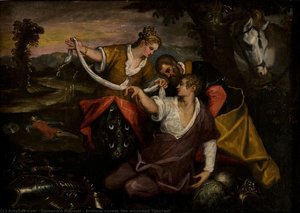
Artist Biography
The Venetian Maverick: The Life and Legacy of Paris Bordone
In the vibrant, sun-drenched landscape of the sixteenth-century Venetian Renaissance, few figures possess a spirit as fiercely independent as Paris Bordone. Born in Treviso around 1500, Bordone emerged from the shadow of the great masters to carve out a reputation defined by a unique tension between classical grace and a restless, Mannerist energy. While his contemporaries often sought the polished perfection of the High Renaissance, Bordone embraced a more complex, sometimes provocative aesthetic that blended the monumental scale of his era with a distinctively provincial vitality. His journey was one of constant negotiation between the established traditions of Venice and an unyielding desire to forge a personal visual language.
The foundation of Bordone’s technical prowess was laid during his formative years in Venice, most notably through his apprenticeship under the legendary Titian. This period was undoubtedly the crucible of his talent, exposing him to the rich textures, dramatic lighting, and atmospheric depth that define the Venetian school. However, the relationship between master and pupil was famously fraught with creative friction. Historical accounts, including those by Vasari, suggest a certain discordance between Bordone’s experimental impulses and Titian’s more refined aesthetic. Rather than being stifled by this tension, Bordone utilized it as a catalyst for growth, developing a style that moved away from pure imitation toward a more intricate and sometimes agitated compositional approach.
A Tapestry of Myth, Devotion, and Portraiture
Bordone’s prolific career is characterized by an extraordinary breadth of subject matter, ranging from the sacred to the profane. His ability to navigate religious iconography with the same vigor as mythological narratives allowed him to capture the diverse interests of the Venetian elite. In his religious works, such as the Pentecost housed in the Hermitage Museum, one observes a masterful command of sfumato and warm, emotive tones that invite deep spiritual contemplation. Yet, even within these devotional settings, a sense of Mannerist complexity often emerges through swirling drapery and crowded, dynamic arrangements.
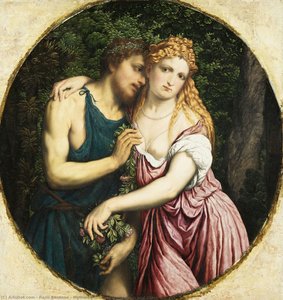
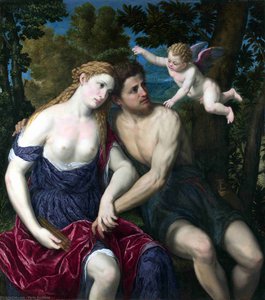
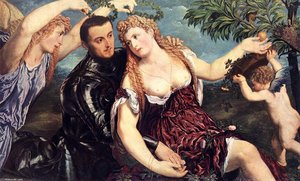
When turning his gaze toward the secular, Bordone achieved a level of narrative drama that remains captivating to modern viewers. His mythological paintings, such as Allegory with Lovers, showcase his talent for using vibrant colors and symbolic depth to weave complex tales of passion and fate. This mastery extended into the realm of portraiture, where he captured the dignity and social standing of his subjects with remarkable precision. A notable example is his 1540 Portrait of Thomas Stachel, currently residing in the Louvre; here, the artist utilizes an intricate composition to highlight the sitter's status, using the fine details of robes and heraldic letters to ground the subject in a tangible historical reality.
Historical Significance and Artistic Endurance
The enduring significance of Paris Bordone lies in his refusal to conform. He stands as a vital bridge between the balanced harmony of the early Renaissance and the more stylized, expressive complexities of the Mannerist period. While he may not have reached the universal heights of Titian, his work offers a necessary counterpoint—a more textured, experimental, and often more humanistic perspective on the Venetian world. His paintings serve as windows into a time of profound transition, where the stability of tradition was being challenged by a new, more restless artistic consciousness.
Today, Bordone’s legacy is preserved in some of the world's most prestigious institutions, inviting scholars and art lovers alike to rediscover his unique vision. His contributions can be summarized through several key artistic pillars:
- Stylistic Innovation: The successful integration of Titian-inspired grandeur with a more complex, Mannerist compositional structure.
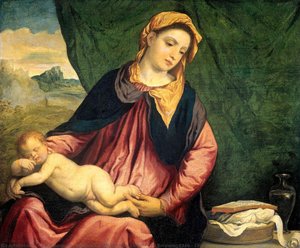
- Versatility of Theme: An unparalleled ability to move seamlessly between the serene beauty of the Madonna with Sleeping Child and the dramatic intensity of historical allegories.
- Technical Mastery: A sophisticated use of light, color, and texture that brought a palpable sense of life and movement to the canvas.
- Cultural Impact: Representing the vibrant, often turbulent spirit of Treviso and Venice during one of the most transformative eras in Western art history.
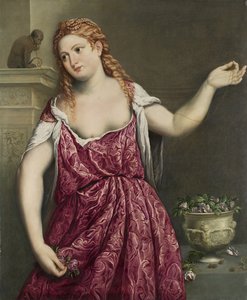
Paris Bordone
1500 - 1570 , Italy
Quick Facts
- Artistic Movement Or Style: Mannerist
- Artists Who Influenced This Artist: Titian
- Date Of Birth: July 5, 1500
- Date Of Death: January 19, 1571
- Full Name: Paris Bordone
- Nationality: Italian
- Notable Artworks:
- Fisherman's Ring
- Pentecost
- Jupiter & Io
- Baptism of Christ
- Place Of Birth: Treviso, Italy
Related Articles
The Enduring Legacy of Formal Portraiture: Power, Identity & Artistic Exploration
Explore the rich history of formal portraiture & its enduring power to capture identity and shape perception. Discover investment-worthy artworks, expert appraisals, and custom reproduction services at ArtsDot.
The Grandeur of Presence: Exploring Representations of Stately Bearing in Western Portraiture
Explore the art of stately bearing in Western portraiture with expert analysis of Renaissance & Baroque masterpieces. Discover symbolism, techniques, and the legacy of iconic portraits – a guide for discerning collectors.
The Enduring Gaze: Portraiture's Historical & Psychological Evolution
Explore the rich history of portraiture with expert analysis from ArtsDot. Discover iconic Renaissance masterpieces, symbolism & techniques that shaped identity. Find museum-quality art for your collection.
Daniel Ridgway Knight: A Study in Victorian Genre Painting & Rural Idealism
Explore the captivating world of Daniel Ridgway Knight, a master of Victorian genre painting. Discover his serene rural scenes, realistic technique & lasting influence on American Impressionism. Learn about his life, art, and collectibility.
The Enduring Gaze: A Historical & Artistic Exploration of Portraiture Across Cultures
Explore the rich history of portraiture with ArtsDot.com! Discover symbolism, techniques & master artists from antiquity to modern times. Expert insights for art collectors.