 Preview
 Send
Send Share
Share
 Details

 Download
 Similars
 X-Ray
X-Ray Diaporama
The Derby Day
 Oil On Canvas
- WallArt
- Victorian Modern Life
 1858
1858 223.0 x 101.0 cm
 Tate Britain
 Read More
Hand Made Oil Reproduction
Hand-painted oil on canvas in your size and frame, made to order by our artists. ( Buy Print Buy Image)




P118B $10

P118H $10

P118W $10

P438Z $10

P508JH $12

P508YH $12

P805H $10

P805Z $10

P919BZ $10

P919G $10

P919XJ $10

P959ZH $10

P968JZ $12

W106C $8

W218G $10

W218JH $8

W218Y $10

W307PJ $10

W316G $10

W316PJ $8

W316Y $10

W398PJ $8

W4111J $10

W500HY $15

W500JH $15

W692G $12

W849H $8

W940BG $15

W953PJ $8




Pick from our preset sizes that match the artwork's original proportions.

You may enter your own dimensions to fit a specific frame or space. If your selected size does not match the original image's proportions, we will either crop the artwork or extend the painting with additional hand-painted elements. A digital mockup will be sent for your approval before production begins.
Please note that the on-screen preview does not reflect the actual cropping or extension. Only the mockup will accurately show the final composition.
While custom sizes are available, we recommend selecting a dimension from the predefined list to preserve the original proportions.
After order, ArtsDot.com team will email client for instructions and provide a mockup preview
Worldwide Delivery () in 3/4 weeks instead of standard 5 weeks. (17 August). No compromise on quality.

Free Worldwide Express Shipping

High-Quality Linen Canvas

Full Shipping Insurance

Customs Tax Refund Guarantee

True Color Matching Guarantee

60-Day Return Policy (Defects Only)

100% Money-Back Guarantee

Bulk Discount Offer
 Glass option is only available in size under 110 CM

The Derby Day
Reproduction Medium
Reproduction Size
-


Total Price
$ 263
Artwork Description
A Snapshot of Victorian Society: William Powell Frith’s ‘The Derby Day’
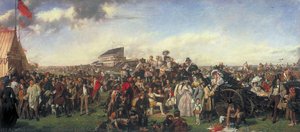
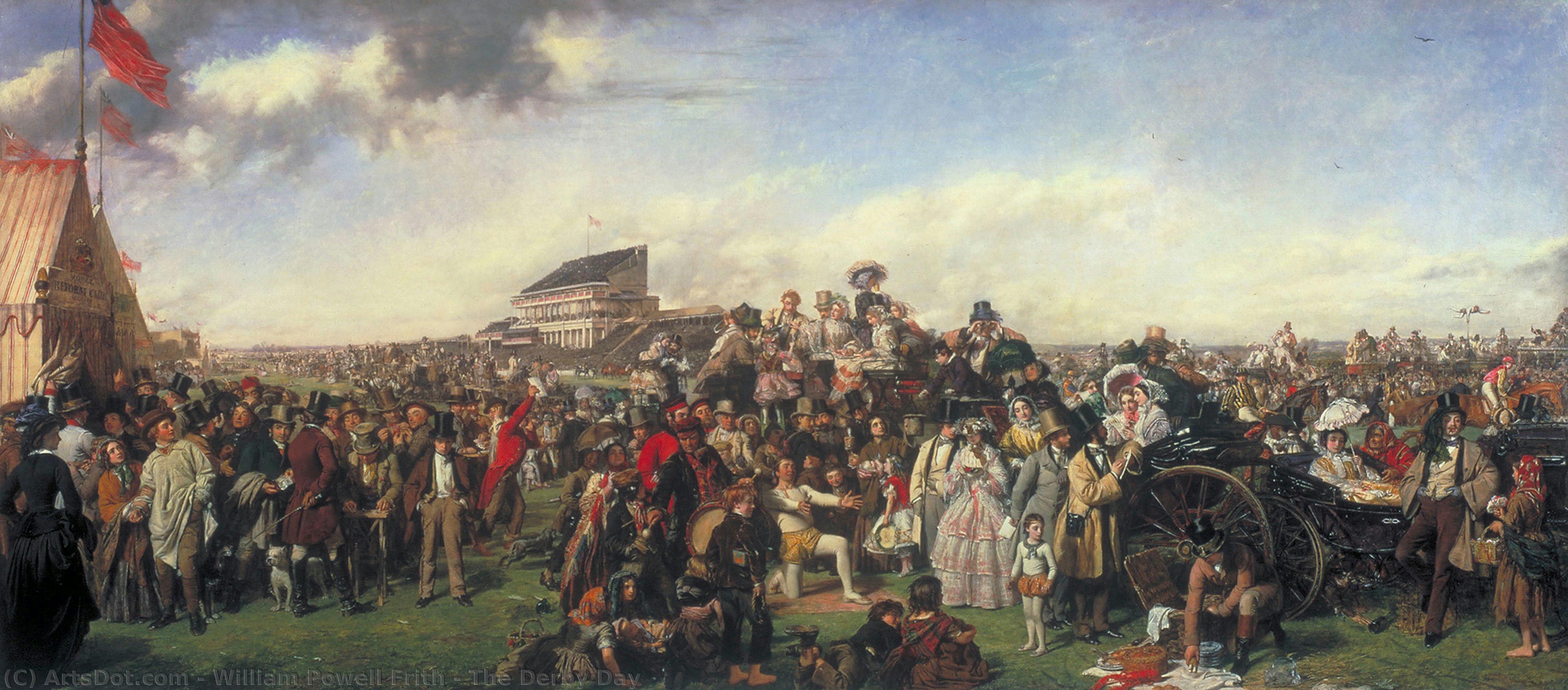
William Powell Frith's “The Derby Day,” painted in 1858, isn’t merely a depiction of a horse race; it’s a meticulously crafted panorama of Victorian society at its most vibrant and, frankly, its most stratified. Exhibited to immediate acclaim at the Royal Academy, this large oil painting captures a single afternoon – a fleeting moment frozen in time – yet offers an astonishingly detailed window into the lives, aspirations, and social dynamics of 19th-century Londoners. Frith, a master of genre scenes, eschewed the traditional portraiture that dominated his early career to become renowned for his ability to distill complex social realities onto canvas with remarkable immediacy and psychological insight.
The painting’s scale – measuring an impressive 40 inches by 88 centimeters – immediately commands attention. Frith employs a technique reminiscent of Sir David Wilkie, whose earlier domestic scenes had profoundly influenced the artist's approach to capturing movement and atmosphere. However, unlike Wilkie’s idealized depictions, Frith doesn’t shy away from portraying the less glamorous aspects of Victorian life. The scene unfolds with a remarkable energy, teeming with figures engaged in a multitude of activities – gambling, socializing, observing the race, and, crucially, exploiting each other. The artist's use of light is particularly masterful, bathing the foreground in a warm glow while subtly receding into cooler tones to create depth and a sense of bustling activity.
A Mosaic of Victorian Life
“The Derby Day” isn’t organized around a single narrative; instead, it presents a carefully constructed mosaic of social classes and behaviors. On the left, we encounter the “thimble-rigger,” a figure representing the impoverished working class, attempting to cheat wealthy gentlemen at a gambling table. This scene immediately establishes the painting's central theme: the stark contrast between wealth and poverty that defined Victorian society. Nearby, an acrobat and his son, gazing longingly at a lavish picnic spread for a well-to-do family, embodies the yearning for social mobility – a common motif in Frith’s work.
The central figures—a gentleman leaning against a carriage, a young woman with a flirtatious air, and a prostitute offering flowers—represent the upper echelons of society. Frith's meticulous attention to detail extends even to the smallest elements: the elaborate carriages, the fashionable attire, the expressions on the faces of the spectators. He deliberately includes figures from all walks of life – beggars, musicians, street vendors, and thieves – creating a truly representative portrait of Victorian London.
Symbolism and Social Commentary
Beyond its immediate visual appeal, “The Derby Day” is laden with symbolism. The thimble-rigger’s activities represent the pervasive corruption and dishonesty that plagued Victorian society. The acrobat's wistful gaze speaks to the limitations imposed by social class. The presence of the prostitute highlights the exploitation inherent in a system driven by wealth and power. Frith, deeply influenced by the moralistic tradition of Hogarth, used his art as a vehicle for social commentary, exposing the inequalities and vices of his time.
The inclusion of the Reform Club’s tent is particularly significant. The Reform Club was a bastion of liberal thought and reform movements, yet even within this supposedly progressive institution, corruption and self-interest were rampant. Frith subtly critiques the hypocrisy of Victorian society by juxtaposing the ideals of reform with the realities of greed and exploitation.
A Masterpiece of Victorian Narrative
“The Derby Day” remains a powerful testament to William Powell Frith’s artistic skill and his keen observation of human nature. It's more than just a painting of a horse race; it’s a vibrant, complex, and ultimately unsettling portrait of Victorian society – a world brimming with both opportunity and injustice. Reproductions of this iconic work continue to captivate viewers today, offering a rare glimpse into the lives and aspirations of those who lived and worked in London during one of its most transformative periods.
Related Artworks

Artist Biography
Early Life and Training
- Born: January 9, 1819, Aldfield, near Ripon, North Yorkshire, England
- Died: November 2, 1909, London
- William Powell Frith’s father was a hotelier in Harrogate.
- He initially intended to be an auctioneer but his father recognized his artistic talent.
- Frith studied at Sass's Academy in Charlotte Street, London and later attended the Royal Academy Schools.
- Early career focused on portrait painting and literary subjects (Shakespeare, Scott).
Career Highlights and Artistic Style
- Membership: Member of The Clique, a group of artists including Richard Dadd, Augustus Egg, Henry O’Neil, John Phillip, Edward Ward, and Thomas Creswick.
- Influences: Heavily influenced by Sir David Wilkie's domestic subjects.
- Genre Painting & Panoramic Narrative: Frith became renowned for his detailed genre scenes and panoramic narrative works depicting Victorian life in public places.
- Notable Works:
- Ramsgate Sands (1854): Depicts a lively scene at the seaside resort of Ramsgate.
- The Derby Day (1858): Captures the atmosphere and social interactions at Epsom Downs Racecourse. This painting was incredibly popular, requiring railings to manage crowds viewing it.
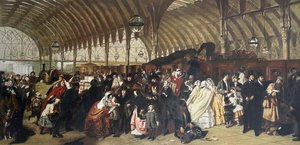
- The Railway Station (1862): A detailed depiction of Paddington Station.
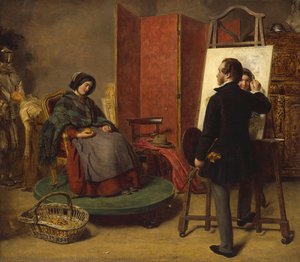
- The Sleeping Model (1853): Presented as his Diploma work at the Royal Academy.
- The Crossing Sweeper (1858): Explores the contrast between wealth and poverty in London.
- Photographic Influence: Frith utilized photographic studies by Robert Howlett to achieve remarkable detail and accuracy in his paintings, particularly in works like The Derby Day.
- Style: Characterized by meticulous observation, a large number of figures, and a focus on capturing the details of everyday life. He was known for his realism and attention to social commentary within his scenes.
Development and Later Years
- Autobiographies: Frith wrote two autobiographies, My Autobiography (1887) and Further Reminiscences (1888), providing insights into Victorian art and society.
- Artistic Views: He was a traditionalist and expressed his aversion to modern art developments.
- Royal Academician: Elected as a Royal Academician in 1853.
- Longevity: Frith lived a remarkably long life, witnessing significant changes in the art world during the Victorian era. He outlived many of his contemporaries from The Clique.
Historical Significance and Legacy
- Social Commentary: His paintings provided valuable documentation of Victorian society, capturing its social dynamics, fashion, and leisure activities.
- Popularity & Commercial Success: Frith was one of the most commercially successful artists of his time, with his works widely admired and sought after.
- Influence on Genre Painting: He significantly contributed to the development of genre painting in Britain, elevating it to a respected art form.
- Detailed Realism: His meticulous attention to detail set a standard for realism in Victorian art.
- Legacy: Frith’s paintings continue to be exhibited and studied, offering a unique window into 19th-century life and solidifying his place as a significant figure in British art history.
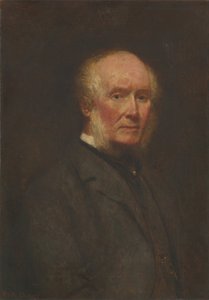
William Powell Frith
1819 - 1909 , United Kingdom
Quick Facts
- Artistic Movement Or Style: Genre painting, panoramic narrative
- Artists Who Influenced This Artist: ['Sir David Wilkie']
- Date Of Birth: January 19, 1819
- Date Of Death: November 9, 1909
- Full Name: William Powell Frith
- Nationality: English
- Notable Artworks:
- Ramsgate Sands (Life at the Seaside)
- The Derby Day
- The Railway Station
- The Sleeping Model
- The Crossing Sweeper
- Place Of Birth: Aldfield, United Kingdom
Related Articles
William Powell Frith: Narratives of Victorian Society & the Rise of Realist Painting
Explore the life & works of William Powell Frith, the 'greatest British painter of social scenes.' Discover his iconic Victorian genre paintings and learn about his lasting impact on realist art. Hand-painted reproductions available.
The Noble Steed on Canvas: A Historical & Artistic Exploration of Horse Painting Across Cultures
Explore the rich history of horse painting! Discover masterpieces from Stubbs to Munnings & learn about symbolism, techniques & artists. Find museum-quality reproductions at ArtsDot.
The Equine Muse: A Historical & Artistic Exploration of Horses in Painting
Explore the captivating history of horses in painting! Discover Renaissance masterpieces, Baroque grandeur & expert insights for collecting equestrian art. Learn about symbolism, techniques & lasting value with ArtsDot.
The Noble Steed: A Historical and Artistic Exploration of Horses in Fine Art
Explore the rich history of horses in fine art! From ancient depictions to Renaissance masterpieces & beyond, discover iconic artworks and artists. Learn about symbolism, techniques, and find museum-quality reproductions at ArtsDot.
John Frederick Herring Sr.: Equestrian Mastery & the Rise of Sporting Art in Victorian England
Explore the life & work of John Frederick Herring Sr., a leading Victorian equestrian artist. Discover his masterpieces, patronage, techniques & investment potential. Expert insights for collectors.