 Preview
 Send
Send Share
Share
 Details

 Download
 Similars
 X-Ray
X-Ray Diaporama
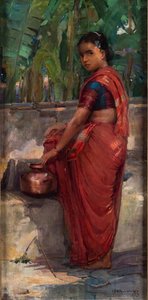
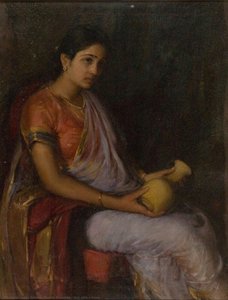
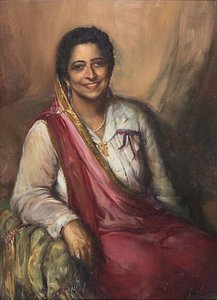
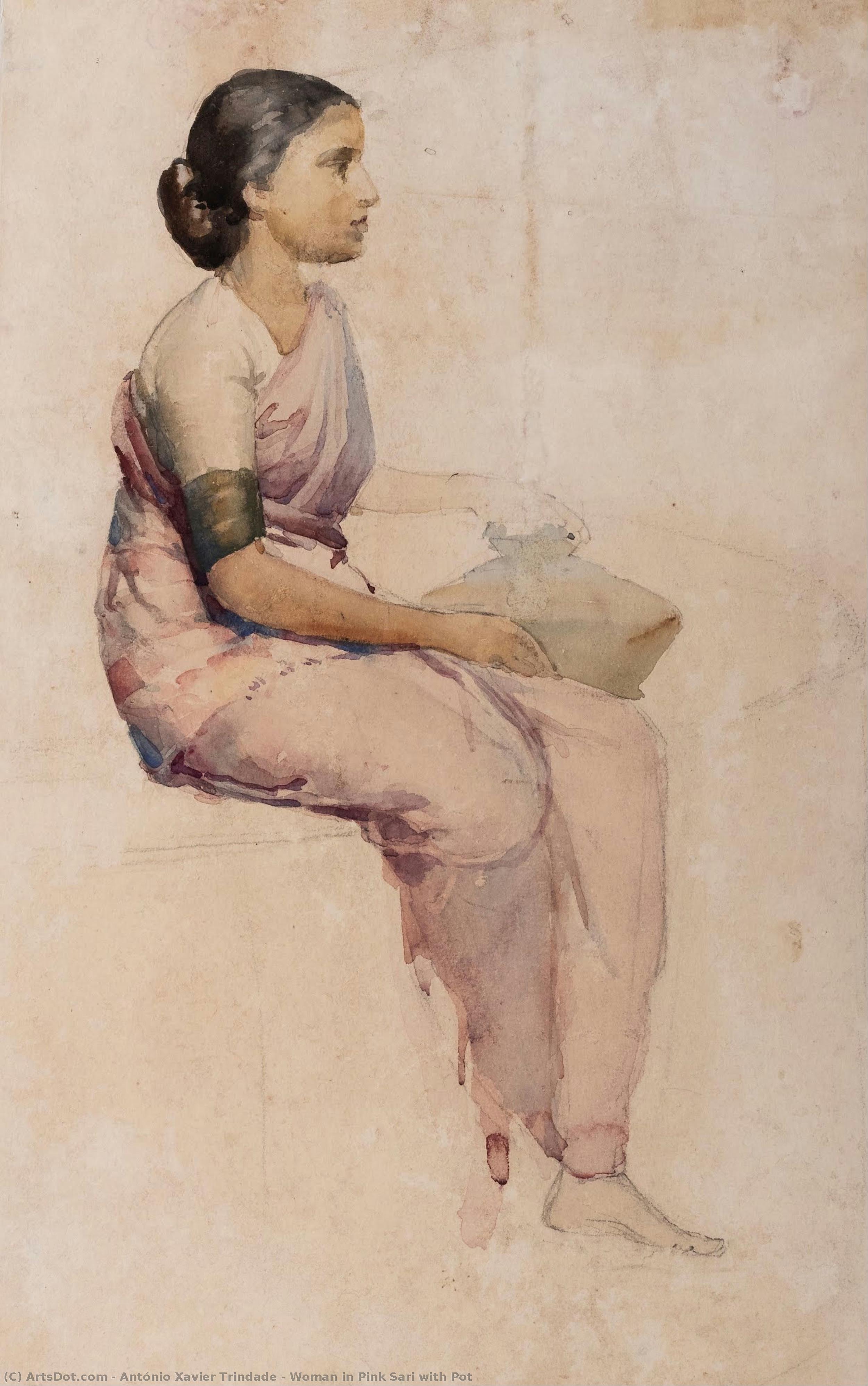
Woman in Pink Sari with Pot
 Acrylic On Canvas
- WallArt
- Bombay School
 1920
1920 60.0 x 45.0 cm
 Museu do Oriente
 Read More
Giclée / Art Print
Museum-quality giclée or canvas print with fast production and flexible finish options. ( Buy Hand Made Painting Buy Image)




P118B $10

P118H $10

P118W $10

P438Z $10

P508JH $12

P508YH $12

P805H $10

P805Z $10

P919BZ $10

P919G $10

P919XJ $10

P959ZH $10

P968JZ $12

W106C $8

W218G $10

W218JH $8

W218Y $10

W307PJ $10

W316G $10

W316PJ $8

W316Y $10

W398PJ $8

W4111J $10

W500HY $15

W500JH $15

W692G $12

W849H $8

W940BG $15

W953PJ $8




Pick from our preset sizes that match the artwork's original proportions.

You may enter your own dimensions to fit a specific frame or space. If your selected size does not match the original image's proportions, we will either crop the artwork or extend the image with a mirrored or solid-fill edge. A digital mockup will be sent for your approval before production begins.
Please note that the on-screen preview does not reflect the actual cropping or extension. Only the mockup will accurately show the final composition.
While custom sizes are available, we recommend selecting a dimension from the predefined list to preserve the original proportions.
Worldwide Delivery () in 2 weeks instead of standard 4/5 weeks. (26 August)

Free Worldwide Express Shipping

High-Quality Linen Canvas

Full Shipping Insurance

Customs Tax Refund Guarantee

True Color Matching Guarantee

60-Day Return Policy (Defects Only)

100% Money-Back Guarantee

Bulk Discount Offer
 Glass option is only available in size under 110 CM

Woman in Pink Sari with Pot
Giclée / Art Print
Reproduction Size
-


Total Price
$ 63
Collectible Description
A Portrait Steeped in Tradition: António Xavier Trindade’s “Woman in Pink Sari with Pot”
António Xavier Trindade stands as a singular figure within the panorama of Indian art history—a painter who transcended mere representation, forging instead a profound dialogue between Western academic rigor and an intrinsic understanding of Indian culture. Born in Sanguem, Goa, in 1870 to Catholic parents, his formative years amidst Portugal’s colonial dominion instilled in him a worldview that would permeate his artistic vision. This confluence of influences resulted in a distinctive style characterized by meticulous realism blended with lyrical sensitivity—a hallmark that earned him accolades like the Mayo Silver Medal for artistic merit in 1892 and cemented his legacy as “The Rembrandt of the East.”- Early Training & Influence: Trindade’s journey began at Sir Jamsetjee Jeejeebhoy School of Art in Bombay, where he immersed himself in European naturalism championed by the South Kensington system. This exposure honed his technical skills and instilled a disciplined approach to observation—a cornerstone of his subsequent oeuvre.
- Bombay School Style: Trindade’s artistic style epitomized the Bombay School, prioritizing detailed depictions of Indian subjects with an unwavering commitment to accuracy. He skillfully captured the nuances of human emotion alongside meticulous rendering of textures and colors, reflecting a humanist sensibility deeply rooted in Victorian ideals.
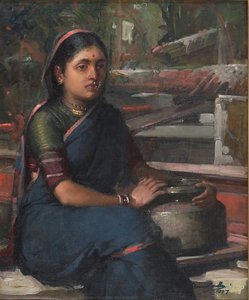
- Subject Matter & Symbolism: Recurring themes in Trindade’s paintings centered on portraits—often depicting Hindu women—and landscapes imbued with spiritual significance. Notably, “Woman in Pink Sari with Pot” exemplifies his fascination with capturing the essence of rural Indian life and conveying its inherent beauty. The pot itself serves as a potent symbol – representing fertility, prosperity, and the feminine role within Hindu tradition.
- Technique: Trindade employed oil on canvas—a technique favored by academic painters of his era—to achieve luminous color palettes and textural depth. His meticulous brushwork meticulously captures the subtleties of light and shadow, creating an immersive experience for the viewer.
- Color Palette & Composition: The painting’s dominant hue is a delicate pink—chosen deliberately to convey grace and femininity. Trindade skillfully arranges elements within the frame—particularly the woman's gaze directed off-camera—to guide the eye and heighten emotional impact.
Related Artworks

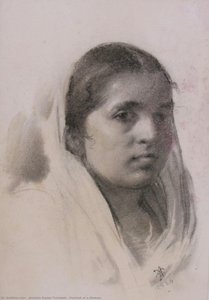
Artist Biography
A Life Etched in Light: The World of António Xavier Trindade
António Xavier Trindade, a name resonating with quiet power within the annals of Indian art history, was more than just a painter; he was a cultural bridge. Born in Sanguem, Goa, in 1870 to Catholic parents, his journey began amidst the lush landscapes and complex colonial tapestry of Portuguese India. This formative environment would indelibly shape his artistic vision, fostering a unique blend of Western academic training with an intrinsic understanding of Indian life and character. Trindade’s early promise led him to the prestigious Sir Jamsetjee Jeejeebhoy School of Art in Bombay, a pivotal institution that exposed him to European naturalism while simultaneously nurturing a growing generation of Indian artists. It was here, within those hallowed halls, that he honed his skills, mastering techniques that would later define his signature style and earn him accolades like the Mayo Silver Medal for artistic merit in 1892—a testament to his burgeoning talent.The Bombay School and a Rising Star
Trindade’s ascent within the Bombay art scene was swift and assured. Appointed as a teacher of drawing and painting at the Sir J.J. School of Art in 1898, he not only contributed to the education of future generations but also solidified his position as a leading figure in the burgeoning Bombay School. Later, assuming the role of Superintendent of the Reay Workshop of Art from 1914 to 1926, he further influenced artistic production and pedagogy. However, it wasn’t merely institutional recognition that marked his success; it was the captivating quality of his work itself. While initially embracing traditional portraiture and landscapes, Trindade gradually developed a style characterized by its realism, sensitivity to light, and an ability to capture the psychological depth of his subjects. He became known for portraying Indian women with a dignity and intimacy rarely seen in colonial-era art, offering glimpses into their lives beyond the confines of societal expectations. This earned him the affectionate title “Rembrandt of the East,” acknowledging both his technical mastery and his profound understanding of human emotion.Themes and Techniques: A Synthesis of Worlds
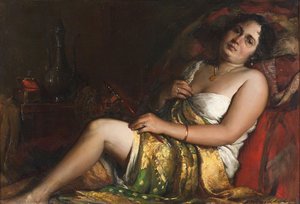
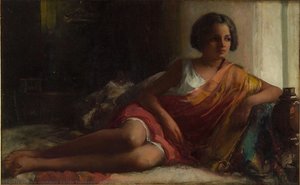
The 1920s witnessed a maturation in Trindade’s artistic expression, marked by an increasing focus on portraits, landscapes, and still lifes. His canvases became windows into the lives of his contemporaries—wealthy patrons, family members, and everyday individuals—each rendered with meticulous detail and a subtle yet powerful emotional resonance. Dolce Far Niente (Flora or Mother Reclining), awarded the Bombay Art Society’s gold medal in 1920, exemplifies this period; it is not merely a depiction of a woman at rest but an exploration of motherhood, serenity, and the quiet beauty of domestic life. Similarly, New Year’s Song (1928) and Hindu Girl (1930), recipients of the Governor’s prize, showcase his ability to capture cultural nuances and individual personalities with remarkable sensitivity. Trindade's technique was rooted in Western academic principles—a mastery of chiaroscuro, precise draftsmanship, and a sophisticated understanding of color theory—but he infused these elements with an Indian sensibility, creating a unique visual language that transcended stylistic boundaries. He wasn’t simply replicating what he had learned; he was transforming it, imbuing it with the spirit of his homeland.Legacy and Enduring Influence
Despite facing personal challenges—including declining health and eventual blindness in later life—Trindade continued to paint, supported by his daughter Ângela Trindade, herself a talented artist who carried on her father’s legacy. His work gained further recognition with an exhibition at the Festival of the Empire in Wembley, London, in 1934, bringing his art to an international audience. Today, António Xavier Trindade's paintings are treasured possessions of museums and private collectors alike, most notably represented by a significant collection held at the Fundação Oriente in Goa. The permanent exhibitions established there—including a dedicated showcase celebrating his 150th birthday in 2021—ensure that his artistic vision continues to inspire and captivate audiences for generations to come. His influence extends beyond mere aesthetic appreciation; he represents a pivotal moment in Indian art history, a time when artists began to forge their own identities, blending tradition with modernity and challenging the prevailing colonial gaze. Trindade’s life and work stand as a testament to the power of artistic expression to transcend cultural boundaries and illuminate the shared human experience.Notable Works
- Dolce Far Niente (Flora or Mother Reclining) – Bombay Art Society Gold Medal, 1920.
- New Year’s Song – Governor’s Prize, 1928.
- Hindu Girl – Governor’s Prize, 1930.
- Girl with a Vase - National Gallery of Modern Art, New Delhi.
- Self-portrait in Green- Fundação Oriente.
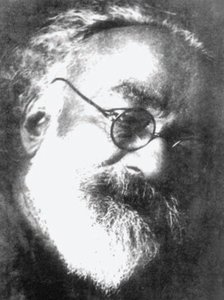
António Xavier Trindade
1870 - 1935 , India
Quick Facts
- Artistic Movement Or Style: Bombay School, Realism
- Date Of Birth: 1870
- Date Of Death: 1935
- Full Name: António Xavier Trindade
- Nationality: Portuguese
- Notable Artworks:
- Dolce Far Niente
- New Year’s Song
- Hindu Girl
- Girl with a vase
- Place Of Birth: Sanquém, India
Related Articles
Raja Ravi Varma: Bridging Tradition & Modernity in 19th-Century Indian Art
Explore the life & art of Raja Ravi Varma, a pioneer who fused European techniques with Indian iconography. Discover his iconic paintings, lasting legacy, and influence on modern Indian art at ArtsDot.
The Enduring Legacy of Formal Portraiture: Power, Identity & Artistic Exploration
Explore the rich history of formal portraiture & its enduring power to capture identity and shape perception. Discover investment-worthy artworks, expert appraisals, and custom reproduction services at ArtsDot.
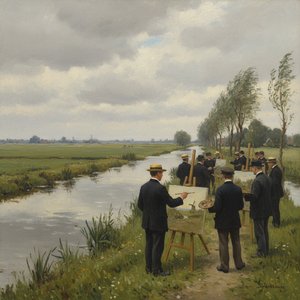
The Hague School: Realism, Atmosphere & the Dawn of Dutch Impressionism
Explore the Hague School's pivotal role in Dutch art history. Discover realism, atmospheric landscapes & its influence on Impressionism. Learn about key artists like Mauve & Maris with ArtsDot.
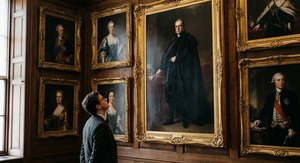
The Grandeur of Presence: Exploring Representations of Stately Bearing in Western Portraiture
Explore the art of stately bearing in Western portraiture with expert analysis of Renaissance & Baroque masterpieces. Discover symbolism, techniques, and the legacy of iconic portraits – a guide for discerning collectors.
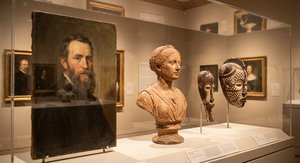
The Enduring Gaze: A Historical & Artistic Exploration of Portraiture Across Cultures
Explore the rich history of portraiture with ArtsDot.com! Discover symbolism, techniques & master artists from antiquity to modern times. Expert insights for art collectors.