 Preview
 Send
Send Share
Share
 Details

 Download
 Similars
 X-Ray
X-Ray Diaporama
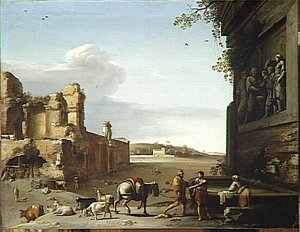
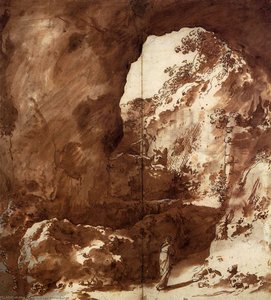
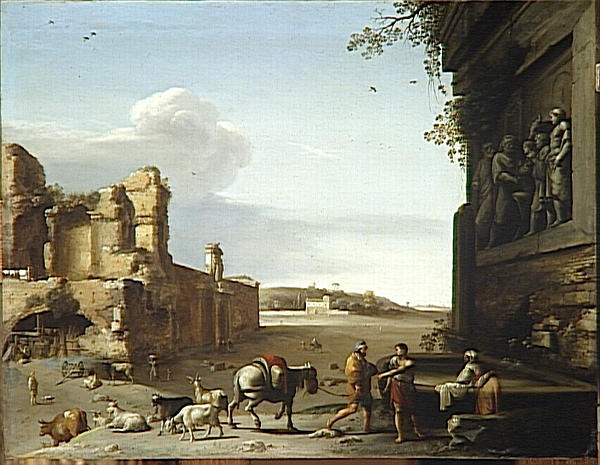
RUINES DE L'ANCIENNE ROME AVEC UN BAS RELIEF ANTIQUE


 Read More
Hand Made Oil Reproduction
Hand-painted oil on canvas in your size and frame, made to order by our artists. ( Buy Print Buy Image)




P118B $10

P118H $10

P118W $10

P438Z $10

P508JH $12

P508YH $12

P805H $10

P805Z $10

P919BZ $10

P919G $10

P919XJ $10

P959ZH $10

P968JZ $12

W106C $8

W218G $10

W218JH $8

W218Y $10

W307PJ $10

W316G $10

W316PJ $8

W316Y $10

W398PJ $8

W4111J $10

W500HY $15

W500JH $15

W692G $12

W849H $8

W940BG $15

W953PJ $8




Pick from our preset sizes that match the artwork's original proportions.

You may enter your own dimensions to fit a specific frame or space. If your selected size does not match the original image's proportions, we will either crop the artwork or extend the painting with additional hand-painted elements. A digital mockup will be sent for your approval before production begins.
Please note that the on-screen preview does not reflect the actual cropping or extension. Only the mockup will accurately show the final composition.
While custom sizes are available, we recommend selecting a dimension from the predefined list to preserve the original proportions.
After order, ArtsDot.com team will email client for instructions and provide a mockup preview
Worldwide Delivery () in 3/4 weeks instead of standard 5 weeks. (16 August). No compromise on quality.

Free Worldwide Express Shipping

High-Quality Linen Canvas

Full Shipping Insurance

Customs Tax Refund Guarantee

True Color Matching Guarantee

60-Day Return Policy (Defects Only)

100% Money-Back Guarantee

Bulk Discount Offer
 Glass option is only available in size under 110 CM

RUINES DE L'ANCIENNE ROME AVEC UN BAS RELIEF ANTIQUE
Reproduction Medium
Reproduction Size
-


Total Price
$ 363
Artwork Description
A Ruined Majesty: Cornelis van Poelenburch’s “Ruines de l'Ancienne Rome avec un bas relief antique”
Cornelis van Poelenburch’s “Ruines de l’Ancienne Rome avec un bas relief antique” isn’t merely a landscape painting; it’s a poignant meditation on time, memory, and the enduring allure of vanished grandeur. Completed around 1630, this oil-on-copper masterpiece transports us to the heart of ancient Rome, not as a vibrant metropolis but as a hauntingly beautiful ruin – a testament to both human ambition and inevitable decay. The painting’s power lies in its ability to evoke a profound sense of melancholy and contemplation, inviting viewers to consider their own place within the vast sweep of history.
Van Poelenburch, a pivotal figure in the Utrecht school of landscape painting, was deeply influenced by his time spent in Rome. He absorbed the classical ideals of beauty and proportion while simultaneously embracing the dramatic contrasts of light and shadow championed by Caravaggio. This dual influence is strikingly evident here; the composition echoes the balanced arrangements favored by Renaissance masters, yet the use of tenebrism – a hallmark of Caravaggist style – imbues the scene with an intense emotional charge. The muted palette, dominated by earthy browns, ochres, and subtle blues, creates a sense of atmospheric depth, drawing the eye into the receding landscape.
Composition and Perspective: A Journey Through Time
The painting’s composition is meticulously crafted to guide the viewer's gaze across the scene. The foreground is dominated by imposing Roman ruins – crumbling columns, fragmented walls, and weathered arches – that immediately establish a sense of scale and antiquity. These monumental structures are strategically placed to create a strong diagonal line, leading the eye towards the distant horizon where a hazy, atmospheric perspective suggests an endless expanse of countryside. The artist masterfully employs linear perspective, subtly converging lines to create the illusion of depth and distance, while simultaneously utilizing aerial perspective – softening colors and reducing detail in the background – to further enhance this effect.
Scattered throughout the landscape are figures—a small group of people and animals—adding a layer of narrative complexity. These figures, rendered with a delicate realism characteristic of van Poelenburch’s style, appear almost as if they are caught in a timeless moment, interacting with the ruins as if they were part of their daily lives. The inclusion of these human elements serves to remind us that even amidst the decay of civilization, life continues on.
Symbolism and Emotional Resonance
The ruins themselves are potent symbols – representing not just the physical decline of Rome but also the transience of power, wealth, and glory. They speak to the cyclical nature of history, suggesting that all empires eventually crumble, leaving behind only fragments of their former selves. Yet, within this sense of loss lies a strange beauty; the weathered stones possess an undeniable dignity, as if they are silently bearing witness to centuries of human drama.
The presence of animals – likely sheep and goats – further reinforces the painting’s themes of pastoral simplicity and connection with nature. They represent a return to a more primal existence, contrasting sharply with the artificiality and ambition of the Roman Empire. The overall effect is one of poignant beauty—a bittersweet reminder of the past and an invitation to contemplate our own mortality.
Technique and Materials: A Master’s Touch
Van Poelenburch's skill as a painter is evident in every brushstroke. He employs a traditional oil painting technique, layering thin glazes of paint to build up form and texture with remarkable precision. The surface of the copper panel—a material favored by Dutch artists at the time—adds a subtle sheen that enhances the richness of the colors. Close examination reveals the artist’s meticulous attention to detail – from the rough texture of the stone to the delicate folds of the clothing worn by the figures. The use of impasto, particularly in rendering the relief sculpture, adds a tactile quality to the painting, inviting viewers to reach out and touch its weathered surface.
This artwork is a remarkable example of Dutch Golden Age landscape painting, seamlessly blending classical influences with a distinctly personal vision. “Ruines de l’Ancienne Rome avec un bas relief antique” remains a captivating work of art, offering a timeless meditation on the beauty and fragility of human existence.
Related Artworks
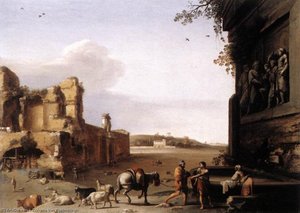
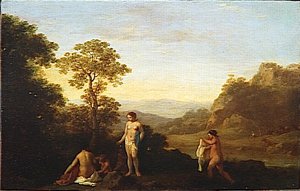
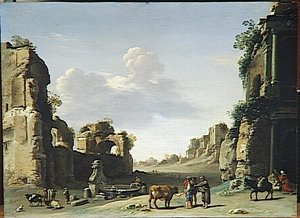
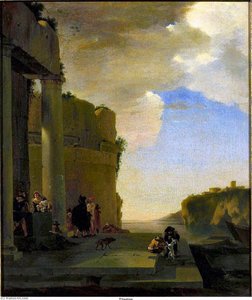
Artist Biography
early life and training
cornelis van poelenburgh, a prominent dutch landscape painter, was born in utrecht, netherlands in 1594. he initially trained with abraham bloemaert, a renowned artist of the time. this foundational training laid the groundwork for van poelenburch's future success.artistic career and influences
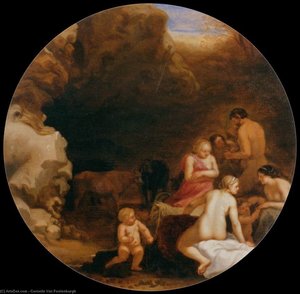
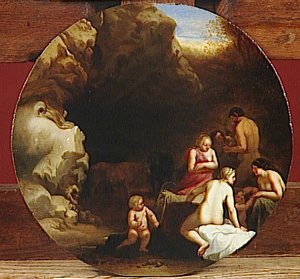
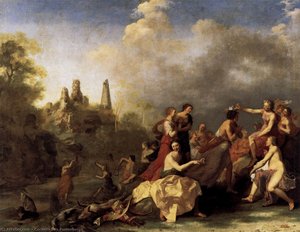
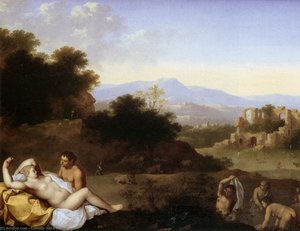
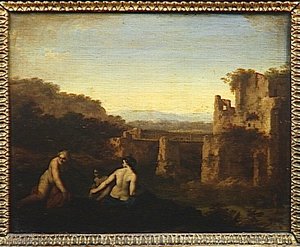
van poelenburch's travels to rome in the early 17th century significantly influenced his work, making him a leading representative of the first generation of dutch landscape painters active in italy. his small-scale paintings, often featuring italianate landscapes with small figures enacting biblical or mythological scenes, showcased his unique style. notable works:- satyrs spying on nymphs (after 1627), a characteristic example of van poelenburch's work, featuring archaic landscapes with figures bathing. (view on ArtsDot)
- council of the gods (c. 1630), a painting showcasing van poelenburch's idealized hilly landscape and roman-inspired goddesses, now housed in the mauritshuis (the hague, netherlands). (view on ArtsDot)
legacy and later life
van poelenburch's work was highly regarded by his contemporaries, including the grand duke of tuscany and the dutch stadholder. he later returned to utrecht, where he passed away in 1667, just a few years after his old teacher abraham bloemaert. key points:- born in utrecht, netherlands in 1594
- trained with abraham bloemaert
- influenced by his time in rome
- known for small-scale italianate landscapes with figures
- died in utrecht in 1667 view cornelis van poelenburch's artworks on ArtsDot learn more about cornelis van poelenburgh on wikipedia
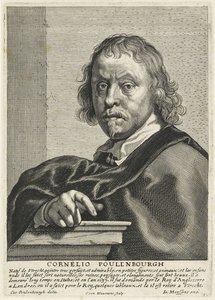
cornelis van poelenburch
1594 - 1667 , Netherlands
Quick Facts
- Artistic Movement Or Style: Dutch Landscape, Romanate
- Artists Or Movements Influenced By This Artist: ['Claude Lorraine']
- Artists Who Influenced This Artist: ['Abraham Bloemaert']
- Date Of Birth: 1594, Utrecht, Netherlands
- Date Of Death: 1667, Utrecht, Netherlands
- Full Name: Cornelis van Poelenburgh
- Nationality: Dutch
- Notable Artworks:
- Satyrs spying on nymphs
- Council of the gods
- Place Of Birth: Utrecht, Netherlands
Related Articles
Van Gogh's Masterpieces: Explore 25 Iconic Paintings & Art for Your Home
Journey through Vincent van Gogh's 25 most iconic paintings! Explore 'Starry Night', 'Sunflowers,' and more—discover the stories, techniques & emotions behind these Post-Impressionist masterpieces. Find museum-quality art reproductions for your home at ArtsDot.com.
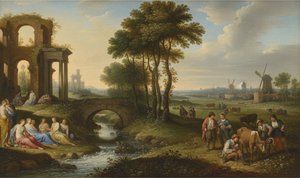
Cornelis van Poelenburch: Bridging Mannerism & the Dutch Baroque Landscape
Discover Cornelis van Poelenburch, a pivotal Dutch Baroque landscape painter bridging Mannerism & Italianate styles. Explore his life, key works, and lasting influence on 17th-century art with ArtsDot.
Jan van Goyen: Master of Dutch Landscape & Atmospheric Perspective
Discover Jan van Goyen, the master of Dutch landscape painting. Explore his subtle technique, atmospheric realism & lasting influence on art history. Learn about this 17th-century pioneer at ArtsDot.

Rembrandt's Masterpieces: Explore 25 Iconic Paintings & Prints | ArtsDot
Journey through Rembrandt van Rijn's 25 most iconic paintings & etchings. Explore Dutch Golden Age masterpieces, dramatic chiaroscuro, and timeless portraits. Find museum-quality art reproductions to elevate your home decor on ArtsDot.com.

Beyond the Horizon: 10 Landscape Masterpieces for Your Home Decor
Journey through 10 breathtaking landscape paintings by Monet, Van Gogh & more! Explore iconic artworks, artistic techniques & find inspiration for your home decor. Museum-quality reproductions at ArtsDot.com. Discover all masterpieces on ArtsDot.com