 Preview
 Send
Send Share
Share
 Details

 Download
 Similars
 X-Ray
X-Ray Diaporama
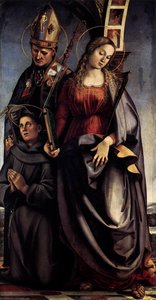
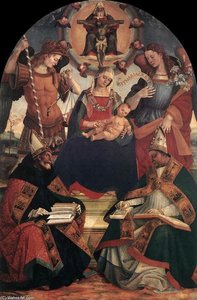
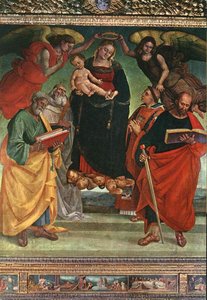
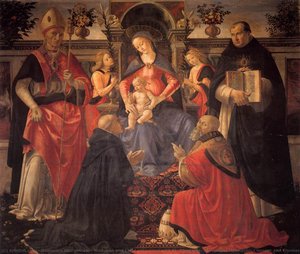
The Trinity, the Virgin and Two Saints
 Oil
Oil- WallArt
- High Renaissance
 1510
1510 272.0 x 180.0 cm
 Galleria degli Uffizi
 Read More
Hand Made Oil Reproduction
Hand-painted oil on canvas in your size and frame, made to order by our artists. ( Buy Print Buy Image)




P118B $10

P118H $10

P118W $10

P438Z $10

P508JH $12

P508YH $12

P805H $10

P805Z $10

P919BZ $10

P919G $10

P919XJ $10

P959ZH $10

P968JZ $12

W106C $8

W218G $10

W218JH $8

W218Y $10

W307PJ $10

W316G $10

W316PJ $8

W316Y $10

W398PJ $8

W4111J $10

W500HY $15

W500JH $15

W692G $12

W849H $8

W940BG $15

W953PJ $8




Pick from our preset sizes that match the artwork's original proportions.

You may enter your own dimensions to fit a specific frame or space. If your selected size does not match the original image's proportions, we will either crop the artwork or extend the painting with additional hand-painted elements. A digital mockup will be sent for your approval before production begins.
Please note that the on-screen preview does not reflect the actual cropping or extension. Only the mockup will accurately show the final composition.
While custom sizes are available, we recommend selecting a dimension from the predefined list to preserve the original proportions.
After order, ArtsDot.com team will email client for instructions and provide a mockup preview
Worldwide Delivery () in 3/4 weeks instead of standard 5 weeks. (16 August). No compromise on quality.

Free Worldwide Express Shipping

High-Quality Linen Canvas

Full Shipping Insurance

Customs Tax Refund Guarantee

True Color Matching Guarantee

60-Day Return Policy (Defects Only)

100% Money-Back Guarantee

Bulk Discount Offer
 Glass option is only available in size under 110 CM

The Trinity, the Virgin and Two Saints
Reproduction Medium
Reproduction Size
-


Total Price
$ 263
Artwork Description
Luca Signorelli’s Divine Embrace: A Study in Florentine High Renaissance
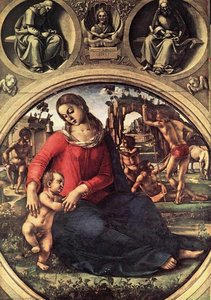
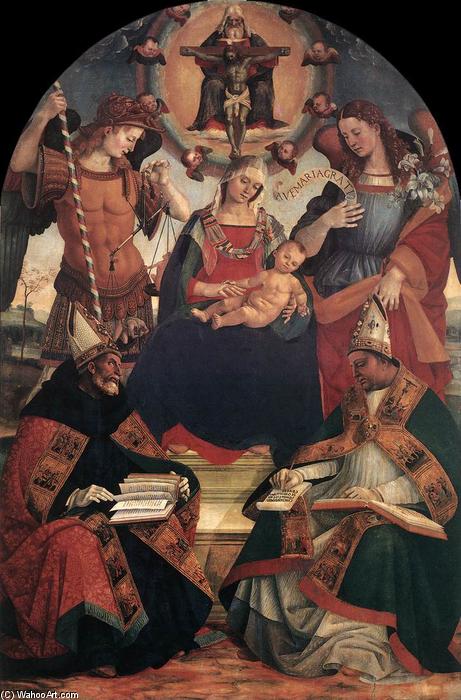
Luca Signorelli's “The Trinity, the Virgin and Two Saints,” painted around 1510, is more than just a religious depiction; it’s a profound meditation on faith, grace, and the intricate relationships within the Christian narrative. Born in Cortona, Italy, in 1450, Signorelli was a master of draftsmanship and foreshortening – techniques he employed here to create an astonishingly dynamic and deeply layered composition. The painting immediately draws the eye to the central figure: the Virgin Mary, rendered with a serene dignity that speaks volumes about her role as both mother and mediator between humanity and divinity. Her pose is deliberately balanced, reflecting the harmonious order of the universe she embodies, while the subtle folds of her garments hint at the earthly reality from which she emerges.
The scene unfolds within a carefully constructed architectural space, reminiscent of Florentine High Renaissance ideals. The backdrop isn’t merely decorative; it establishes a sense of depth and perspective, guiding the viewer's eye through the complex arrangement of figures. Notice the deliberate use of light – a soft, diffused illumination that highlights key elements while leaving others in shadow, creating an atmosphere of contemplative solemnity. Signorelli wasn’t simply illustrating a biblical story; he was crafting a visual theology, inviting viewers to contemplate the mysteries of faith and salvation.
The Trinity: A Symbol of Divine Unity
At the heart of the composition lies the depiction of the Holy Trinity – Father, Son, and Holy Spirit. Signorelli masterfully avoids overt symbolism, instead conveying this complex theological concept through a carefully orchestrated visual dialogue. The central figure, often interpreted as Christ, is flanked by the Archangels Michael and Gabriel, representing divine judgment and grace respectively. The arrangement isn’t haphazard; it's meticulously planned to create a sense of balance and harmony, reflecting the fundamental unity of God. The subtle gestures and expressions of these figures – Michael’s outstretched hand and Gabriel’s serene countenance – communicate profound spiritual truths without resorting to explicit iconography.
The inclusion of Saint Augustine and Saint Athanasius adds another layer of intellectual depth to the scene. These prominent theologians, representing reason and faith, underscore the importance of both intellect and spirituality in understanding God's will. Their placement alongside the central figures highlights the interconnectedness of divine revelation and human understanding.
Technique and Artistic Innovation
Signorelli’s technical skill is immediately apparent in the painting’s remarkably detailed rendering. He employed a technique known as *sfumato*, subtly blurring lines and edges to create an atmospheric effect, particularly noticeable in the drapery and the background architecture. This creates a sense of softness and depth, drawing the viewer into the scene. His mastery of foreshortening is equally impressive – evidenced by the figures on the left side of the painting, which appear to recede dramatically into space, creating a powerful illusion of three-dimensionality.
The color palette is restrained yet sophisticated, dominated by earthy tones—ochres, browns, and deep blues—that evoke a sense of solemnity and reverence. However, Signorelli also incorporates touches of vibrant color – particularly in the robes of the saints – to draw attention to key figures and enhance the overall visual impact. The painting’s surface is rich with texture, achieved through meticulous layering of paint and subtle variations in brushstroke.
A Legacy of Renaissance Beauty
“The Trinity, the Virgin and Two Saints” stands as a testament to Luca Signorelli's artistic genius and his deep understanding of religious iconography. It’s a painting that rewards careful study, revealing new layers of meaning with each viewing. The work was originally commissioned for pilgrims in Cortona, reflecting the artist’s connection to his community and his desire to inspire faith and devotion. Today, it resides in the Uffizi Gallery in Florence, where it continues to captivate viewers with its beauty, complexity, and profound spiritual message. A high-quality reproduction offers a remarkable opportunity to experience this masterpiece firsthand, bringing its timeless elegance and intellectual depth into your home or studio.
Related Artworks
Artist Biography
early life and training
lucca signorelli, an italian renaissance painter, was born in cortona, tuscany, around 1450. his birthdate is uncertain, but it is believed to be between 1441 and 1445. he was known for his exceptional skill as a draftsman and his use of foreshortening.artistic career
signorelli's first impressions of art seem to have originated in perugia, where he was influenced by the styles of artists such as benedetto bonfigli,notable works
* the last judgment (1499-1503), orvieto cathedral - considered his masterpiece, this massive fresco showcases signorelli's skill in depicting the apocalypse and the last judgment. * the polyptych of st. medard (1507), museum san medardo, arcevia, italy - a prime example of signorelli's work, featuring a highly detailed and naturalistic depiction of the human form.art movement
signorelli was part of the italian renaissance movement, which marked the transition between medieval and early modern europe. this period saw a renewed emphasis on classical traditions, naturalism, and humanism.- the early renaissance art movement - a brief introduction to the art movement that shaped the course of art history.
- fra angelico - the renowned artist who influenced signorelli's work and was known for his exceptional skill as a painter.
- luca signorelli - a brief biography of the artist, featuring his notable works and art movement.
legacy
signorelli's work had a significant impact on the development of renaissance art. his use of foreshortening and skill as a draftsman influenced many artists who followed in his footsteps. as a prominent figure in the italian renaissance, signorelli's legacy continues to be celebrated through his works, which can be found in various museums and cathedrals throughout italy. important dates: * 1450: born in cortona, tuscany * 1499-1503: created the last judgment, orvieto cathedral * 1523: passed away, leaving behind a legacy of exceptional art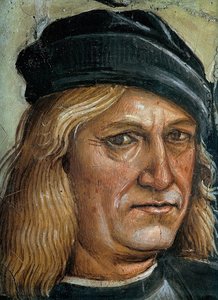
Luca Signorelli
1450 - 1523 , Italy
Quick Facts
- Artistic Movement Or Style: Renaissance
- Artists Or Movements Influenced By This Artist: ['Fra Angelico']
- Artists Who Influenced This Artist: ['Piero della Francesca']
- Date Of Death: 16 October 1523
- Full Name: Luca di Egidio di Ventura Signorelli
- Nationality: Italian
- Notable Artworks:
- The Last Judgment
- School of Pan
- Place Of Birth: Cortona, Italy
Related Articles

Fra Angelico's Masterpieces: 25 Renaissance Paintings for Your Home | ArtsDot
Explore 25 breathtaking masterpieces by Fra Angelico, a Renaissance master. Discover the stories behind his iconic frescoes, Annunciations & religious art. Find museum-quality reproductions and elevate your home decor with ArtsDot.com.
Luca Signorelli: Renaissance Innovation & Dramatic Foreshadowing of Modern Artistic Expression
Explore the revolutionary art of Luca Signorelli, a High Renaissance master renowned for his dramatic frescoes & anatomical precision. Discover his lasting impact on art history and techniques like foreshortening.
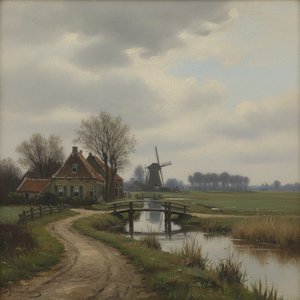
Jacob Henricus Maris: A Master of Dutch Atmospheric Realism & the Intimate Landscape
Explore the captivating world of Jacob Henricus Maris, a leading figure of the Dutch Hague School. Discover his atmospheric landscapes, signature brushstrokes & lasting influence on 19th-century art. Learn more at ArtsDot.

Mary Vaux Walcott: Botanical Precision & Artistic Vision in American Conservation
Discover the exquisite botanical watercolors of Mary Vaux Walcott, celebrated as the 'Audubon of Botany.' Explore her life, art, and lasting impact on American conservation through detailed illustrations & Smithsonian contributions.

Uffizi's 25 Masterpieces: Renaissance Art & Timeless Decor Inspiration
Journey through the Uffizi Gallery's 25 most iconic Renaissance artworks! Explore Botticelli, Leonardo da Vinci & Michelangelo’s masterpieces. Find museum-quality art reproductions and curated decor ideas to bring timeless Italian beauty into your home. Discover all masterpieces on ArtsDot.com