 Preview
 Send
Send Share
Share
 Details

 Download
 Similars
 X-Ray
X-Ray Diaporama
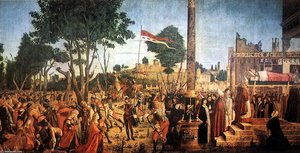
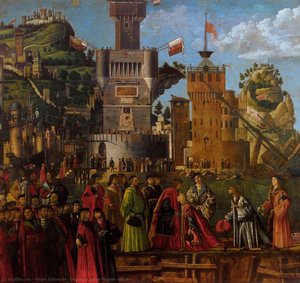
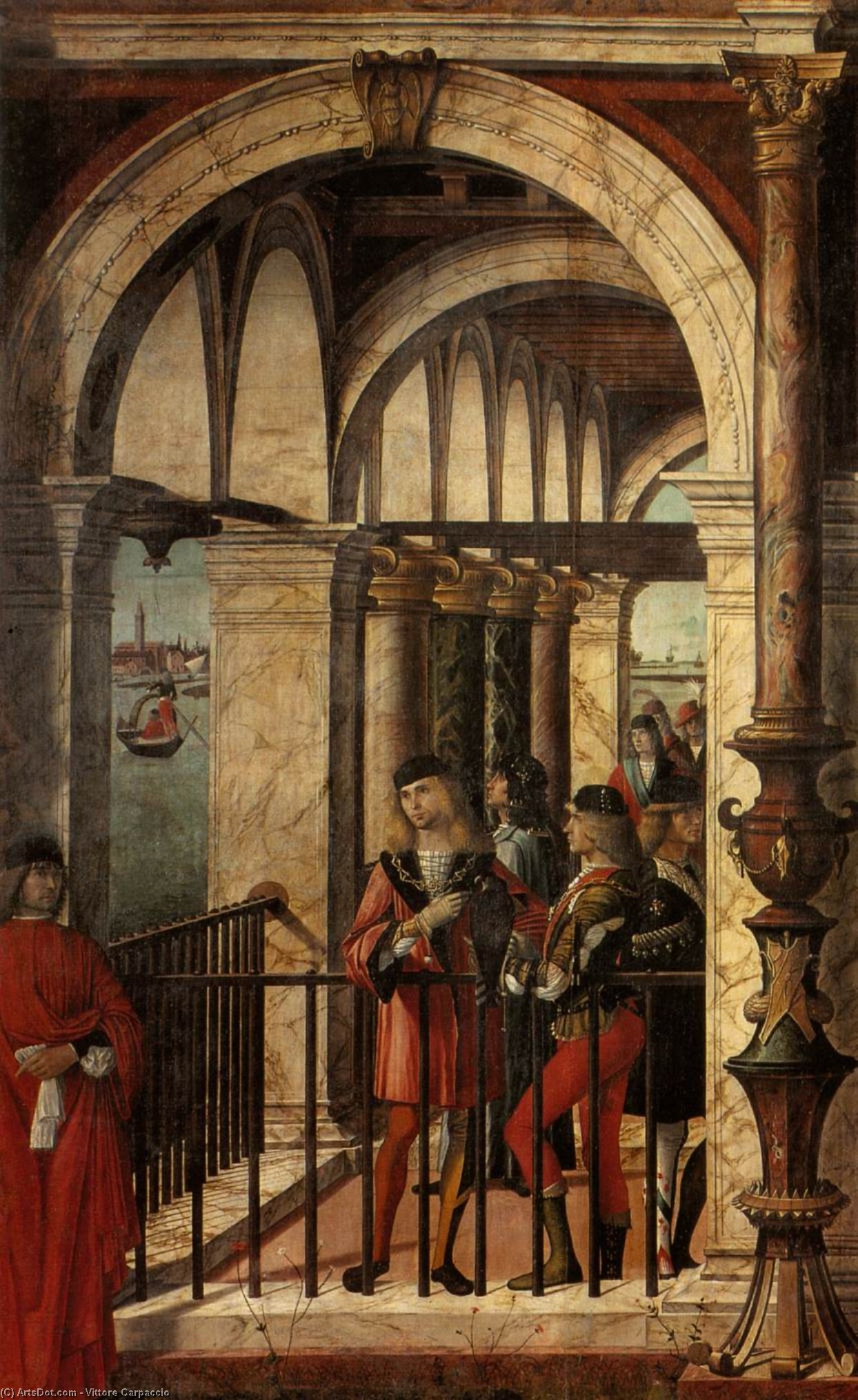
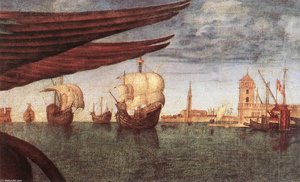
Arrival of the English Ambassadors (detail)


 Read More
Hand Made Oil Reproduction
Hand-painted oil on canvas in your size and frame, made to order by our artists. ( Buy Print Buy Image)




P118B $10

P118H $10

P118W $10

P438Z $10

P508JH $12

P508YH $12

P805H $10

P805Z $10

P919BZ $10

P919G $10

P919XJ $10

P959ZH $10

P968JZ $12

W106C $8

W218G $10

W218JH $8

W218Y $10

W307PJ $10

W316G $10

W316PJ $8

W316Y $10

W398PJ $8

W4111J $10

W500HY $15

W500JH $15

W692G $12

W849H $8

W940BG $15

W953PJ $8




Pick from our preset sizes that match the artwork's original proportions.

You may enter your own dimensions to fit a specific frame or space. If your selected size does not match the original image's proportions, we will either crop the artwork or extend the painting with additional hand-painted elements. A digital mockup will be sent for your approval before production begins.
Please note that the on-screen preview does not reflect the actual cropping or extension. Only the mockup will accurately show the final composition.
While custom sizes are available, we recommend selecting a dimension from the predefined list to preserve the original proportions.
After order, ArtsDot.com team will email client for instructions and provide a mockup preview
Worldwide Delivery () in 3/4 weeks instead of standard 5 weeks. (16 August). No compromise on quality.

Free Worldwide Express Shipping

High-Quality Linen Canvas

Full Shipping Insurance

Customs Tax Refund Guarantee

True Color Matching Guarantee

60-Day Return Policy (Defects Only)

100% Money-Back Guarantee

Bulk Discount Offer
 Glass option is only available in size under 110 CM

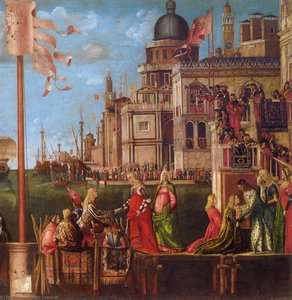
Arrival of the English Ambassadors (detail)
Reproduction Medium
Reproduction Size
-


Total Price
$ 263
Artwork Description
Arrival of the English Ambassadors: A Venetian Tableau of Diplomacy and Intrigue
Vittore Carpaccio’s “Arrival of the English Ambassadors (detail)” – a pivotal fragment from his monumental cycle depicting the Life of Saint Ursula – is far more than a mere historical record. Painted in 1495, this work offers a vibrant snapshot of Venetian society at the cusp of its golden age, brimming with political maneuvering, artistic innovation, and a subtle undercurrent of courtly drama. It’s a painting that invites us to step back in time and witness a crucial diplomatic exchange unfold within the opulent heart of the Republic.
Carpaccio, a master of narrative painting, eschewed the prevailing trends of his era – the burgeoning Renaissance humanism – opting instead for a style rooted in the meticulous observation of Early Netherlandish art and the rich traditions of Venetian painting. His approach is characterized by an almost photographic realism, achieved through painstaking detail and a masterful understanding of perspective. Notice how he renders the textures of the fabrics, the gleam of metal, and the subtle play of light on polished marble – elements that contribute to the overall sense of depth and immediacy. The artist’s use of color is equally striking; bold reds dominate the figures of the ambassadors and their attendants, contrasting sharply with the cooler tones of the Venetian cityscape in the background. This deliberate juxtaposition creates a dynamic visual effect, drawing our eye to the central action while simultaneously anchoring it within the familiar setting.
The Setting: Venice as a Stage for International Relations
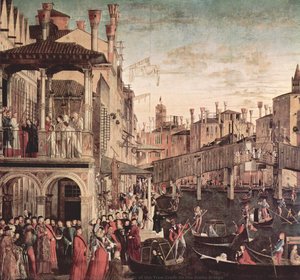
Carpaccio’s choice of location is crucial to understanding the painting's significance. The scene unfolds in a bustling public square, likely the Rialto Bridge area, a vibrant hub of commerce and political activity. The architecture – a grand portico with arched windows and a backdrop of a domed temple-like structure – reflects Venice’s wealth and power as a major maritime trading center. The inclusion of the Ponte di Rialto in the background is not merely decorative; it serves to situate the event within the context of Venetian life, highlighting its importance on the world stage. The painting captures a moment when diplomacy was conducted not just behind closed doors but also amidst the everyday rhythms of the city.
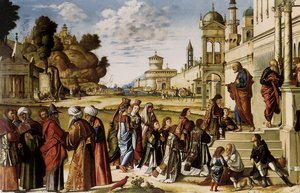
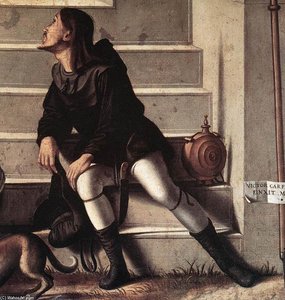
The composition itself is meticulously arranged. On one side, we see the English ambassadors formally presenting their message to King Maurus; on the other, Ursula engages in a more intimate discussion with her father. This division creates a sense of balance and order, reflecting the rigid protocols governing Venetian diplomatic exchanges. The figures are rendered with careful attention to detail, each posture and expression conveying a specific emotion or intention. The young boy with the feather, seemingly detached from the main action, adds an element of intrigue, as if he’s observing the proceedings with a knowing glance.
Symbolism and Narrative Layers
Beyond its surface depiction of a diplomatic meeting, “Arrival of the English Ambassadors” is rich in symbolic meaning. The red robes worn by the ambassadors are a clear indication of their status and authority. The presence of the Doge’s palace – though not explicitly shown – subtly reinforces Venice's position as a powerful republic. The painting also hints at the complex political alliances that shaped the era, with the English ambassadors representing a foreign power seeking to establish relations with the Venetian state.
Furthermore, the inclusion of Saint Ursula herself—a legendary figure associated with piety and virtue—suggests a moral dimension to the diplomatic exchange. The painting subtly elevates the event beyond mere political maneuvering, framing it as an opportunity for virtuous leadership and wise counsel. The scene’s meticulous detail also invites us to consider the role of observation and interpretation in understanding complex social interactions.
A Legacy of Detail: Reproduction and Appreciation
Carpaccio's “Arrival of the English Ambassadors” is a testament to his extraordinary skill as a painter and storyteller. Its intricate details, vibrant colors, and compelling composition continue to captivate viewers centuries after its creation. Reproductions offer an accessible way to experience this masterpiece firsthand, allowing us to appreciate the nuances of Carpaccio’s technique and the richness of Venetian society during the late 15th century. When selecting a reproduction, consider the quality of materials and printing techniques – ensuring that it faithfully captures the painting's original brilliance. This work stands as a remarkable window into the past, inviting us to contemplate the enduring power of art to illuminate history and evoke emotion.
Related Artworks

Artist Biography
early life and training
vittore carpaccio, a prominent italian painter, was born in venice around 1465. he studied under the tutelage of gentile bellini, a renowned artist of the venetian school. this apprenticeship laid the foundation for carpaccio's future success.artistic style and influences
carpaccio's style was characterized by its conservative nature, showing minimal influence from the humanist trends that transformed italian renaissance painting during his lifetime. his work was influenced by antonello da messina's style and early netherlandish art. this unique blend of styles resulted in a distinctive approach to venetian painting.notable works
- the legend of saint ursula, a cycle of nine paintings, is carpaccio's most famous work. this series, now housed in the gallerie dell'accademia, showcases his mastery of narrative painting.
- glory of st. ursula altarpiece (1491) demonstrates carpaccio's skill in capturing light and color, reminiscent of giovanni bellini's style.
- miracle of the relic of the cross at the ponte di rialto (1494) highlights carpaccio's ability to balance composition and narrative.
career highlights and legacy
- carpaccio's principal works were executed between 1490 and 1519, ranking him among the early masters of the venetian renaissance.
- his orientalist style, as seen in st. george baptizing the selenites, reflects a new fascination with the levant.
- carpaccio's work has been somewhat overlooked in comparison to his contemporaries, such as giovanni bellini or giorgione.
references and further reading
discover more about vittore carpaccio and the venetian school on ArtsDot.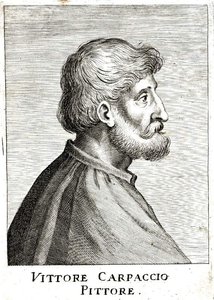
Vittore Carpaccio
1465 - 1526 , Italy
Quick Facts
- Artistic Movement Or Style: Early Venetian Renaissance
- Artists Or Movements Influenced By This Artist: ['Early Netherlandish Painting']
- Artists Who Influenced This Artist:
- Antonello da Messina
- Gentile Bellini
- Date Of Birth: Venice, Italy (c. 1465)
- Date Of Death: 1526
- Full Name: Vittore Carpaccio
- Nationality: Italian
- Notable Artworks:
- The Legend of Saint Ursula
- Glory of St. Ursula Altarpiece
- Miracle of the Relic of the Cross at the Ponte di Rialto
- Place Of Birth: Venice
Related Articles
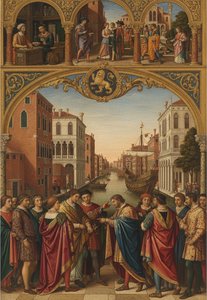
Vittore Carpaccio: Venetian Renaissance Narrative & the Poetics of Detail
Explore the captivating world of Vittore Carpaccio, a master storyteller of the Venetian Renaissance. Discover his intricate details, narrative cycles like 'The Legend of St. Ursula,' and unique artistic style.

Jacopo Tintoretto's Masterpieces: 25 Paintings That Define Venetian Drama | ArtsDot
Explore 25 breathtaking masterpieces by Jacopo Tintoretto, the Venetian master of drama and light. Discover the stories behind iconic Renaissance paintings & find museum-quality art reproductions to elevate your home decor on ArtsDot.com.
The Golden Light of Innovation: Exploring the Venetian Renaissance Art Movement (1430–1580)
Explore the Golden Age of Venetian art (1430–1580). Discover Giorgione, Titian & Tintoretto's techniques, the 'colorito' revolution, and lasting influence. Expert insights for collectors & enthusiasts.
Pietro Longhi's Venetian Scenes: A Study of Rococo Society & Domestic Life
Explore the captivating world of Pietro Longhi's Venetian scenes! Discover insightful analysis of his Rococo masterpieces & social commentary on 18th-century life. Learn about this 'Venetian Hogarth' and his lasting artistic legacy.
Jacopo Palma il Giovane: A Venetian Master's Poetic Evolution
Explore the captivating world of Jacopo Palma il Giovane, a pivotal Venetian Renaissance master. Discover his unique style, influenced by Titian & Tintoretto, and learn about key works perfect for discerning collectors.